Housing equilibrium — part 3
The Economist is simply the most informative magazine in the world today. If I came out of a coma, I’d want it as the first thing I read. One issue, and I’d feel fairly well caught up. The on-line version is an extraordinary supplement to the print edition, and may very well be a one-stop shop for economic research.
With all the obvious sucking-up out of the way (and no, I don’t get a free subscription — I pay for mine just like everyone else), the current issue has a stellar article titled “Suspended Animation” about America’s Housing Market. In prior missives on this blog, I’ve drawn linkages between the home ownership rate (currently at about 66%) and the housing bubble (best visualized with the Case-Shiller Index). The article makes that same comparison, without drawing the conclusions I do (see below).
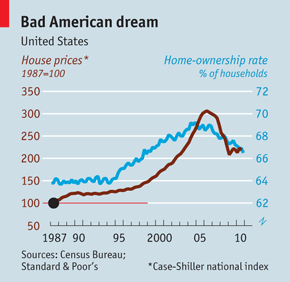
When visualized this way, the linkage becomes fairly clear and obvious. Nonetheless, the real question is “where is the bottom”. There is significant anecdotal evidence to suggest we may be closing in on it right now, but then again, there’s some evidence to the contrary. On the plus side, a LOT of speculative cash is entering the marketplace right now, and about a quarter of all home sales in America are cash-only (see the front page of the February 8, 2011, Wall Street Journal). More interestingly, in the hardest-hit places, such as Miami, this percentage is approaching 50%. From a pure chartist perspective, we note that the C-S index has been “hovering” around 2003 prices for several quarters now. Back in my Wall Street days (LONG before the movie of the same name), the technical analysts would talk about “bottoms” and “breakouts” and such. Of course, residential real estate is not a security, per se (although mortgages are), and the comparisons fall apart at the granular level.
On the down side, the Fannie Mae/Freddie Mac controversies continue to simmer. The Obama Administration and the Republicans in Congress are finding common ground hard to find. The “Tea Party” Republicans want the government out of the home lending business entirely, which means privatizing the F’s. This idea is getting no traction at all among the Realtors and the Homebuilders, two typically “Republican” groups who generally sound like Democrats on this issue. One might blame this on grid-lock, but these are fundamental issues regarding the government’s role in the housing market which date back to the Roosevelt administration. Congress — both Republicans and Democrats — emphatically wanted to goose the home-ownership rate over the last twenty years, and empowered the F’s to do that. After that, the Law of Unintended Consequences got us where we are today. Now, in the words of Keenan Thompson on Saturday Night Live, everyone wants congress to “just fix it!” but with no solution in sight. Until this gets “fixed”, house prices will, at best, probably bounce along where they are today.
Share this:

Paul Krugman’s Column
Frequently I disagree with Prof. Krugman, but I nonetheless enjoy reading what he has to say. His writing is clear and lucid, and he backs up what he has to say with facts rather than simplistic conjecture. Nobel Prize Winners tend to write like that.
Today’s column in the New York Times is no exception, and this happens to be one of those times that I agree with him. Indeed, I think he doesn’t go far enough. I’ll leave the bulk of what he’s said for you to read on your own, but basically he ties global warming (even if you disagree with the theory, you can’t argue with the empirical observations) to floods, famine, and food inflation. Many critics (the Chinese, right-wing-ers, etc.) blame Ben Bernake and QE2 for the crisis. That theory has a real cart-before-the-horse problem. As it happens, global food price inflation became a reality before QE2, not after. Some theorists would also blame China and other developing nations — as their economies grow, their people want and indeed need better calorie counts. City dwellers have less time to prepare complex meals from simple ingredients, thus adding to the food logistics chain.
Krugman draws, I think, a difficult but correct conclusion that global unrest (Egypt, Tunisia) has to be placed in the context of food prices. In developing countries, food makes up a much larger portion of consumption expenditures than it does in the U.S., Japan, or Europe.
Where Krugman stops short, unfortunately, is the more direct implications for the U.S. Authoritarian governments who draw this lesson properly will find themselves caught between a rock and a hard place. On one hand, they will want to pay workers more, either directly (through higher wages) or indirectly (through food subsidies). China, with enormous cash reserves, has the easiest time of this. Indonesia, for example, will face problems. On the other hand, rising wages means either directly raising the costs to the consumers (that’s us and our European friends) or indirectly raising it via currency manipulation (which few countries have the ability to do). Of course, consumers faced with rising prices have the option of decreasing consumption, something which is fairly easy to do when we’re talking about non-essentials. Declining consumption leads to unemployment abroad, which frightens the daylights out of authoritarian regimes.
U.S. consumers have enjoyed rapid increases in consumption with relatively flat-lined prices for the last three decades, due to the juxtaposition of relatively flat commodity prices (food, energy, raw materials), rapid increases in productivity, and global application of the law of comparative advantage. Spikes in commodity prices could change all of this, as we saw in the 1970’s, and THAT may be the most important thing to look at in the economy right now.
Share this:

Movie reviews now? Say it ain’t so!
About half the movies I see are on a 5 X 8 screen on the back of the airplane seat in front of me. Fortunately, I fly Delta, generally coast-to-coast, and they usually have a pretty good selection, particularly up front where the drinks are comp’d. (Note — I said “comp’d”, not “free”. There’s a critical economic difference, but I digress….)
Anyway, last night, I flew in from Memphis and watched “Wall Street — Money Never Sleeps” with Michael Douglas and a first class supporting cast. The important thing to note is that it was “done” (written, directed, etc.) by Oliver Stone. This was very much an Oliver Stone movie, and that means it had a very obvious message and a very obvious point of view. Like many (most?) Stone movies, this one was set against the backdrop of very real events (the market melt-down, the Lehman Brothers collapse, the housing finance crisis) but then superimposed a very fine but fictional story which fit the events in question. Stone had the advantage that the events of the past few years were absolutely perfect for a Gordon Gekko reprise, played with his normal scenery-chewing skills by Michael D. Even Charlie Sheen made a one-minute cameo, reprising his character from the original W.S. just to bring closure to that story arc (and provide a very obvious product placement for a firm that, by weird coincidence, called me trying to solicit my business today.)
Yes, I liked the movie, from the perspective of a piece of fiction. However, even though the events of the past three years fit perfectly into Stone’s world-view, I none-the-less have to pick a bone or two with him over the tone of the movie. The characters, with the possible exception of the highly flawed “young male engenue” (played surprisingly well by Shia LaBeouf) are all portrayed as greedy, soul-less SOB’s for whom making obscene amounts of money is just a way of keeping score of how many of their friends/competitors they’re able to screw. Every single character in a suit is made out to be driven by sheer greed and lust for money, without a single redeeming quality. Even the one supposedly “good” character — Winnie Gekko, Gordon’s estranged daughter, played without a single smile in the whole movie by Carey Mulligan — is so deeply flawed by her relationships with her Dad and her dead brother that she lets Gordon rot in prison rather than visit him. (Ironically, the plot begins with her in love with LeBeouf, who at the start of the movie is essentially a 30 year old version of her father. As he goes through his painful and inevitable redemption process, she rejects him at the very points in his life when he probably needs her the most… but I’m digressing again, aren’t I?)
I’ve had the pleasure of working in finance for a long time — over 3 decades — and a fair chunk of that was spent on Wall Street (Dean Witter). The vast majority of the folks I knew, from the bottom to the top, were honest, family oriented, hard working, pillars of their communities. They really saw themselves performing the twin public services of financial intermediation, which is providing quality investments on one hand, and providing capital and liquidity for business on the other. Unfortunately, some terribly bad mistakes were made during the run-up to this crisis, mainly in terms of the financial products which did not properly account for or manage the risk of an increase in the foreclosure rate. As it turns out, a very small increase in household foreclosures, precipitated by a lot of things (not the least of which were borrowers who shouldn’t have borrowed) set off a cascade that got us where we are today.
Over the past couple of years, I’ve been in PLENTY of forums, panels, and meetings with financial “types” from every facet of the money industry, who are focused on one and ONLY one thing — trying to get the system fixed. Do these folks get paid well? Yes, they do. A small handful of them are paid obscene amounts of money, in the same way that a small handful of baseball players get paid obnoxiously well, too. At the top of any game, there are a handful of extraordinarily talented folks who work very hard and get paid obscenely. But, 99% or more of the folks in the finance industry are paid “well” (not “Gulfstream G-IV” money, but “I get to ride in first class most of the time” money). They work hard. They want to see the system work, and they know just how important it is to the whole world for this system to get fixed.
So there it is. Watch “Wall Street” as a very well done piece of fiction, but please recognize that Stone’s characterization of the Finance community is highly skewed and w-a-a-a-a-a-y off base.
Share this:
Housing equilibrium — part 2
My meanderings on housing equilibrium are about to become even more muddled, in a way, and clearer in others.
To wit… in the middle of the just-past decade, before the market started melting down, it was already apparent to researchers that the housing market looked decidedly different than it had before. It was clear that prior to about 1994, the homeownership rate had hovered around 64% for many years. Why, then, did it apparently take-off to higher ground and make a nearly non-stop upward run from then until about 2004?
The “run up” was the topic of a great paper by Matthew Chamber, Carlos Garriga, and Don Schlagenhauf of the Atlanta Federal Reserve Bank, produced as part of their working paper series in September, 2007. For a copy of it, go here.
Their focus was on the “run-up”. Our focus today is on the “run-down”. In short, if they can explain why ownership rates ballooned up in the past decade, then perhaps we’ll have some idea of how far down they will drop in the coming decade.
They find that as much as 70% of the change in homeownership rates can be explained by new mortgage products which came on the market during that period. “Easy money”, which is how this has been described in the press, made homeownership possible for millions of new owners. The remainder of the changes, in their study, are explained by demographic shifts.
There is some intuitive logic in all of this (as there usually is, ex-post, in good empirics). The American population got a bit older during the period in question, as the baby-boomers came into their own and also into an age bracket when homeownership makes a lot of estate and tax planning sense. Since these demographic shifts are still with us, and indeed continue to move in ownership-positive directions, it would suggest that a new equilibrium will probably fall out somewhere higher than the old one.
As of the most recent American Housing Survey, the current homeownership rate in America is 66.7% (down from 69.8% at the peak a few years ago). During the 80’s and 90’s (the boom which followed the 80’s recession), the rates held nearly constant at 64%. The FRB-Atlanta study thus suggests a new equilibrium somewhere between 64% and 66.7% (where we are today). In fact, if you concur that 70% of the boom came from mortgage products (which are no longer available) and the remainder from factors which ARE still at play, then one might surmise that the new equilibrium is close at hand.
Share this:
w-a-a-a-a-ay off topic….
We’re all stunned by the attempted murder of Cong. Gabby Giffords in Tucson on Saturday. It’s particularly stunning when you look at what she stands for, her essentially centrist, “let’s all try to work together” approach to things. She is exactly the sort of member of congress we wish all 435 of them were, and which all too few of them actually are.
I’m personally outraged more than most. Lynnda and I met Gabby and her husband Mark (Capt. Mark Kelly, USN, decorated combat fighter pilot, test pilot, and the Commander of the space shuttle Discovery) back in 2009 at Renaissance Weekend in Charleston, and saw them again just a week before the shooting. We partied with them on New Years Eve, and Mark and I were on a program together at Renaissance. Totally ignoring the public persona, they’re terrific people, and from all appearances totally in love with one another. It’s amazing too, when you consider that the two of them have devoted their lives to public service. Gabby was quite successful in business before she devoted her life to public service, and no one needs to tell you that Mark, despite the adventure of his job, takes home about half of what an airline pilot makes.
I’ve sent Mark and the family a letter of condolence and encouragement. They’ve asked that well-wishers show their support by making contributions to two very important charities:
Community Food Bank
3003 S Country Club Rd # 221
Tucson, AZ 85713-4084
(520) 622-0525
American Red Cross, Southern Arizona Chapter
2916 East Broadway Boulevard
Tucson, AZ 85716
(520) 318-6740
I would second that recommendation, and wish Gabby and her family, as well as the families of all of the folks killed in this madness, all the best through this terrible tragedy.
Share this:
Housing equilibrium — part 1
This is going to be a bit convoluted, so bear with me.
This week, I’ve been at Renaissance Weekend, an annual gathering of top minds in a variety of fields (Nobel laureates, authors, actors, CEOs, etc) and I’ve been asked to make several presentations on real estate finance and economics. It’s a pretty heady experience, but more on that later.
One of the principle questions thrown my directions is, ‘When will real estate bottom?’ One might argue that commercial real estate has already bottomed, and there’s a fair amount of data to support that. (A weak “bottom”, I’ll grant you, but a bottom, none-the-less.) Apartments are coming back particularly strong, but even hotels and industrial are showing positive gains this year.
Owner-occupied residential is a completely different story. We’ve really never had a phenomenon like this, and according to both the Federal Housing Finance Authority and Case-Shiller, housing prices continue to collapse all across the country. Indeed, C-S just released a report two days ago indicating that new lows were hit in 6 out of 20 top markets. Overall, housing prices have been downtrending every quarter since mid-2007.
When will this bottom? I’m toying with a set of models which suggest that the pricing market won’t bottom until the ownership rate reaches an equilibrium. Heuristically, that optimal rate appears to be around 64%. Why? I’m looking at the last time ownership rates ballooned, which was at the end of the hyper-inflation period of the late 1970’s. Pricing markets stabilized after the ownership rates stabilized.
This posting is a deviation from my normal routine — My thinking on this topic is evolving, and I’m hoping to trace that evolution here on the blog until I reach something that I can actually flesh out into a paper. I’d appreciate any comments you have, either added as a comment here on the blog or, if you’d like privacy, e-mail them directly to me (john@greenfieldadvisors.com)
Share this:
Conway-Pedersen
If you’re in business in Western Washington (as we are), then the quarterly Puget Sound Economic Forecaster by Dick Conway and Doug Pedersen is must-reading. The latest issue just hit my desk, and given the current state of flux, it’s worth reviewing.
You have to get to the back page to find what I consider to be the most interesting graphic — a chart of Puget Sound Leading Economic Indicators dating back to the early 1970’s. The era is marked with 5 recessionary periods — 1974, the “hic-cup” recessions of 1979-1982 and 1990-1992, the “9/11” recession (which really started in late 2000) and the current mess, which dates to 2007. Intriguingly, in each of these periods, the index turns downward well before the beginning of the recession. Of more interest, the index turns upward well before the end of the recession (as it has now) and turns into a sustained multi-year period of growth which carries it to a new peak. If you’re a chartist (as I am) this is interesting stuff.
C & P note that the Puget Sound region — despite its famed economic health — actually had a somewhat worse time than the nation as a whole during this recession. We lost 7.4% of our jobs during this period, compared with 6% for the U.S. They suggest this means that the region will trail the nation as a whole coming out of the recession. I concur with them that the region lost disproportionately in construction and finance.
Share this:
Fa.. la… la… la.. la…
Having a good holiday season yet?
About 20 years ago (darn, time flies…) I wrote a paper using Monte Carlo simulation to model the potential failure rate in shopping centers. Ended up presenting it (of all places) at a major Economic Geography conference, and it got published in the proceedings of that conference.
Now fast forward to today. As regular readers know, we do a LOT of environmental valuation work. I don’t use M/C simulation, even though it has been used in the valuation literature. Well, this year, the 5th Circuit Court of Appeals was faced with an environmental case in which the testifying expert used M/C simulation to aid in allocating damages between two responsible parties, Lyondell Chemical Co. v. Occidental Chemical Corp., 608 F.3d 284 (5th Cir. 2010).
“The other side” opposed M/C, arguing that it hadn’t been applied in these cases, and that the error rate could not be determined. The Appeals Court rejected those arguments, and ruled in favor of M/C.
Neat. I need to work up a working paper on this, but I can already see some significant applications to what we do.
Share this:
Tis the season….
Intriguing mixed messages from the economy. Employment continues to lag, but holiday shopping was up. Go figure?
Two or three things may be in store. First, I’m sure that some of the more profitable businesses, fearing future tax increases, were holding off spending tax-deductable money until 2011 rather than 2010. The key lesson for lawmakers — get some stability and predictability into the tax system.
Second, while “on-line” shopping went up, the unmeasured impact of on-line was the ability to target shopping. Lots of holiday shopping went at bargain prices, and I’m interested to see how much sustainability there will be in the increases. It’s very difficult to imagine, with the underlying instability in economic fundamentals, just how long the shopping bubble can be sustained.
But, on to real estate. What looks good right about now? What looks bad? We continue to be doom-sayers on housing construction into 2011. Normally, in a recession, there’s a build-up of excess supply (construction in the pipeline pre-recession get unsold DURING the recession). However, past recessions rarely have a contemporaneous melt-down in homeownership rates (see the following).

Note that since we began keeping records in 1960, ownership rates have inexorably trended upward but for two instances — this one and the 1980-84 period. After 1984, it took until the mid-1990’s for rates to start trending upward again, and many would suggest that this up-trend was only the result of Greenspan’s “easy money” policies. In a more cautious lending environment, it’s hard to say where the true equilibrium might lie. However, it’s intriguing that the run-up in the 1970’s is often blamed on the high levels of inflation (making home ownership the favored “inflation hedge” for families) and that in the post-recession, low-inflation period of the late 80’s and early 90’s, rates seemed to hover around 64%.
If in fact that’s where the equilibrium lies, then the U.S. has about three more percentage points in owner-occupied homes to absorb. This absorption occurs in one of three ways — growth in the population, conversion of homes to other uses (usually rental in lower-end or transitional neighborhoods), or demolition. Whatever the reason, with the current slope of the trend-line (which, intriguingly, matches the slope of the 1980-84 period), we see that it took about 5 years (2004 through 2009) to get from about 69% to about 67%. At this rate, getting to 64% will take another 7 – 8 years, suggesting a best case scenario of stability in the 2016 range.
This scenario, interestingly enough, matches some of the employment-growth scenarios I’ve seen, which suggest we’re looking at the mid-to-late teens for unemployment to get back down to pre-recession levels.
So, if owner-occupied housing stinks, what looks good on the menu? Apartments. In very rough numbers, we WERE building about 1.5 million homes per year prior to the recession (year-in, year-out, with a HUGE amount of variance from year to year). Now-a-days, we’re building about a third of that or less, suggesting an un-met demand for housing of about a million units per year, more or less. Apartment construction also flat-lined during the recession, primarily because banks simply didn’t have the money to lend for construction financing. (Permanent money comes from other sources, and it’s available, but the construction financing problem is still with us.)
As credit continues to ease — particularly with the recent announcements by the FED in that regard — we can see some strong lights at the end of that tunnel. Good news for construction workers — their unemployment rates have been huge lately, but the same folks who drive nails for owner-occupied homes can also drive nails in apartment complexes. Easing credit in this area will thus fuel job growth, which also fuels consumption, home purchases, etc. Thus, addressing the housing demand/supply problem may be the most important single thing policy makers can do to restore the economy to good health.
Share this:

Post Thanksgiving, time to go back to work…
In past years (say, pre-2008), the Thanksgiving thru New Years period at Greenfield was always slow, as clients and projects seemed to hunker down for the holiday season. Naturally, 2008 was an aberration on a number of levels — the real estate let-down was in full force, and while our business flow was down, we were busy “hunkering down” for what we projected would be a long recession trough.
Last year (2009) was unpredictable. The first half of the year was dreary, but the last half was a rebuilding period for us, as has been 2010. We’re not yet where we want to be (that is to say, back on our pre-recession growth curve), but the accumulations of lessons-learned have put us in a great position for the future.
I’m commenting on our specific experience at Greenfield for a reason. I think our own company experiences are emblematic of what is happening at tens of thousands of other businesses across the U.S. and other countries, and has significant implications for the future of real estate, the economy, and finance for the next few years. I’m always reluctant to get into the prediction business (I’ll leave that up to Faith Popcorn and her ilk), but I can make a few generalizations, particularly as the parallel what I saw back in the 1970’s —
1. Business profits (and valuations — as we see from the stock market) are headed upward, not so much from increased sales (flat across the board) but also thru extraordinarily increased efficiency. One might wonder, if firms are so doggone efficient today, why weren’t they acting efficiently a few years ago? Simply put, “efficient” firms don’t grow very well. Growth usually requires a significant degree of wastage. Hewlett Packard was famous for this — they would budget engineers a certain amount of time and support to just tinker with things, knowing that the sort of Edison-esque profitability that came out of such tinkering. At one time, Xerox was so inventive that they thru away lots of great ideas, the Graphical User Interface being the best known example. Additionally, efficient firms cut wa-a-a-a-a-y back on hiring, training, and marketing. We see this now on college campuses, as new graduates (even in the “vocational” schools like business and engineering) are getting no offers or offers far beneath what their big brothers and big sisters got a few years ago.
2. This “hunkering down” not only cuts the demand for commercial real estate, but also means we may have a substantial excess supply of offices, warehouses, and shopping centers for some time to come. Ironically, business travel is coming back (as executives work harder to sell the same amount as before) but everyone is going “down” a notch on the hotel food chain — executives who used to stay at a Ritz Carleton are now at Marriotts, and former Marriott customers are now at Courtyard Marriotts. (Intriguingly, the Marriott organization is highly vertically integrated, and so actually takes great advantage of this phenomenon). The interesting off-shoot is that while aggregate hotel room counts are up, hotel employment lags (as customers move from “full-service” to “limited service” stays). The same is true with hotel restaurants, as dining-out budgets get slashed.
3. The “trainee” employment picture is worsening in some ways, but may actually improve in others. As noted, new graduates are having real problems getting placed, and are having to accept entry-level jobs far below expectations. I spoke with a young woman recently who graduated in 2010 in Finance. She had great grades and a stellar resume, and fully expected to get an entry-level job commensurate with her expectations. Guess what? No one is hiring. After several frustrating months, she accepted a job as a teller at a Credit Union at about half the starting salary she’d previously expected. Is there a silver lining in this? Yes, two. From the business’ perspective, they’re getting entry-level talent at bargain basement prices, and if they’re willing to mentor and foster these kids, they’ve got talent who will have a much greater familiarity with the nuts-and-bolts of the business once expansion does return. From the “hiree’s” perspective, a foot in the door builds experience and puts her at the starting gate ahead of the rest of the pack.
4. The early 1980’s recession was actually the last of a series dating back to the late 1960’s (the period was called “stag-flation”). While the early-80’s recession was the worst of the bunch, it seemed to have wrung the last of the “bad stuff” out of the economy, and set the stage for two decades of nearly continuous growth. Many credit the pro-business agenda of the Reagan Administration, but that ignores the tremendous pent-up inventiveness which had been waiting for an opportunity. Gates, Allen, Jobs, and Wozniak had been tinkering with computers and software for a decade, but needed a business expansion to really get themselves going. Sam Walton had great ideas about merchandising, but the explosive growth of WalMart depended in no small part on the availability of cheap construction and development credit to build mega-stores at seemingly every street corner. We decry the sloppiness of the mortgage market of the past few years, but no one seems to complain about the millions of construction workers and realtors who rode from apprenticeship to retirement on the wave of the housing boom. Recessions do not last forever, although this one does have the symptoms of lasting for a while longer. When 4% GDP growth returns (and remember, folks, that’s really all it takes), we should be poised for a period of expansion not-unlike the one that started in the mid-1980’s.
Well, folks, that’s really it. Like most of you, I have a lot to be thankful for. I live in a fairly free country, with an economy that considers 9% unemployment and 2% GDP growth to be unacceptable. I get the opportunity to interface with students and young folks on a daily basis, and they constantly refresh my positive outlook for the future.


 From a small northwestern observatory...