Archive for the ‘Real Estate’ Category
…of Japan, earthquakes, and real estate
It’s hard to overstate our sympathies for our friends in Japan who find their country in tatters, with hundreds — if not thousands — of their fellow citizens dead, thousands (tens of thousands? hundreds of thousands?) more homeless, and the economy at a standstill. Fortunately enough, the Japanese are a terrifically resilient and stoic people, with a hard-working culture and more experience dealing with earthquakes than any other developed nation. I have no doubt they started the clean-up and rebuilding process the moment the aftershocks ended.
At Greenfield, we’ve enjoyed a terrific relationship with the Japan Real Estate Institute over the years. It almost seems embarrassing to talk about business while people are still dying, but a quick “google” search on news about the earthquake shows that the top page of stories deals with how this will affect global business, ranging from impacts on energy prices to the availability of Apple’s Ipad-2. Our focus, of course, is real estate, and that may prove to be one of the more interesting problems in this aftermath.
After WW-II, the Japanese people adopted a new constitution which was largely written by U.S. General Douglas MacArthur, the commander of the occupying forces. MacArthur really thought of himself as a Viceroy, and fashioned himself as an expert in governance. (In actuality, his administration of post-war Japan was probably the highpoint of his stellar career.) Despite being relatively conservative in most things, he was a very traditional liberal (albeit in a Victorian sense) in governance. As a result, the Japanese constitution provided for women’s suffrage. It also provided extraordinary rights to small, private property owners, as a mechanism to break-up the hold feudal land holdings. Indeed, eminent domain “taking”, as we think of it in the U.S., is very hard to accomplish in Japan. Small property owners — even the owners of the smallest pea-patch — have exceptionally strong property protections under law.
As great as this sounds, it makes it very difficult to clean up after a disaster. In 1995, Kobe was struck with what is known in Japan as the Great Hanshin earthquake, with a magnitude of 7.2. About the same time (1989), California was hit with the Loma Prieta earthquake, which measured 7.1. Both earthquakes hit in highly populated areas, although the Kobe quake killed over 6,000 while the Loma quake only killed 63. The Kobe quake destroyed about 200,000 buildings, while Loma damaged about 18,000 (12,000 homes and 6,000 businesses).
Of more direct comparison was the destruction in California of Oakland’s Cypress Street Viaduct and a portion of the San Francisco-Oakland Bay Bridge. In Japan, about 1km of the Hanshin Expressway collapsed.
In California, the highway collapses were repaired quickly. Indeed, one of the repair contractors won a huge bonus award for completing a large chunk of the work in record time, and the Bay Bridge was reopened in 32 days. The Cypress Street Viaduct required longer to replace, but traffic was rerouted quickly.
In Kobe, on the other hand, rubble from the expressway was still piled up five years later. Why? At the heart of the problem was access to private property under, near, and surrounding the expressway. Many of these small parcels had hundreds of individuals listed on deeds, and each of those individuals had to be contacted and permissions gained before reconstruction could begin.
Eminent domain can be a contentious issue here in the U.S. — taking agencies typically try to acquire property on a shoe-string, and my own analyses of “takings” appraisals show that they’re not done very well. That having been said, at least we HAVE mechanisms for handling these problems in the U.S., and should be thankful for that.
Again, our best wishes to our friends and colleagues in Japan. They’re going to need a lot of support as they emerge from these trying times. I also don’t want to forget our friends in New Zealand who had, on a relative level, an equally devastating earthquake in Christ Church. I have great friends from that country, and have enjoyed doing business down there. Best wishes to all of them.
Share this:

Conerly Consulting
Dr. Bill Conerly of Portland, Oregon, produces a wonderful little economic report called the Businenomics Newsletter. You can check it out here. While it is heavily Pacific Northwest focused, he has some great insights into the “big picture” of the U.S. economy as a whole. I highly recommend his research, and (as long as I’m in the promotion game), he’s a great public speaker.
He discusses two key elements of the “end of the recession” right up front — the current consensus forecasts of strong GDP growth for the next two years and the current “bounce-back” in consumer spending (which fell off significantly from mid-08 to mid-09). Unfortunately, capital goods orders are only sluggishly recovering, and state-and-local budget gaps continue to be a drag on the economy.
As for construction, the decline is over, but the bounce-back is sluggish. Residential construction fell from an annual rate of about $550 Billion in the 2007 range to about $250B in 2009, and continues to flat-line there. Private non-residential peaked at about $400B in 2008/09, and has since declined to about $250B (where it’s been hovering for since early 2010). Public non-residential has been on a bit of an up-swing all through the recession, but is still barely above 2007 levels (about $300B). In short, these three sectors taken together have more-or-less flat-lined for the past year and a half or so, and appear to be staying there for the time being.
Anyone who reads the paper or watches the news on TV knows we’re in the midst of a raw materials crisis, with aggregate materials prices (the “crude materials index) up about 25% from its recent mid-2009 low. However, the price index is still well-below early 2008. Conerly suggests that the rise is “hard on some, but will not trigger general inflation.”
The money supply (M-2) continues to grow, and QE2 has apparently not had an inflationary impact, at least from reading the charts. Indeed, prior to QE2, the money supply chart looked like it was ready to flat-line. In total, as Conerly notes, the stock market appears to be happy that the economy is growing again.
Share this:
Mueller’s Market Cycle Monitor
Dr. Glenn Mueller’s Market Cycle Monitor just hit my desk from the folks at Dividend Capital. To access it, or some of their other great stuff, just click here.
I’ve written about Dr. Mueller’s work before — while his model isn’t able to forecast really major moves (like the “fall off the wagon” move of 2008/2009), his Market Cycle synopsis does a great job of assessing how various property types and submarkets are moving through the normal stabilized cycle of business. In short (and I’m sure he’d do a better job of explaining this than I could), at any given point in time, a market or submarket is in one of four investment states: Recovery, Expansion, Hypersupply, and Recession. The way market participants react to one situation drives the market forward to the next situation. For example, in the recovery phase, no new properties are coming on-line. Natural expansion of the market drives up occupancy, and with it rents. The subsequent shortage of space leads to expansion. Too much expansion leads to hyper-supply, in which too much property is competing for too-few tenants. This leads to recession. (In a very macro sense, that’s more-or-less what happened in 08/09, with the added problem that too many banks were trying to loan too much money and thus not properly pricing risk.)
The nuances of his model and report are too numerous to synopsize here. In short, he finds that on a national basis, every property type (e.g. — apartments, industrial, suburban offices) are in various stages of recovery, with the health facilities and senior housing being the closest to breaking out to expansion. Intriguingly, both limited-service and full-service hotels are following in close order.
He also tracks most of the top geographic markets in the country, and all of these are either deep in recession or in the earliest stages of recovery. No markets are close to break-out into expansion. The worst two markets (and “worst” is just relative here) are Honolulu and Sacramento, while the best (again, relative) are Austin, Charlotte, Dallas-Fort Worth, Nashville, Richmond, Riverside, Salt Lake, and San Jose. My home city of Seattle is ranked — along with a dozen others — deep in the heart of recession.
Share this:
Construction defects
Took a “day trip” to Marina del Ray, California, yesterday to speak at HB Litigation Conference’s Construction Defects conference. It was very well attended, with a great cross-section of attorneys and experts on this complex topic. I was the only valuation expert on the panel, and spoke about the variety of challenged converting physical defects to market value determinations.
One of the really interesting issues arising now is in the area of “green buildings”. Insurers, contractors, and the attorneys who feed and care for them, are apoplectic over the vision of courtroom battles a few years from now over what was SUPPOSED to be a “green building” that turned out to be “not-so-green”. The industry has entered into a new realm. While there are plenty of prescriptive standards (LEED, Energystar, etc.) these standards do not take on the same level of codification of building codes, nor is there the same level of inspection and certification associated with building permits. Hence, a property PROPOSED as “green” may not actually turn out to be “green”, or at least the same shade of “green” that the investors were promised. When that happens, litigation ensues.
Share this:
Food and real estate
Great article today in The Economist on world-wide food demand/supply. This is a hot-button issue right now, because in the emerging world, food price inflation (along with energy inflation) is critical. For a copy of the article, click here.
The linkage between food demand/supply and real estate is critical, but less than obvious. IN a very simplistic way of thinking, increasing the food supply requires increasing acreage devoted to crop and grazing land, right? Actually, technology has disentangled this equation. During the past 40 years, the world has increased the production of some key crops (wheat, corn) by as much as 250% with little change in the amount of pasture and crop land in the world (according to recent data from the U.N.). The Economist estimates that demand increases in the next 40 years will only be a fraction of the increase in the past 40 years, nonetheless distributional issues (among other things) lead to regional shortages, price inflation, and erratic agricultural investment patterns.
From a real estate perspective, the real issues are in logistics and distribution. A generation or two ago, a significant portion of the world’s population lived either on the land (as subsistence farmers) or not far removed from the land (in villages or towns directly served by surrounding farms). This was even true in the U.S. — we tend to forget that prior to WWII, the majority of Americans lived on farms and ate what they grew.
Development of the developing world leads to a disruption between the source of food and the demand for food. First — and less obvious — city dwellers demand a more balanced diet. Millions of Chinese peasants who subsisted on a rice-oriented diet a generation ago are now moving to the burgeoning cities, and demanding meat, vegetables, and other staples we take for granted in the west. This phenomenon is being repeated all over Asia, Africa, and South America. Note that of the top 25 largest cities in the world, only six are in the U.S. or Europe (New York, Los Angeles, Moscow, Paris, Chicago, and London). This trend will accelerate in the future.
Thus, the problem accelerates. It’s not just a matter of moving a sack of rice from the Chinese countryside into Beijing. It’s a matter of moving a sack of tomatoes from Chile or a side of beef from Australia into Beijing. This requires not only transportation but also the multi-modal logistics train to support that transportation. This may very well be the most exciting real estate related challenge of the rest of this century.
Share this:
Scope creep…. or evolution?
In December, 2010, a whole new set of mortgage lending regulations went into effect — the first major change since 2004. Given the recent pronouncements from the Treasury Department, it’s clear that future changes will come in rapid-fire form.
The various discussion groups I review — particularly the ones involving real estate appraisers — are filled with comments about “scope creep”, that is, how the mortgate lending community is requiring more and more information from appraisers and yet paying less and less. As one commenter put it, “If I’m going to lose money at this, I’d rather stay home and drink beer on my porch.”
Let’s face it, folks, the mortgage lending business has undergone a HUGE sea-change in the past 3 years, and will continue to evolve rapidly for the remainder of this decade. The ONLY reason to order an appraisal on a property to be financed is to confirm — or deny — the value of the collateral.
At the core of the issue is that, historically, the people inside the banks probably knew the local appraiser, understood appraisal methodology and terminology, and frequently were trained in appraisal practice. In the future, this will no longer be the case. Appraisal Management Companies (AMC’s, as they are commonly called) are intermediating the process, and all of this is screaming “lowest bidder” with no communications between the underwriter (who may not even be in the same country) and the appraiser. Unfortunately, appraisal methodology has changed little in recent decades, and automated valuation models speak a language that the new generation of underwriters understand better (cheaper, with known error rates, and predictable levels of statistical validity).
I wish I had a quick and simple answer to this. The appraisal profession frankly let the S&L crisis of 20 years ago dissipate without the sort of professional consolidation that they should have pushed for (what the CPA’s did during the Great Depression). Clearly, the appraisal profession is letting THIS crisis go to waste, too. This was probably their last chance to save themselves from marginalization.
At Greenfield, we’re VERY heavily engaged in the Gulf Oil Spill mess. When property owners turn in claims for property damage, guess who reviews those? Appraisers? Nope. CPA’s, who have a very different expectation regarding methodology, terminology, and statistical support. I wouldn’t at all be surprised to see the accounting profession emerge on top of the real estate valuation heap in the not too distant future.
Share this:
Zicklin School of Business
I’m in Manhattan today, getting ready to deliver a pair of lectures at the Zicklin School of Business, Baruch College. For those of you not familiar, Baruch is one of ten “senior college” units within the City U. of NY system, and contains CUNY’s business school (Zicklin), the Weissman School of the Arts and Sciences, and the School of Public Affairs, along with a number of important centers and institutes. A few years ago, with a gift from alumni William Newman (founder of the REIT New Plan Excel Realty Trust), the Zichlin school embarked on developing a top-tier program in Real Estate. I was honored to be asked to serve as one of their Visiting Scholars, and every now and then I drop in to deliver a lecture or two.
In keeping with my general light-hearted tone on the podium, the title of my talk is “Cool Things I Get to Do” (although, in deference to SOME level of decorum, Baruch has titled the talk “A Conversation with Dr. John Kilpatrick”).
In general, I want to walk students (and whomever else wanders in the door) through a panoply of complex valuation challenges, ranging from Hurricane Katrina to some of the “Yucca Mountain” push-back, to the current Gulf Oil Spill mess.
I’m actually presenting two talks — today (Wednesday) I’m presenting a somewhat lighter version of the talk, limited to just the “cool” stuff. Tomorrow evening, with a talk focused more to graduate students, I’m adding some material on expert systems and some of the ways non-parametric techniques can be added to the valuation process to measure accuracy and consistency.
For more information on the talk, click here.
Share this:
The death of the fixed rate mortgage
It might also be called the “death of the easy mortgage”, and will almost certainly be the death of the small-town lender….
The Obama Administration today outlined the broad-stroke strategy for dealing with Fannie Mae and Freddie Mac. They suggest three solutions, all of which basically call for a multi-year wind-down of the two troubled institutions, which have cost taxpayers about $150 Billion in recent years to bail out.
How we got this way has been covered in thousands of articles, blog posts, and even text books. FNMA and FHLMC were set up to provide liquidity to small mortgage lenders (primarily, small-town S&L’s, of which there aren’t many now-a-days). A small-town S&L had a fairly finite pool of deposits, and once they made a few home loans (which were very long in duration), they simply couldn’t loan anymore until those mortgages were paid-off. Worse still, in times of rapidly changing interest rates, low-rate, fixed-rate mortgages didn’t get paid off, but depositors ran for higher-rate money funds. S&L’s were caught in a liquidity trap, and crisis after crisis ensued.
Today, of course, the mortgage lending business is filled with several thosand-pound gorillas with names like Wells Fargo, BofA, and JPMorgan/Chase. These institutions have the muscle to package mortgage pools and sell them off to investors. Why, then, do we have/need FNMA and FHLMC?
Congress is firmly on the hook for this one. Over the past decade and a half, the F’s were encouraged by Congress to morph into investors of last resort for mortgages that the securities market didn’t want. (It was actually a lot more complicated than that, but you get the general picture, right?) Why didn’t the private sector want these mortgages? Because they knew eventually many of them would go bad — and they did. Congress essentially got what it wanted, a subsidy of home ownership which, unfortunately, wasn’t sustainable.
This deal isn’t done yet, of course. Wait for the long-knives to come out from the Realtors and Home Builder’s lobbies. The current proposal would privatize all housing lending with the exception of FHA/VA lending. To put this in a bit of perspective, today, FHA loans constitute over 50% of housing lending. Back in the “hey-day” of the liquidity run-up, FHA loans were down around 4%. Without the F’s, we’re looking at a privatized mortgage market not far different from what we see out there right now, and that’s fairly unsustainable for the homebuilding industry.
Share this:
Housing equilibrium — part 3
The Economist is simply the most informative magazine in the world today. If I came out of a coma, I’d want it as the first thing I read. One issue, and I’d feel fairly well caught up. The on-line version is an extraordinary supplement to the print edition, and may very well be a one-stop shop for economic research.
With all the obvious sucking-up out of the way (and no, I don’t get a free subscription — I pay for mine just like everyone else), the current issue has a stellar article titled “Suspended Animation” about America’s Housing Market. In prior missives on this blog, I’ve drawn linkages between the home ownership rate (currently at about 66%) and the housing bubble (best visualized with the Case-Shiller Index). The article makes that same comparison, without drawing the conclusions I do (see below).
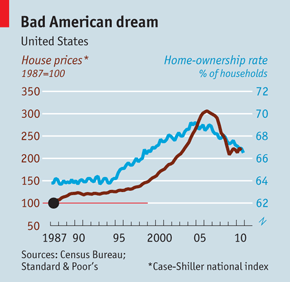
When visualized this way, the linkage becomes fairly clear and obvious. Nonetheless, the real question is “where is the bottom”. There is significant anecdotal evidence to suggest we may be closing in on it right now, but then again, there’s some evidence to the contrary. On the plus side, a LOT of speculative cash is entering the marketplace right now, and about a quarter of all home sales in America are cash-only (see the front page of the February 8, 2011, Wall Street Journal). More interestingly, in the hardest-hit places, such as Miami, this percentage is approaching 50%. From a pure chartist perspective, we note that the C-S index has been “hovering” around 2003 prices for several quarters now. Back in my Wall Street days (LONG before the movie of the same name), the technical analysts would talk about “bottoms” and “breakouts” and such. Of course, residential real estate is not a security, per se (although mortgages are), and the comparisons fall apart at the granular level.
On the down side, the Fannie Mae/Freddie Mac controversies continue to simmer. The Obama Administration and the Republicans in Congress are finding common ground hard to find. The “Tea Party” Republicans want the government out of the home lending business entirely, which means privatizing the F’s. This idea is getting no traction at all among the Realtors and the Homebuilders, two typically “Republican” groups who generally sound like Democrats on this issue. One might blame this on grid-lock, but these are fundamental issues regarding the government’s role in the housing market which date back to the Roosevelt administration. Congress — both Republicans and Democrats — emphatically wanted to goose the home-ownership rate over the last twenty years, and empowered the F’s to do that. After that, the Law of Unintended Consequences got us where we are today. Now, in the words of Keenan Thompson on Saturday Night Live, everyone wants congress to “just fix it!” but with no solution in sight. Until this gets “fixed”, house prices will, at best, probably bounce along where they are today.
Share this:

Housing equilibrium — part 2
My meanderings on housing equilibrium are about to become even more muddled, in a way, and clearer in others.
To wit… in the middle of the just-past decade, before the market started melting down, it was already apparent to researchers that the housing market looked decidedly different than it had before. It was clear that prior to about 1994, the homeownership rate had hovered around 64% for many years. Why, then, did it apparently take-off to higher ground and make a nearly non-stop upward run from then until about 2004?
The “run up” was the topic of a great paper by Matthew Chamber, Carlos Garriga, and Don Schlagenhauf of the Atlanta Federal Reserve Bank, produced as part of their working paper series in September, 2007. For a copy of it, go here.
Their focus was on the “run-up”. Our focus today is on the “run-down”. In short, if they can explain why ownership rates ballooned up in the past decade, then perhaps we’ll have some idea of how far down they will drop in the coming decade.
They find that as much as 70% of the change in homeownership rates can be explained by new mortgage products which came on the market during that period. “Easy money”, which is how this has been described in the press, made homeownership possible for millions of new owners. The remainder of the changes, in their study, are explained by demographic shifts.
There is some intuitive logic in all of this (as there usually is, ex-post, in good empirics). The American population got a bit older during the period in question, as the baby-boomers came into their own and also into an age bracket when homeownership makes a lot of estate and tax planning sense. Since these demographic shifts are still with us, and indeed continue to move in ownership-positive directions, it would suggest that a new equilibrium will probably fall out somewhere higher than the old one.
As of the most recent American Housing Survey, the current homeownership rate in America is 66.7% (down from 69.8% at the peak a few years ago). During the 80’s and 90’s (the boom which followed the 80’s recession), the rates held nearly constant at 64%. The FRB-Atlanta study thus suggests a new equilibrium somewhere between 64% and 66.7% (where we are today). In fact, if you concur that 70% of the boom came from mortgage products (which are no longer available) and the remainder from factors which ARE still at play, then one might surmise that the new equilibrium is close at hand.


 From a small northwestern observatory...