Archive for the ‘Finance’ Category
Real Estate Marketing Focus
I’ve observed over the years that real estate investors, developers, and such try to aim for the “middle”. It’s a defensive strategy. Lots of community shopping centers got built before the recession hit, not because they were hot or trendy or even hugely profitable, but because they were generally considered to be “safe”. The same was true with single family subdivisions, all of which looked pretty much alike by 2006. Lots of “average” apartments were built, Class B to B+ office buildings (some of which marketed themselves at Class A, but could get away with that only because of demand), and plain, vanilla warehouses were added to the real estate stock.
Now that we’re (hopefully!) coming out of a recession, it may be a good time to dust off some basic truths about business in general as it applies to real estate. Sure, there’s a very strong temptation to rush to the middle again, and in the case of apartments (for which there is a demonstrably strong demand right now), that may not be a bad idea. Nonetheless, I recall one of the great pieces of advice from Peters and Waterman’s In Search of Excellence: “average” firms achieve mediocre results. The same is frequently true in real estate.
Case in point — there was a great article on page B1 of the Wall Street Journal yesterday titled “The Malaise Afflicting America’s Malls”. by WSJ’s Kris Hudson. (There’s a link to the on-line version of the article on the WSJ Blog.) Using Denver, Colorado, as an example, they note how the “high end” mall (Cherry Creek Shopping Center), with such tenants as Tiffany and Neiman Marcus is enjoying sales of $760/SF. At the other end of the spectrum, Belmar and the Town Center at Aurora are suffering with $300/SF sales from lower-end tenants. Other malls in Denver are shut-down or being demolished and redeveloped. For SOME consumers and SOME kinds of products, in-person shopping is still the normal. It’s hard to imagine buying a truck load of lumber from Home Depot on-line (and Home Depot has done very well the past few years), although even they have a well-functioning web presence for a variety of non-urgent, easily shipped items.
I noted recently that some private book sellers are actually doing well in this market, and have partnered with Amazon to have a global presence. (We buy a LOT of books at Casa d’Kilpatrick, and nearly all of them come from private booksellers VIA Amazon’s web site.) On the other hand, it’s hard to imagine buying couture fashion over the web. Intriguingly, Blue Nile, the internet-based jeweler, notes that their web-sales sales last year (leading up to Christmas) were great at the both ends of the spectrum, but lousy in the middle. Stores like Dollar General, who aim for a segment of the market below Wal Mart, have done quite well in this recession (the stock has nearly doubled in price in the past two years). Ironically, Wal Mart, which is increasingly being viewed as a middle-market generalist retailer, hasn’t fared as well. Target, which seems to aim for the middle of the middle of the middle, has seen it’s stock price flat as a pancake for the past two years, and Sears, the butt of so many Tim Allen jokes, is trading at about half of where it was two years ago. These lessons are being lost on some retail developers, but being heeded by others. Guess who will come out on top?
So, who needs offices, warehouses, and other commercial real estate? Businesses at the top, middle, or bottom? If we follow the adages of Peters and Waterman, we’ll expect the best growth — and hence the most sustained rents — at the top and bottom of the spectrum. (Indeed, even in apartments, one might build a great case that the best demand today is at the low end and high end). However, we’re willing to bet that developers will aim for the middle, as always.
Share this:

Latest from S&P Case Shiller
The always excellent S&P Case Shiller report came out this morning, followed by a teleconference with Professors Carl Case and Bob Shiller. First, some highlights from the report, then some blurbs from the teleconference.
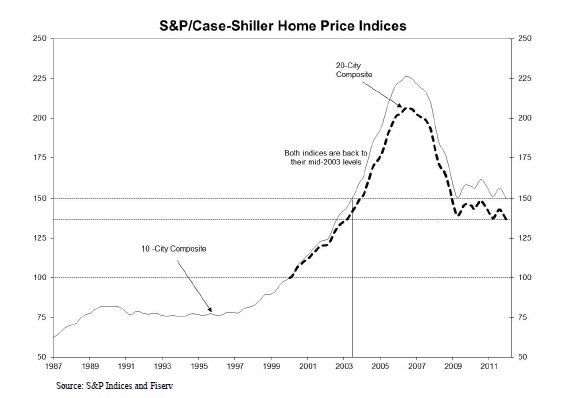 The average home prices in the U.S. are hovering around record lows as measured from their peaks in December, 2006, and have been bounding around 2003 prices for about 3 years. Overall in 2011, prices were down about 4% nationwide, and in the 20 leading cities in the U.S., the yearly price trends ranged from a low of -12.8% in Atlanta to a high (if you can call it that) of 0.5% in (amazingly enough) Detroit, which was the only major city to record positive numbers last year. In December, only Phoenix and Miami were on up-tics.
 One thing struck me as a bit foreboding in the report. While housing doesn’t behave like securitized assets, housing markets are, in fact, influenced by many of the same forces. Historically, one of the big differences was that house prices were always believed to trend positively in the long run, so “bear” markets didn’t really exist in housing. (More on that in a minute). With that in mind, though, w-a-a-y back in my Wall Street days (a LONG time ago!), technical traders — as they were known back then — would have recognized the pricing behavior over the past few quarters as a “head-and-shoulders” pattern. It was the mark of a stock price that kept trying to burst through a resistance level, but couldn’t sustain the momentum. After three such tries, it would collapse due to lack of buyers. I look at the house price performance, and… well… one has to wonder…
As for the teleconference, the catch-phrase was “nervous but hopeful”. There was much ado about recent positive news from the NAHB/Wells Fargo Housing Market Index (refer to my comments about this on February 15 by clicking here.) The HMI tracks buyer interest, among other things, but the folks at S&P C-S were a bit cautious, noting that sales data doesn’t seem to be responding yet.
There are important macro-economic implications for all of this. The housing market is the primary tool for the FED to exert economic pressure via interest rates. Historically (and C-S goes back 60 or so years for this), housing starts in America hover around 1 million to 1.5 million per year. If the economy gets overheated, then interest rates can be allowed to rise, and this number would drop BRIEFLY to around 800,000, then bounce back up. However, housing starts have now hovered below 700,000/year every month for the past 40 months, with little let-up in sight.
Existing home sales are, in fact, trending up a bit, but part of this comes from the fact that in California and Florida, two of the hardest-hit states, we find fully 1/3 of the entire nation’s aggregate home values. The demographics in these two states are very different from the rest of the nation — mainly older homeowners who can afford now to trade up.
An additional concern comes from the Census Bureau. Note that for most of recent history, household formation in the U.S. rose from 1 million to 1.5 million per year (note the parallel to housing starts?). However, from March, 2010, to March, 2011, households actually SHRANK. Fortunately, this number seems to be correcting itself, and about 2 million new households were formed between March, 2011, and the end of the year. C-S note that this is a VERY “noisy” number and subject to correction. However, the arrows may be pointed in the right direction again.
Pricing still reflects the huge shadow inventory, but NAR reports that the actual “For Sale” inventory is around normal levels again (about a 6-month supply). So, what’s holding the housing market back? Getting a mortgage is very difficult today without perfect credit — the private mortgage insurance market has completely disappeared. Unemployment is still a problem, and particularly the contagious fear that permeates the populus. Finally, some economists fear that there may actually be a permanent shift in the U.S. market attitude toward housing. Historically, Americans thought that home prices would continuously rise, and hence a home investment was a secure store of value. That attitude may have permanently been damaged.
“Nervous, but hopeful”
Share this:

A few thoughts about the stock market
As the Dow Jones Industrial Average creeps ever so slowly toward 13,000, I’m reminded of the words of William Shakespeare, from the famed “Seven Ages of Man” soliloquy in the comedy, As You Like It:
…and then the whining school-boy, with his satchel and shining morning face, creeping like snail, unwillingly to school…
Now of course this blog is primarily focused on real estate and the various economic forces that affect it. However, since so much of real estate is securitized, particularly in the U.S., and so many of the players in the real estate market are publicly traded companies, an occasional glance at the ticker-tape is in order.
With that in mind, I have a small idea. It’s not a huge one, but just a little observation, if you will, about why the market is creeping so slowly, even though so many pundits claim that it’s underpriced right now. (I neither agree nor disagree with that sentiment — I’m in a wait and see mode.)
However….. I serve on the board of a small Trust which is VERY conservative. Our sole manager also manages a lot of high-tech money (remember — Microsoft is headquartered here… duh…). We have a lot of liquidity, and even our bond investments have a very short average duration.
As one money manager put it to me, “Our clients aren’t interested in MAKING money in the stock market. They just don’t want to LOSE any more money in the stock market.”
Thus, there MAY BE some upside potential to this market. However, it may take a long time to realize it, because so many money managers got singed in the flames of the market burn-out a few years ago.
Share this:
Retail — on the mend?
The Marcus and Millichap 2012 Annual Retail Report just hit my desk. It’s a great compendium — one of the best retail forecasts in the industry — and not only looks at the national overview but also breaks down the forecast by 44 major markets.
A few key points:
- What they call “sub-trend” employment growth will prevail until GDP growth surpasses 2.1% (we would add: “…sustainably passes….”) Increased business confidence will continue to transition temporary jobs to permanent ones.
- Most retail indicators performed surprisingly well in 2011, defying a mid-year plunge, a slide in consumer confidence, and a modest contraction in per-capita disposable income.
- The Eurozone financial crisis could undermine the U.S. recovery, but fixed investment will remain a pillar of growth, with capital flowing to equipment and non-residential real estate.
- All 44 markets tracked by M&M are forecasted to post job growth, vacancy declines, and effective rent growth in 2012.
- A rise in net absorption to 77 million square feet in 2012 will dwarf the projected 32 million SF in new supply, with overall vacancy rates tightening to 9.2%.
- However, some major retailers, most notably Sears and Macy’s, will continue to downsize or close stores that fail to meet operational hurdles.
- CMBS retail loans totalling $1.5 Billion will mature in 2012, but many may fail to refinance — about 81% have LTV’s exceeding acceptable levels.
- The limited number of really premier properties in the “right” markets will hit what M&M calls “high-high” price levels, moving some investors into secondary markets as risk tolerance expands and capital conditions become more fluid.
For your own copy of this research report, or to get on M&M’s mailing list, click here.
Share this:
Canada looking more like the US and UK?
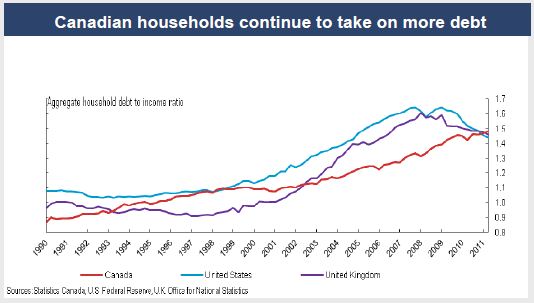
The books are still being written on the causes and effects of the recent recession, but one wide-spread agreement is that aggregate household debt, and particularly the ratio of debt to household income, has been a real problem for developed nations. In the U.S., this ratio hit between 1.6 and 1.7 at the onset of the recession, and then fell to about 1.4 today. In the U.K., the ratio topped out at just under 1.6 in late 2007, and is now down under 1.5. Given the flat-lining of household incomes in the two countries, this constitutes a very significant pay-down in household debt. Note that for most of the 1990’s, this ratio hovered between 1.0 and 1.1 in the U.S., and between 0.9 and 1.0 in the U.K. It wasn’t until the easy money period of the late 1990’s that these ratios started soaring. (In the U.S., this was a gradual rise, really starting about 1990. In the U.K., the rise was more abrupt, beginning about 2001.)
Now we har that our neighbors to the north are trying to copy our bad behaviors. In 1990, the typical Canadian household had a debt/income ratio of about 0.9. This gradually rose to about 1.1 by the late 1990’s, then hovered there for a few years. Over the past 10 years, the Canadian debt ratio has continuously grown, with no “peak” in the early days of the recession, and now sits at about 1.5.
courtesy RICS Global Real Estate Weekly
Share this:

Housing News
I was just at a luncheon (sponsored by the local chapter of the Appraisal Institute) on apartments. One of the speakers noted that a real problem in doing adequate analysis was getting a handle on the single-family housing market — the data simply stinks due to the foreclosure mess, the number of homes being turned into rentals, etc. Thus, as we try to ALSO project the future of the homebuilding industry (really down for the count the last few years), that same dirty-data problem is a real issue.
That aside, the National Association of Homebuilders released a report today noting that the NAHB/Wells Fargo Housing Market Index rose in February for the fifth consecutive month. As I discussed back in November (click here for a link) this index attempt to project home sales based on model home traffic, customer inquiries, and such. Even though the over all stock market was down today, this news sent homebuilder prices higher — indeed, Beazer Homes (BZH) rose by 3.1%, albeit to just over $3/share.
NAHB’s Chief Economist David Crowe said, “this is the longest period of sustained improvement we have seen in the HMI since 2007.” Great news for homebuilders — we hope it stays this way. For a full copy of the article, on Fox Business News, click here.
Share this:
European Banking
I like Forbes magazine, and while I’ve only met Steve Forbes once, he’s seems to be a terrifically engaging fellow. That having been said, while he and I are probably not very far apart in our core political thinking, I DO disagree with him on many key points (gold standard being the top of the list). However, he wrote an excellent op-ed piece back in December about Angela Merkel and the actions/inactions which permeate European decision-making today. Recent events, particularly in Greece, suggest that Ms. Merkel may have read Mr. Forbes and followed suit. Nonetheless, I think some of Forbes conclusions may be ill-founded. (For a full copy of his article, click here.)
Forbes draws an analogy between the European actions of this past Fall with the draconian anti-inflation actions of the last days of the Weimar Republic during the great depression. Students of history may recall that those actions led to the fall of the German republic and the rise of Hitler. Forbes suggests that Merkel is frightened of the inflationary impacts of European central banks buying up Italian and Spanish bonds (thus pumping lots of Euros into the economy).
Forbes points out that banking is very different in Europe than in the U.S. He does not explicitly note — but seems to assume his readers would know — that Europe doesn’t have a system analogous to our Federal Reserve, but rather the major money-center banks serve that same purpose. (In practice, the European banks are joined at the hip with U.S. banks, and thus have an implicit liquidity guarantee from the U.S. Fed.) Forbes notes that liquidity is already strained in Europe, with U.S. money market funds having already withdrawn about $1 Trillion. In addition, European businesses look more to banks than bonds for raising long-term capital. In the U.S., industrial bank loans to nonfinancial corporations totals about $1.1 Trillion, while in Europe the corresponding number is about $6.4 Trillion. Contrast this with the bond market — in the U.S., corporate bonded debt is $4.8 Trillion, but only $1.2 Trillion in Europe. European banks are also the primary buyers of European government debt, while in the U.S. the banks are only one set of many sets of buyers.
I think where Forbes misses the point in his criticism is his failure to recognize that liquidity for this bond-buying spree would come not from a central source such as a Federal Reserve system but rather from German taxpayers. The Germans have bent over backwards already to bear the financial brunt of this crisis, mainly because they are apoplectic at the idea of the collapse of the Euro.
Forbes is also implicitly paying some homage to the Hamiltonian idea that a centralized, Federal Europe (which does not yet exist) could buy up bonds from member countries and issue a new “Euro Bond” which would take its place. The first U.S. Treasury Secretary came up with this idea for two reasons — first, the individual states were heavily in debt to pay for the Revolution, and second it would create a much stronger central government, which would issue a uniform currency and raise money through Federal taxes.
However, Europe of 2012 isn’t nearly as well organized as the U.S. of 1790 (amazing, but true). Plus, even if Angela and Nick (remember — Sarkozy gets a vote, too!) could wave Harry Potter’s wand and create a unified Federal Europe, the burden would still be borne disproportionately. Northern European countries (and even Northern Italy, which is more like Germany than pundits recognize) are quite healthy with the status quo. The peripheral countries (the “PIIGS” for short) are the principle problem right now. Back in the 1790’s, the debts of the various states were actually fairly well-distributed. (And yes, the irony of using Harry Potter as an example — a British wizard who still uses the Pound rather than the Euro — was on purpose.)
So, Forbes gets it half right. The model we now see in Greece may be the answer — a compromise on the bonds, with fiscal restraints borne by the countries that are in trouble. Will Europe ever see a Federal system with the same sort of fiscal and monetary controls we have here in the U.S.? Probably not for a long time. In the meantime, Angela has to play the cards she’s dealt, not the ones Forbes would like to imagine she has.
Share this:
Conerly’s Businomics Newsletter
I’ve mentioned before that one of my favorite economic writers, particularly for the Pacific Northwest, is Dr. Bill Conerly out of Lake Oswego, Oregon. Even though Greenfield’s practice is national, we have to maintain a bit of a Northwest focus to our work. Dr. Conerly helps us with the underlying economics driving the economy of this salmon habitat in which I live.
Dr. Conerly’s “charts” are wonderfully informal and informative at the same time. In the ‘old days’ he would simply hand-write his thoughts on the charts then fax them to his subscribers (remember “faxing”?). Today, of course, it’s all digitized and stored on his web site, with an emailed link. Nonetheless, the succinct hand-written notes are still there, and the brevity is welcomed. (I could learn from that.)
Rather than reproduce the charts here, I’ll simply give you a link (here) and you can go view them yourself. If you’d like to contact Dr. Conerly — he’s a great speaker and consultant on economic issues — then the e-mail address is bill@conerlyconsulting.com. A quick synopsis may whet your appetite:
- Business equipment orders are still not back to the pre-2008 peak.
- Consumer sentiment is up, but not back to 2007 levels
- A January, 2012, Wall Street Journal survey pegged the risk of recession at 19%
- Private non-residential construction has “turned the corner”, but is still significantly lower than 2007-2009 levels.
- Unemployment: great headlines, but we’re a very long way from feeling good.
- Mortgage rates are at all-time lows, but only if you have great credit.
- Stock market: lots of up-side if Europe manages to muddle through
- Oregon and Washington bankruptcy filings on the way down, but still over double the 2007 rates
- Boeing orders may be tapering off, but still significantly exceed deliveries — no need to cut output
- Wheat prices (an important economic component in our area) are downturning, due to the global slowdown.
Well, folks, that’s about it — great reading from a great analyst.
Share this:
Marcus & Millichap’s Apartment Report
Of the major commercial real estate brokerage firms, Marcus and Millichap seem to consistently do the best job of thoughtful and insightful research. We track their work regularly here at Greenfield. Their 2012 Apartment Report just hit our desks, and it follows our expectations of excellent work on their part.
courtesy Marcus & Millichap
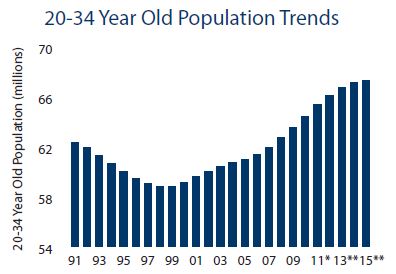
The apartment sector is rebounding nicely, but because of the intersection of favorable demographics and unfavorable economics. It’s driven by pent-up demand among “prime renters” (young adults who want to “unbundle” from parents and roommates) who would potentially have become homeowners a few years ago. Development had been stagnant for a few years, leaving the market with a potential shortage in supply. Developers, lenders, and investors had a brief pause late last year, but M&M expects to see steady additions to supply over the next three years.

courtesy Marcus & Millichap
As a result of all of this, vacancy rates are trending downward, and are expected to hit 5% this year (down from a peak of about 8% in 2009). This has the effect of driving up rents to historically high levels, even after a net decline from 2008 to 2009. With all this, apartment transactions are back up to pre-2009 levels, while the average price per unit is now topping $90,000 (up nearly to the peak of 2006) and cap rates are down in the 6.5% range (still off the trough of about 5.5% seen in the 2006-2006 period).

- courtesy Marcus & Millichap

The surprising upshot of all of this is that apartment cap rates are still at record high spreads over the 10-year Treasury long-term average. Market participants got nervous back in the 2006 period, when the spread had shrunk to 90 basis points (from a more “normal” rage of 380 to 430 basis points experienced since the S&L crisis 15 years earlier). Today, the spread is at 460 basis points, reflecting a bit of continued risk-aversion on the part of market participants, along with historic low rates on treasuries.
Share this:

Yet another comment about today’s economic news
It’s hard NOT to be pleased at today’s economic news. The unemployment rate is down, total employment is up (the two numbers don’t ALWAYS move in sync, due to the growth in the potential workforce), the stock market is up, the dollar is up versus the Euro, Yen, and Pound (not always a good thing), and bond yields are up (reflecting a potential demand for borrowing — a very “old school” view of stocks versus bonds). Intriguingly, oil is up but only by $0.59 a barrel as of this writing (12:35am EST on Friday the 3rd) — one would normally expect that great economic news would spur a run on oil.
Which may, in fact, reflect the continued anxiety in the marketplace. Recessions rarely happen in a straight line (see my post a few weeks ago on the relationship between the yield curve and the onset of a recession — click here for a shortcut). Real estate continues to be in disarray, and the banking sector is still in rehab, with the continued concern of a relapse if the Euro crisis doesn’t solve itself.
Ben Bernake’s testimony before the House Budget Committee this week was painful to watch — members of Congress would prefer to listen to themselves rather than the Chair of the Fed, and it was clear that members of that august committee had only a cursory understanding of what the FED actually DOES. Nonetheless, a piece of Bernake’s testimony had the tone of Armageddon. He noted that we’re on our way to addressing the CURRENT problems — the huge deficit overhang, the Euro crisis, etc. Congress still has ample work to do in those areas, but we are at least confronting the issues. The larger problem, in his mind, is what start happening in about 10 years or so when the demographic overhang starts hitting. The rapid shrinkage in the number of people PAYING into social security and medicare versus the number of people COLLECTING these transfer payments will be substantial, and this doesn’t even begin to address the productivity problems associated with a society in which a substantial number of people are retired and not contributing to the nation’s output.
Sigh…. at least it looks great today, right?


 From a small northwestern observatory...