Archive for the ‘Economy’ Category
The Livingston Survey — Semi-Good News
Regular readers of this blog will note that I’m enamored with the Philadelphia FED’s surveys of professional economists. They actually do two surveys — one quarterly series, which has a slightly larger survey base, but doesn’t go into as much depth; and the semi-annual Livingston Survey, which has a smaller audience but a lot of detail. For direct access to the current Livingston Survey, click here.
Bottom line? The first half of 2011 isn’t as rosy as economists previously predicted, but they’re still modestly bullish on the second half of the year. Currently, the annualized GDP estimate is an anemic 2.2%, down from an almost-equally boring 2.5% in the December survey. However, GDP growth in the second half of the year is expected to be even stronger than previously thought, with second-half growth forecasted at an annual rate of 3.2%. More significantly, previous estimates of unemployment are being cut. In the last survey, economists collectively projected that year-end 2011 unemployment would stand at 9.2%; today, that projection has been lowered to 8.6%. Of course, these projections were surveyed before the most recent nasty jobs-growth reports, so everyone who uses this data is taking a bit of a “wait and see” prospective.
The nasty news is on the inflation front — prior estimates put the consumer price index rise from 2010 to 2011 at 1.6%; current consensus thinking is 3.1%. While that doesn’t sound like much, the producer price index is even worse — a prior estimate of 1.9% is now being revised to 6.3%. Both indices are expected to settle down in 2012, but we can only hope.
With that in mind, projections of T-Bill and T-Note rates are, not unexpectedly, higher than previously thought. The current 3-month T-Bill rate (as of this morning) is 0.04%. Current thinking is that we will end June in the range of 0.08%, but that by the end of 2012, 3-month bill rates will be up to 1.58%. Ten-year Note rates will follow a similar, but slightly flatter pattern (representing a slight expected flattening in the yield curve). The 10-year composit Note rate as of this morning (according to the Treasury Department) was 3.77%. Economists actually project it will decline a bit by month-end (to 3.25%), then rise slightly by the end of 2012 to 4.5%.
Share this:

A Movie Review of Sorts
I just saw HBO’s “Too Big To Fail”, staring a whole host of Hollywood “names” (James Woods, John Heard, William Hurt, Paul Giamatti, Cynthia Nixon, Topher Grace, Ed Asner etc.). Sadly, it’s a fairly boring movie, albeit about a terrifically exciting piece of near-term history. It focuses on the collapse of Lehman Brothers, mostly through the eyes of Treasury Secretary Hank Paulson (played spot-on by William Hurt). Asner does a wonderful Warren Buffett (who almost, albeit reluctantly, came to Lehman’s rescue) and Giamatti is a wonderful Ben Bernake. (As an aside — Bernake is the most dead-pan person I’ve ever met. Giamatti’s version of Bernake is even more deadpan than reality.)
The movie gets one thing right and one thing wrong. First, the wrong, and then the right.
The movie keeps referring to Lehman’s “real estate”. No one will buy Lehman if they have to buy its real estate holdings, too. Lehman’s real estate “problem” is at first estimated at $40 Billion, then $70B, then “who knows”. The truth, of course, was “who knows”. Cynthia Nixon plays Paulson’s press secretary, who serve as an amiable foil to allow Paulson and his Chief-of-Staff Jim Wilkinson (Topher Grace) to explain the nature of the crisis to her (and thus to the viewer). Unfortunately, Lehman’s “real estate” isn’t “real estate” but “real estate mortgages”. More to the point, they have “tranches” of real estate mortgage pools, and to understand what a “tranche” is would be well beyond the capacity of a two-hour movie. Tranche, by the way, comes from the French word for “slice”. Imagine we pool $100 million or so in mortgages, then split up the ownership into three equal parts — an “A” tranche which will get paid in full, including interest, before anyone else gets paid; a “B” tranche which gets paid next, and a “Z” tranche which only gets paid after everyone else gets paid.
In theory, all three tranches should be good securities, since the underlying mortgages are pretty safe bets, and in practice the “A” and “B” tranches really were pretty good. However, the “Z” tranches will bear all the default risks. Banks (both mortgage and investment) made tons of money on these things, because the default risks could be “priced” as long as market continued to rise. Various investment banks then borrowed money to buy “Z” tranches, and coupled with credit-default swaps (essentially, a mutual insurance pact among investment banks), they were able to borrow huge amounts of money with very little capital.
The Paulson/Wilkinson explanation in the movie makes it sound like the whole problem came from mortgage defaults and foreclosures. In reality, mortgage defaults DO cycle up when a recession comes along, but these are usually predictable cycles. The REAL problem came from borrowing huge amounts of money — with almost no capital — to buy “Z” tranches that didn’t reasonably price the increased in defaults. A slight up-tick in defaults sent everyone to the emergency room, and when owners couldn’t sell or re-finance, the whole market went down the tubes. THAT was the “real estate” problem which plagued Bear Sterns, Lehman Brothers, Salomon Brothers, Morgan Stanley (my old alma-mater) and all the others. Sadly, the movie perpetuates the myth that the real estate down-turn was an exogenous event, and fails to discuss the sins of the secondary mortgage market which took a simple, cyclical downturn and turned it into a long-term, world-wide crisis.
But, even with that, the movie got one thing so very right that made up for the mistakes. In one pivotal scene, Paulson and his team are presenting the TARP idea to the leaders of Congress. (Central Casting found some excellent look-alikes for Pelosi, Dodd, Shelby, Frank, and the rest.) Note that this comes very late in the movie, well after Paulson (an almost billionaire, who really didn’t sign on for this level of stress) and his team have tried ever possible solution to stem the crisis. The movie does a great job of playing Paulson up as the unsung hero who really saved the world’s economic life, by the way. Anyway, the leaders of Congress don’t “get it” until Giamatti’s Bernake gives the most important 2-minute economic lecture in history. He notes that while the Great Depression started with a stock market crash, it was the failure of the credit markets which made the depression last so long. The current crisis, if left un-solved, would spin the world into a much worse, much longer economic depression. Giamatti really nails the tone of the reality which was facing the nation’s top economic thinkers at the time.
Anyway, I don’t watch very many movies. I saw Adam Sandler and Jennifer Anniston in “Just Go With It” on an airplane last week, and thought it was a hoot. As movies come-and-go, “Too Big To Fail” doesn’t even rise to the entertainment level of “Just Go With It”, but as an educational piece, it’s a must-see, even with its critical flaws.
Share this:
Housing Finance — Take 2
Again, from the Wall Street Journal, we find reasons for concern. The “Ahead of the Tape” column in today’s Journal, we find an excellent — but troubling — article by Kelly Evans titled “Economy Needs a Borrower of Last Resort.” It really follows my theme from yesterday, and I couldn’t agree more.
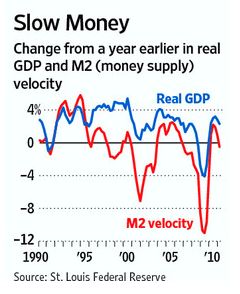
Graph courtesy The Wall Street Journal
Imagine a dollar (or a hundred thousand dollars) injected into the system which is loaned to a family buying a new home. They pay the builder, who deposits the money in the bank (actually, paying off the construction loan) and then that money can be loaned back into the system. Some of it bleeds off into taxes, exports, and such, with each iteration of the deposit-and-loan cycle, but still, the money cycles thru the system. Since each subsequent deposit and loan doesn’t happen instantly, there is a little bit of a lag. Nonetheless, over a short period of time, the system should work. The math behind this is called the “Cambridge Velocity Equation” and it’s been known to economists for hundreds of years.
So, since November, the FED has purchased $684 Billion in bonds, which SHOULD have resulted in trillions of dollars in new money creation. Instead, M2 (the abbreviation for the money supply, defined as all of the cash, bank deposits, and money market funds in the system) has only increased by $326 Billion, suggesting that the velocity of money is about 0.5. Note that it SHOULD be 2 or 3 or more in a vibrant economy. This means that for every dollar injected into the system by the FED, half of it has dissipated.
As the article points out, this is why the recovery has remained so anemic. I would posit that a big problem is in the home loan business, which is far weaker than merely “anemic” — it’s on life support with the undertaker waiting in the lobby.
Kelly Evans posits that the market needs a lender of last resort, which is exactly what I was saying yesterday. Unless and until the system starts turning into the skid, by fixing the totally busted mortgage market, a double-dip recession seems inevitable.
Share this:

Housing — and today’s WSJ
The front page of the Wall Street Journal today is plastered with the story of the continued problems with house prices, courtesy of info from the S&P-Case Shiller Index. I’ve commented on this several times before in this blog, but it bears further investigation.

Prior post-WWII real estate recessions (if we can call them that) have been quickly self-correcting. Stagnation in house prices lead to increased investment, as buyers look for deals and bankers need to make loans. As such, real estate recessions rarely have actual price declines, but instead are marked with volume slow-downs or price stagnation.
This recession is very different. Bankers are highly reluctant to make loans, in stark contrast to prior recession-exits. Regulatory problems, lack of bank capital, a doubling of REO portfolios, lack of cash from retail buyers, and a real fear (by both bankers and buyers) that collateral values will continue to decline puts the market in a continued downward spiral. To make matters worse, since many owner/sellers (particularly the most fragile ones — in the “zero down payment” starter homes) are themselves faced with economic travail and often the need to move to find work, the potential for further foreclosures down-the-road is very real, thus further driving down prices. Add to this the fact that a very big chuck of the U.S. economy is housing-related (contractors, developers, bankers, realtors, and many other intermediaries), it’s easy to see that a sustainable jobs market is hard to envision without “fixing” the housing problem.
We can re-examine the causes of this crisis over and over, but very few analysts are focused on the cure. Pilots are taught that when airplanes stall and go into a spin or a downward spiral, after “pulling the power” the pilot has to do something that’s rather counter-intuitive: point the nose downward and actually fly INTO the stall to get out of it. It’s like steering a car INTO the skid on an icy road. It’s very counter-intuitive, but it’s necessary. (The “black box” — it’s actually orange — recently recovered from the Air France 447 crash showed that the two very junior co-pilots who were at the controls when the plane went into a stall tried to pull BACK on the stick, when they should have pushed FORWARD. If they’d thought back to “Flying 101” they might be alive today.)
The “thing missing” from today’s market is the national policy in favor of affordable housing, which was manifested through Fannie-Mae and Freddie-Mac. Pulling the plug on the secondary market (which was at the core of the housing bubble) basically took our financial markets out of the housing business. Now that the price-bubble has bursts, our financial markets need to step back up to the plate and provide some liquidity. Admittedly, a “fixed” market will need to provide better risk-measures and possibly some hedging tools, but these are details that can be worked out once we get the plane flying again. I hate to say this — I’m generally a “free-market” kinda libertarian guy — but the government will need to step up to the plate as a guarantor of last resort…. and yes, I know the U.S. government is effectively broke. However, until it gets the housing market back on its feet, it’s going to stay broke. At some point, they need to steer the car into the skid.
Share this:

Apartment Investing — Cap Rate Divergence
The fact that apartment “cap rates” are declining in the face of rising fundamentals is old news. (For the newbies — the “cap rate” is the ratio of net operating income, or NOI, to value or purchase price. If NOI is rising, then purchase prices must be rising even faster, indicating increased investor sentiment.) Indeed, as of April, nationwide, mean cap rates on apartments were back to early 2008 levels. (Again, for the newbies — cap rates on all property types rose during the recession, reflecting both declining fundamentals AND declining investor sentiment.)

The more interesting piece of news comes out of our friends at REIS, who just released a report today showing that Class “A” apartment cap rates have declined much faster than Class B/C, indicating that high-end, investment grade properties are much in favor today for their income by institutional investors.
Those same investors are wary of lower-grade apartment investments, although REIS suggests that this wariness should dissipate over time. This suggests some significant opportunities for developers, turn-around specialists, and other non-institutions during the coming months.
Share this:

Mueller’s Market Cycle Monitor
Sorry it’s been so long — I’ve been traveling a good bit lately, and it’s hard to keep up!
One of my favorite real estate pieces hit my desk while I was gone — Dr. Glenn Mueller’ Market Cycle Monitor, published by Dividend Capital. He developed this model about 15 years ago, and it tracks occupancy and absorption of major commercial property types in about 50 geographic markets. As a property type (in a given market) sees increasing occupancy, market participants bring new property on-line. This creates an expansion. At the peak of the expansion curve, “hypersupply” begins, following which the new supply exceeds the market ability to absorb property. Vacancy rates increase, even as new property is still coming on line. This stimulates a recession. During the recession, no new property comes on-line, and occupancies hit a nadir. At that point, natural expansion of the economy stimulates a recovery, during which excess properties are absorbed and the cycle continues. The following, taken from Dr. Mueller’s excellent 1995 paper, captures the entire idea:

Currently, the market can be best described as “flat-lined”. Office occupancies were flat during the first quarter, and rents were actually down slightly (0.3%, on an annual basis). Industrial occupancies improved slightly, but rents actually fell signficantly (3.1% annualized). APartment occupancies improved slightly, and rental growth improved significantly (2.8% annually). Retail occupancy actually improved significantly, but rental growth trended downward (3.1% annually). Finally, hotel occupancies improved a bit (0.8%), and hotel income (measured as RevPAR, or Revenue per available room) increased 8.9% on an annualized basis.
For a complete copy of Dr. Mueller’s report, click here or write us at info@greenfieldadvisors.com.
Share this:

Phily Fed — Econ Forecast
One of my favorite economic touchstones is the quarterly survey of professional economists by the Philadelphia Federal Reserve Bank. Forty-four economists are surveyed, including such notables as Mark Zandi from Moodys, John Silvia from Wells Fargo, and Neal Soss from Credit Suisse. The focus is on “practicing” economists rather than “academics”, and as such gives a great snapshot of what decision makers at major corporations are thinking.
The Phily Fed then takes a synopsis — both a mean and a distribution — of their collective thinking in several key areas, such as Real GDP growth, unemployment, monthly payroll growth, and inflation. The interesting factors include both the current thinking, the CHANGE in current thinking (from the previous projections) and the probability distribution.
Current thinking about GDP growth is a bit less optimistic than it was before. As noted in the graph below (reproduced from the Phily Fed’s report), prior consensus thinking put GDP growth in the 3.0% to 3.9% range, while the current consensus mid-point is between 2.0% and 2.9%. Good news — hardly anyone projects negative GDP growth for this year. As we get into out-years (the graphics are on the Phily Fed’s report), which you can download by clicking here ), the consensus is a bit blurry, but in general most economists still see GDP growth postiive and between 2% and 4%. Unfortuantely, this isn’t the best of news — for the U.S. economy to really get back on track, much stronger GDP growth is needed (solidly high 3% range and even above 4%).

Philadelphia FED GDP Projectsions 2Q 2011
Unemployment projections for 2011 are somewhat rosier. In the prior survey, the mean projection was in the range of 9.0% to 9.4%, with a significant number of economists projecting from 9.5% to 9.9%. Currently, the mean is 8.5% to 8.9%, and a signficant number project in the 8.0% to 8.4% range — a very real shift in the outlook for the nation’s economy as we head into the second half of the year. On the downside — projections for out-years (2012, 2013, and 2014) show a very slow restoration of “normality”, with mean unemployment projections above 7% in all years.
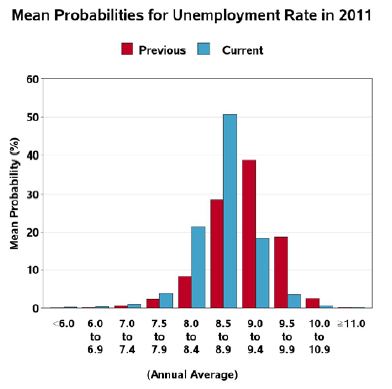
Philadelphia FED Unemployment Projections 2Q 2011
One piece of good news — and this may be the FED patting itself on the back a bit — is that its inflation projections have been quite accurate over the years, and they continue to forecast exceptionally low CPI changes over the next ten years. While the median forecast is up slightly from last quarter (2.4% up from 2.3%), this continues to be great news for consumers and bond-holders. Notably, as you can see from the graphic, there is a fair degree of agreement among economists surveyed — the interquartile range is less than a percentage-point.

Philadelphia FED Ten-Year Inflation Projections as of 2Q 2011
Share this:

Global and Local Data
Two important economic research pieces hit our desks this week — the RICS Global Commercial Property Survey, and the Dr. Bill Conerly’s Businomics Newsletter. The former, as its name implies, has a very global reach (the U.S. included), and gives a great basis for comparison of how the U.S. commercial real estate economy is doing relative to other economies. Naturally, this begs the question, “Are there OTHER economies?” From an investment perspective, all “economies” are integrated, and while each occupies a different place on the risk/reward graph, they are all viewed through the same lens by the equity and debt markets. Dr. Conerly’s work focuses narrowly on the Pacific Northwest, and gives us a great snapshot on how our local economy is doing. It’s a “must-do” resource piece for any work we do in our backyard.
RICS, of course, stands for Royal Institution of Chartered Surveyors. First charted by Queen Victoria in 1881, it is now the world’s oldest and largest property-focused organization, with 100,000 professional members and 50,000 students in 140 countries. Greenfield has been pleased to be affiliated with RICS here in the U.S. for quite a few years.
The headlines speak for themselves:

from RICS Global Commericial Real Estate Survey 1Q2011
For your own copy of the report, or one of the regional reports, visit the RICS web site by clicking <here>
Dr. Bill Conerly, based out of the Portland, Oregon, area, is a great friend of ours here at Greenfield and one of the region’s top consulting economists. His newsletter presents key national economic trends (along with his pithy comments) and then focuses on how these play out in the Pacific Northwest. He calls national GDP growth since the start of the recovery “disappointing”, and notes that while consumers seem to be rebounding and business equipment capital spending is growing moderately, construction spending is still “weak”. Housing starts are still troubling (for more on this, see some of my prior blogs on the housing market) and despite gas prices, inflation still seems to be under control (actually near the lowest levels in the past 5 years.) The spread of junk-bond yields over treasuries hit a peak of nearly 2000 basis points in 1009, and is back down to between 500 and 1000, but still above the roughly 300 basis point level of 2007. Dr. Conerly suggests there is still some worry about risk, although I would posit that 700 or so basis points is probably a healthy level. Finally, on a national view, Dr. Conerly is looking for “decent but not dramatic gains” in the stock market.
On the local front, Dr. Conerly notes that both Oregon and Washington bankruptcy filings have turned downward from their peak levels last year, although both are still well above levels pre-2009. Through the recession, both states have seen substantial net in-migration (Oregon at about half of Washington’s level), although Oregon’s in-migration had trended slightly downward and Washington’s slightly upward.
For more information on Dr. Bill Conerly or copies of his charts, visit him here.
Share this:

Home Prices Decline — Why?
Our neighbors down the street, zillow.com, just released a report showing that home prices nationally fell by 3% in the first quarter, or a total of 8.2% from March, 2010. The cumulative national average decline from the market peak (June, 2006) is 29.5%, and this quarter’s decline was the worst since 2008.

By the way — and this may seem totally obvious — but one of the biggest reasons people buy homes is because they are expected to go up in value, not down. Hence, a home is expected to be a storer of value and a hedge against inflation, not a dissipating asset. A buyer in June, 2006, would have reasonably expected his or her home to increase in value by 5% or so per year. For example, as Zillow’s chart shows, even back in the 1990’s, a home bought in 1996 (where their chart begins) went up by a total of about 20% by 1999 — slightly over 5% per year compounded. In five years, 5% compounded annually totals about 28%. Hence, not only are homes going down, they are totally contra to expectations by a total (28% plus 29%) of nearly 60%.
It sounds trivially obvious, but bankers also expected that. It’s one of the reasons why they fearlessly (and yes, foolishly) made loans to anyone who could sign their name (or make a “X”) back in the bygone days, because if the loan went sour (and they KNEW some of them would), they could always dump the collateral for more than they had in it. “Heads, we win. Tails, we don’t lose.”
CNBC had a nice piece on this topic this morning, featuring (among others), Dr. Susan Wachter, of U. Penn, who we’ve had the pleasure of knowing for many years. All of the talking heads agreed that banks won’t loan money today unless they’re absolutely sure of creditworthiness of the borrower. Hence, fewer people can borrow today, so fewer homes can get sold. Values decline due to lack of demand (pretty simple ECON 101 stuff happening here) and, as Prof. Wachter put it, the spiral will continue downward until an equilibrium is reached.
I’ve opined about that equilibrium in this column for quite some time. There is some significant albeit anecdotal evidence to suggest that the equilibrium home ownership rate will constitute the floor in all of this — probably somewhere around 64%, which is where we were back in “normal” times of the late 1980’s to mid-1990’s. I wish we had more data, but systemically declining housing markets don’t happen very often.
Share this:

JPMorgan-Chase settles military class action
This is a little bit off-topic (just a little), but the case of Marine Corps Capt. Jonathon Rowles, and the class-action suit which he began, has been a particular burr under my saddle since I first heard of it. Apparently, JPM-C has finally done the right thing and offerred to settle, but the fact that they got into this mess in the first place says a lot about their practices.
In short, the Servicemens Civil Relief Act provides for certain protections against overcharging, fraud, and egregious foreclosure during periods when the servicemember is fighting overseas and unable to defend him or herself in the normal due process. Note that debts aren’t forgiven, but mortgage loan interest cannot exceed 6% during such time of service, and certain collection and foreclosure actions are prohibited.
To say that JPM-C ignored the SCRA is apparently an understatment. Capt. Rowles repeatedly informed the bank of his active duty status, and made timely payments based on JPM-C’s own 6% calculations. Nonetheless, they apparently failed to credit him with the proper payments he made, and initiated collection and foreclosure actions against him and his family. For more details on the issue, read the court filings here.
Fortunately, Marines don’t scare easily, and Capt. Rowles and his attorney filed a class action suit on behalf of all service members similarly treated by JPM-C. Seeing the handwriting on the wall (the suit was filed in South Carolina — one of the most pro-military states imaginable), a settlement was forthcoming. For details on the settlement, click here.
Sadly, this class action ONLY covers servicemembers. One has to wonder how many similar stories come from the civilian population?


 From a small northwestern observatory...