Archive for the ‘Real Estate Investments’ Category
PWC Surveys Investors
PriceWaterhouse Coopers does a great job with they’re quarterly survey of commercial real estate investors. Previously known as the Korpacz Survey, after it’s founder, Peter Korpacz, the lengthy but highly readable review gives investors, brokers, appraisers, and others a snapshot of anticipated market performance both by property type (retail, office, etc.) and market (regional, and in some cases by metro area). The most recent issue just hit my desk, and as usual it’s terrifically informative.
The headline this quarter is, “Investors Scrutinize Cash Flow Assumptions”. As it turns out, the assumptions and resultant aggressiveness (or lack thereof) varies significantly by property type and geographic market. For example, strip shopping centers (nationally), apartments (also nationally), and regional warehouses in the pacific and east-north-central regions are enjoying increased optimism, measured by very significant declines in overall capitalization rates. On the other hand, 20% of investors surveyed expect regional mall cap rates to increase over the next six months, and 40% of investors felt the same about the overall Denver market.
Intriguingly, cap rates in CBDs trend lower than in the suburbs of those same cities, driven mainly by higher barriers to entry and a lack of available land downtown. Additionally, most downtown cores in major markets provide the sort of 24/7 lifestyle and transportation alternatives that appeal to younger workers, and hence the firms that employ them. As such, the downtown locations are viewed as less risky, overall.
Overall, vacancy rate assumptions have remained steady over the past year. Coupled with that, tenant retention rates have also remained steady across markets.
In general, office markets remain fundamentally strong, and PWC survey respondents project falling vacancy and rising rental rates over the next few years. Retail market conditions are improving, with no major markets currently in recession and an increasing number in expansion. In the industrial sector, the expansion of the past few years is likely to abate, according to the survey, and a few metros may find themselves in the overbuilt state (Austin, Jacksonville, Las Vegas, Portland, and DC). Apartments will continue in expansion in many markets, but the peak may be near, and an increasing number of markets are reported to be in contraction as 2015 turns into 2016.
As noted, the report is detailed, and this issue also features their less frequent surveys of medical office markets, development land, and student housing. For your own copy (they come at a subscription cost, by the way) visit www.pwc.com/realestatesurvey.
Share this:

12th Fed District issues 3q report
Greenfield is a global firm (albeit mostly in the U.S.), and even though we’re headquartered in Seattle, we try to focus our attention broadly rather than locally. That said, the 12th Federal Reserve District just released First Glance 12L (3Q15) which takes an early cut at the data from the nine western states. It’s very telling data — the “left coast” as I like to call it tends to suffer worse when times are bad and boom better when times are good. Thus, there are some interesting facts and figures to be gleaned from this well-written report.
Naturally, the report is focused on the health of the member banks in the region, but the macro-econ factors driving that health are of much broader importance. Nationally, unemployment stood at 5.1% at the end of the 3rd quarter. Western states tended to be a bit worse off, with 3 states (Idaho, Utah, and Hawaii) recording lower unemployment rates and the rest showing higher numbers, ranging from Washington’s 5.2% up to Nevada’s 6.7%. California, always the thousand pound gorilla in the room, came in at 5.9%.
However, job growth in the western states is well above the national average — 3% annually for the region versus 2% for the U.S. as a whole. However, the west is digging out of a deeper hole — while job growth nationally hit a trough of -4.9% at the peak of the recession, it bottomed out at -6.7% in the west. Generally, job growth in the west over the past 20 years had held steady at about one percentage point above the national trend during “boom” years.
Housing starts in the west are well below the pre-recession peaks. As of September, 2015, the seasonally adjusted annual rate (SAAR) of housing starts stood at 161,000, with 107,000 of that in 2+ family units. This compares with a peak of 449,000 SAAR in the 2005-2006 period, at a time when 2+ unit housing only made up 85,000 of the starts. Arguably, the market in the west is still absorbing the huge shadow inventory built up during the boom days.
Commercial vacancy rates in the west have been drifting down for the past few years in the office, industrial, and retail sectors. Apartments, however, seem to have plateaued around 4.3% at the end of the 3rd quarter, and are forecast to rise a bit to 4.7% a year from now. I might posit that historically, profit-maximizing apartment vacancy rates have been found to be somewhat higher than these numbers, so apartment managers and owners may have some lee-way to continue building.
The 5 western maritime states are very export-driven, and the strength of the U.S. dollar (up about 18% against major currencies since 2014) has been rough news for those markets. While western state exports rebounded nicely from the trough of the recession (up about 17% from 2009 to 2010), export growth has flat-lined since 2012. Regionally, exports declined about 2.5% since last year, with positive growth reported in only four states (Arizona, Hawaii, Nevada, and Utah). Bellweather California saw exports decline 3.6%. Note that in Washington, my semi-home state, exports make up 21.2% of the gross state product. (We export things like big trucks, big airplanes, software, and agricultural products.) Hence, this is critically important stuff.
The remainder of the report focuses on the health of the regions banks. I’ll leave that up to the reader if you care to download your own copy. Short answer, though, is that the region has seen loan growth accelerate even while the nation as a whole has flattened. Further, the regions banks tend to be a bit more efficient in terms of expenses and staff, both compared to the nation as a whole and compared to the “boom days” pre-recession. Both small and large commercial borrowers generally reported tightening credit standards at the end of the 3rd quarter, which is a change from previous reports. However, consumer borrowers (residential mortgage, credit cards, and auto loans) generally reported easier standards. The bulk of loan growth for small banks (under $10B) came from non-farm non-residential, while for large banks the biggest growth sector was in consumer lending. The percentage non-performing assets (the “Texas Ratio”) in the region, which peaked at 38.9% in 2009, is now down to 5.4%, although still higher than in the 2004-2007 period. By comparison, the national peak hit in 2010 at 19%, and is now standing at 7%, also higher than pre-recession levels.
Share this:
PWC’s Emerging Trends in Real Estate for 2016
Ever since PWC acquired Peter Korpacz’s excellent quarterly commercial real estate survey, they have really leveraged that theme into a great regular read. Along with my subscription, their annual Emerging Trends just landed in my in-box, and it’s a really excellent read. (To access a copy, just click on the link above.) The report is a must-read for anyone in real estate, particularly in the investment or finance side. I’ll skip to two of the summaries — one they call “expected best bets” as well as the capital market summary, to give you a flavor of their report.
Expected Best Bets — PWC recommends, “Go to the secondary markets”. They note that gateway markets have pricing problems, while the “18-hour cities” are “…emerging as great relative value propositions.” They particularly cite Austin, Portland, Nashville, and Charlotte.
PWC also discusses “middle-income multifamily housing,” and notes the solid business opportunities providing creative answers for what they call the “excluded middle” households. PWC also encourages planners to re-think parking needs, in light of the changing demands of “live/work/play downtowns.”
On the securities side, PWC notes that many REITs are priced well below net asset value, providing an interesting arbitrage opportunity in 2016.
Capital Markets — PWC opens by noting, “In many ways, it appears that worldwide capital accumulation has rebounded fully from the global financial crisis. The recovery of capital around the globe has been extremely uneven. And the sorting-out process has favored the United States and the real estate industry, affecting prices, yields, and risk management for all participants in the market.”
Whew…. I’m usually loathe to quote so much from another’s work, but I simply could not have said that any better. PWC quotes one of their survey respondents, a Wall Street investment advisor, who says, “There is going to be a long wayve of continued capital allocation toward our business….”
Survey respondents largely were split on short-term inflation, with about 40% predicting modest increases and 60% looking for stability at current rates. However, when they look down the road 5 years, 80% of respondents look for modest increases in inflation. Coupled with that, over 60% of respondents think both short term interest rates and mortgage rates in specific will rise next year, and nearly 80% think such rises will occur over the next 5 years. Intriguingly, a small but significant minority — about 20%, believe rates will rise substantially over the next 5 years. Almost no one believes rates will fall, either in the short-term or the long-term.
To sum up the capital markets view, PWC says the general spirit of the industry is positive, albeit with an eye toward risk. Many are calling for a “long top” to this recovery, but many are also taking defensive postures by shortening investment horizons, paying more attention to the income component of total return rather than the capital appreciation component, and moving down the leverage scale.
As always, I would stress that I am citing a 3rd party source here, and nothing in this review should be construed as investment advise. That said, PWC’s Emerging Trends is an excellent read, and I highly recommend it.
Scotland Independence and U.S. Real Estate
If you haven’t been keeping up, about 4 million voters in Scotland will go to the polls tomorrow (Thursday, Sept 18) to decide one simple question, “Should Scotland be an independent country?” If a majority vote no (the “unionist” position), then the question of Scotland’s independence should be put to rest for a long time to come. If a simple majority votes “yes”, then Scotland and the United Kingdom will sever most of the ties that bind. Scotland will apparently remain part of the British Commonwealth, but with the same relationship to London and the Crown that Australia, New Zealand, and Pakistan have. (Yes, folks, Elizabeth is the Queen of Pakistan. Betcha didn’t know that.) As of this writing (Wednesday afternoon here in the states), it is reported by the Washington Post that the independence movement is slightly ahead.
So what are the implications, other than for scotch and haggis? As with any such major event, the unknowns outnumber the knowns, and the negatives may be overblown. However, from the perspective of global finance and European stability, no one can discern a plus and the minuses seem to be having a field day.
One thing is obvious — Scotland is the heartland of liberalism in the U.K. Independence means the remaining components of the U.K. (England, Northern Ireland, and Wales) will be governed by the conservatives for the foreseeable future. More to the point, Scotland’s indigenous political parties range from left of center to further left of center. Proponents of independence hope for a Scandinavian-style socialist state free of meddling from the Tories in the south. Of course, exactly how Scotland plans to pay for this isn’t quite clear just yet.
Oh, did we mention oil? Britain’s oil comes mainly from the North Sea. However, those reserves are being pumped by firms with names like BRITISH Petroleum, not SCOTTISH Petroleum. However, actual ownership of the oil revenues is a matter which has yet to be discussed, much less decided. Indeed, the Institute for Fiscal Studies indicates that Scotland will actually have to cut social spending by about $9.9 Billion per year.
Then there’s the issue of currency. Scotland benefits by using the pound, which is a globally accepted reserve currency. London is adamant that the pound will not be shared with Scotland, any more than it is shared with any other commonwealth state. (Note that Australia, Canada, Lesotho, and the like may have the Queen on their currency, but have to print their own money. As a result, many Scotland based businesses have threatened to de-camp to the south. Will Royal Bank of Scotland become Royal Bank of…… East Northumberland? (In fairness, Scotland could unofficially use the pound the same way Equator uses the U.S. dollar.)
How about nuclear weapons? Currently, Scotland is where the U.K. keeps theirs. Scotland has declared that they will be a nuclear-free zone. Further, Scotland’s chances of joining NATO or the European Union appear slim.
All of this has some very real implications for one of the world’s anchor currencies and 6th largest economy ($2.8 T estimated 2014 GDP, according to CNN.com). To suggest that this wouldn’t have implications for global real estate investment would be short sighted in the extreme.
Retail Real Estate
The current common wisdom (such that it is) about retail real estate is that the Amazons of the world will crush retail real estate. Add to that the pressures of retrenchment among traditional shopping mall anchors such as Sears and JC Penney (neither of whom have figured out how to make “on-line” work), as well as the changing shopping habits of the millennial generation and the “halt” of suburban sprawl, and it comes as no surprise that only three traditional enclosed malls have been completed in the last decade, compared with 19 in the 1990’s (according to the International Council of Shopping Centers).
A neat article in the current edition of Real Estate Investment Today (REIT) published by the National Association of Real Estate Investment Trusts, illustrated both the challenges and the potential solutions for real estate investors. The principle focus of the article was on Macerich, one of the nation’s premier retail trusts. While the article does a great job of illustrating how this one firm is addressing today’s challenging retail landscape, the underpinnings of the article were even more interesting for projecting the future of this important property sector.
Among other ways to address the issues, Macerich is targeting its top performing malls for significant redevelopment. For example, the Tysons Corner Center in Fairfax, VA, is slated for a $525 million expansion. In addition, many top-tier malls are being multi-purposed, with hotels and office space added for synergy and operational leverage. Much of the redevelopment has been aimed at making properties in densely populated markets more up-scale or even “luxury” branding. Macerich also has a technology program, including social media, aimed at the millennial shopper. Finally, the outlet mall product continues to be strong, and Macerich intends to build a few of those in the near term.
On the flip side, Macerich sold about $1 Billion in assets over the past 14 months, and has another $250 million slated for disposal during the rest of 2014. Lower quality assets and properties in secondary markets are largely on the chopping block.
What does this mean for the industry? In some ways, the news isn’t all that bad. The lack of new construction favors existing properties, particularly those with good fundamentals and solid (and growing) customer bases. On the down-side, mid-grade properties are going to become “malls people USED to shop at”, and retail is extraordinarily hard to reposition. Thus, while there are bright spots in retail sector, there are certainly players who won’t survive the next cycle.
Housing starts, you say?
Housing starts reportedly dipped 9.9% in June, with the bulk of that in multifamily starts. A few quick points about that. First, rebounds from a recession are anything but smooth. Come back in December and we’ll see what the trend line looks like. Second, note what happened to apartments. While apartment vacancies are still very healthy (5% range, nationwide), there are signs we’re getting a bit overbuilt in that sector. There was a huge rush, and I wouldn’t be surprised if many (most?) of the equity investors and lenders are looking for a chance to catch their breath.
Finally, I’ve opined in a number of places about the loss of construction talent and infrastructure. The long, deep recession really cost us in skilled labor (apprentice programs all the way to master crafts people) and in entitled land. A lot of building sites which were carrying entitlements (zoning, permitting, concurrence requirements, etc.) saw these vital legalities pass into the sunset (most of these had “build-by” dates). Even worse, many local planning and permitting offices are short-staffed, as cities and counties had to decide between laying off under-utilized permitting staff or over-utilized cops, firefighters, and EMTs. Guess what decisions councils and mayors made? On top of that, these understaffed departments will be the last to staff back up to normal.
Sigh….. normal housing starts in America post-WWII are about 1 million per year. When the total got down to, say, 800,000, the Fed would goose the monetary base, banks would make loans, and builders would fire up the pick-up trucks. When starts got above 1.5 million, the Fed would dim the lights a bit, and builders would go fishing. Overall, starts came in at 836,000 in June, down from May but amazingly up 10% from last year. Prior to 2008, a sustained level of starts in this range would be emblematic of a recession. Today, it’s good news. Go figure.
Oh, and one other quick thing — one pundit (I want to say on CNBC) recently suggested Ford, Chevy, and Chrysler as plays on housing starts. When starts go up, Ford sells more F-series pickups. Reportedly, Ford profits to the tune of $10,000 for each of these main-stays of the building site, and currently sells 72,000 of them a month. Do the math.
Share this:
Tea Leaves and Such
Flying back from Milwaukee to Seattle last night, I sat next to a fellow who owns several big truck dealerships in the mid-west. (Seattle, famed for Boeing and Microsoft, is the lesser-recognized headquarters of Paccar, the world’s third largest maker of heavy trucks, after Daimler and Volvo. Last year, they made and sold over $16 Billion worth of Kenworths and Peterbilts.)
ANYWAY, after the usual “how’s business?” question, I got an earful. Turns out no one’s buying heavy trucks right now, even though financing is historically affordable, and customers have cash. Why? Simply put, his customers are scared of the fiscal cliff. (We also talked about customers deferring potential acquisitions until after/if tax rates go up, but he said that this wasn’t a big issue in his surveys of customer sentiments.) He noted that demand for long-haul trucking was down, and noted that his trucking-company customers were reporting a lower volume of hauling for consumer retailers.
Now, if this was an isolated incident, we could write it off. However, the danger of the fiscal cliff isn’t just what will happen after January 1. Much like an impending hurricane, people are already packing their bags and getting out of the way or hunkering down and bolting the doors.
What is the impact on real estate? While it’s too early to completely quantify, clearly there is reluctance right now to make new investments in office, industrial, and retail. Add to this the realization that the apartment boom may have leveled off, and we have a fairly flat new development market on the horizon. This doesn’t bode well for real estate private equity firms that are focused on development profits or capital gains, but it does mean that income-oriented real estate (publicly traded REITs for example) may exhibit some buying opportunities due to both their tax advantaged nature. The most recent Current Market Commentary from NAREIT shows slight downward trends in apartment, office, and retail vacancy, with all three sectors showing positive rental rate growth (albeit at lower levels than earlier this year). The three-year moving average for renter household formation continues to trend upward, while the owner-occupied household formation is in negative territory (despite recent gains in home sales and housing starts).
Notwithstanding the dangers of the fiscal cliff, changes in non-farm payrolls have been strong and positive every month since mid-2010, and even though unemployment is higher than anyone wants to see it, the trend has been solidly downward since the peak of late 2009. As such, the fiscal cliff is the most significant economic problem on the horizon today. Fix it, and we continue on the track to full recovery. Let us drive off the cliff, and…. well, that’s a pretty good mental picture, eh?
Share this:
Corporate Investment — Much ado about…. something
I can’t believe it’s been a month since I posted — I’ve been traveling almost constantly the past few weeks, and between that and the elections, my dance card has been fairly full.
The trigger for day’s post was an article in the Wall Street Journal on Monday, “Investment Falls off a Cliff”, with obvious homage to the impending fiscal cliff. I don’t want to minimize the danger of the “FC”, and in fact all bets are really off if the worst case scenarios come to pass. Here at Greenfield, we don’t really believe Congress and the White House will both fail to blink. Nonetheless, “keeping your powder dry” is always good advise in perilous times.
I’d like to comment on two things, though. First, while direction of corporate investment isn’t good, it’s not quite “double dipping” just yet. Indeed, one might argue that the current downswing in investment is nothing more than seasonal backing-and-filling.
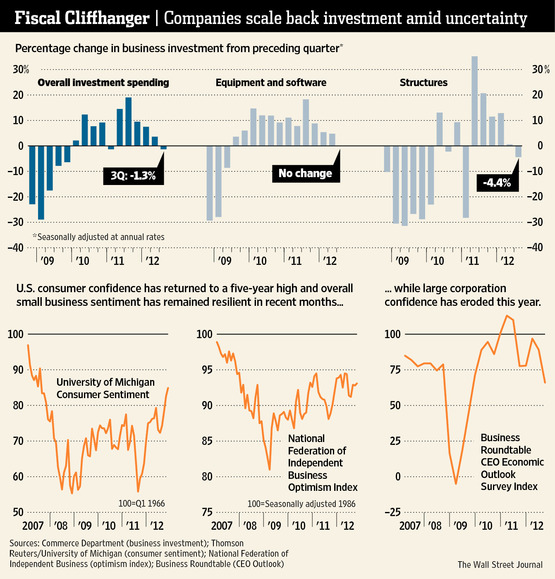
courtesy, Wall Street Journal
Note that after coming out of the recession, overall investment spending took a brief respite in early 2011, as well. Of course, equipment and software appear to continue healthy, but structures are dragging the overall index down. Part of this can be explained by the relaxation of the apartment construction surge that we saw over the past several quarters. Many analysts now believe the demand-overhand in apartments is close to saturation (or at least satisfaction) and this sort of slow-down is neither unusual nor unhealthy. Note that the NFIB optimism survey is still trending upward, although the Business Roundtable CEO survey (which surveys heads of larger firms than the NFIB does) had turned downward. I suspect that’s a rebound effect — small businesses are still clawing their way out of the recession, and are less affected by what may happen if the FC becomes reality. The larger firms were the first to enjoy the fruits of the recovery, and would be the worst hurt by tax increases and the FC cutbacks (particularly in defense). Nonetheless, both of these sentiment measures are well off their 2009 bottoms. Consumer sentiment, which ultimately drives much of this, is as good as its been since before the recession.
Second, I’m concerned about the negativity spreading to real estate. Note that real estate investment comes in three flavors — development, capital gains, and income. The downturn in investment has SOMEWHAT negative implications for the first. Real estate developers will have to be more careful in a slow-down environment, but that’s been true throughout this recovery. Financing is difficult, even in the “hot” apartment market, and so admittedly the commercial real estate developers may be in for a tough run. (Residential development, on the other hand, is rebounding nicely.) Capital gains is a “long game” anyway. Certainly the tax changes which seem inevitable in 2013 and beyond have negative implications for the buy-and-sell crowd, but the returns to those who can hold thru cyclical downturns have always been healthy even after tax considerations.
Real estate income (primarily REITs) may actually be benefitted by a slight retrenchment in development. If and as the economy continues to rebound, offices, warehouses, and shopping malls continue to fill up. Lack of new supply (from a cyclical downturn in development) benefits the sort of existing structures which are typically part of a REIT portfolio. As always, investors will be benefitted from looking at good managers with top-drawer properties and a history of increasing FFO.
Share this:

European Real Estate Funding Gap
Property Investor Europe sent me a report today about the shortfall in real estate funding in Europe. The implications are a bit nerve wracking.
First, some background — European commercial real estate investors place significantly more emphasis on “traditional” bank lending than Americans. As such, the sort of private-debt network that exists in the U.S. has not grown in Europe.
According to a report by the research firm Swisslake, central bank liquidity flows gave been directed at small and diversified loans, which are in high demand. However, commercial lending in Europe is actually facing cuts of €500 Billion or so. In addition, banks are increasing equity requirements, leaving real estate with large financing gaps, Swisslake calculates that only about $3.8 Billion headed towards Europe in the last year from non-bank lenders.
However, this is creating a market opportunity for private debt funds. Reportedly, 30 new funds have been launched in 2012, adding to the 20 new funds created in 2011. These funds have increased their market share to 20%, up from 15% at the beginning of 2012. Intriguingly, many former equity fund managers are now shifting to private debt funding.
Share this:
Economic outlook — fundamentals and shocks
I love boating, I really do. To quote from Grahame’s famous The Wind in the Willow, “…there is NOTHING–absolute nothing–half so much worth doing as simply messing about in boats.” However, any experienced sailor has had one of those days when the water was perfect, the wind was with you, but off on the horizon a storm cloud lurked. “Will it head our way, or pass us by?” is the key to whether the fun cruise continues or not.
Today, and for the next few weeks, the economy is like that. The wind is definitely at our backs, and things are generally looking up. That having been said, the fiscal cliff continues to loom on the not-too-distant horizon.
First, the good news, and there’s plenty of it. I’m on the Board of an investment fund (and in fact just got named chairman of the board this month, for a two-year stint). We had a great briefing yesterday from our lead fund manager, and macroeconomic news was as good as I’ve seen it in a while. Corporate profits are at near-record levels as a percentage of GDP, and non-financial interest expense as a percentage of profits is at a near-record low. Lending is back up, although corporate lending isn’t quite as robust as consumer lending, and current stock market price-earnings ratios (measured on a 12-month trailing basis) are at levels usually associated with strong intermediate-term (5-year) market returns. Equity risk premia tell the same story.
On the real estate side, everyone’s seen the news that the S&P Case Shiller index is trending back up, and this morning’s news report puts current housing starts above an 800,000 annualized level (note that we’re hoping for a million, and at the trough of the recession we were at a record low 300,000-ish). Manufacturing has added about a half-million jobs since the trough of the recession (early 2010), and is about 300,000 above where it stood in July, 2009.
The implications for real estate investment are clear, and as I reported earlier this week, the total return on U.S. REITs has exceeded 30% in the past year, besting the S&P 500.
With that in mind, though, the fiscal cliff continues to trouble us all. If you’re not familiar, on January 1, the Bush Tax Cuts will expire and mandated federal spending cuts are scheduled. Together, these two will hit the economy to the tune of about 4% of GDP (yes, driving us into a second recession). Sadly, the solution is political, and this is all coming at a time when Congress and the White House are totally focused on the impending election.
We’ll keep you posted, and we’re preparing some private white papers on this subject for our clients as the season moves forward.


 From a small northwestern observatory...