Archive for the ‘Real Estate’ Category
Real Estate Marketing Focus
I’ve observed over the years that real estate investors, developers, and such try to aim for the “middle”. It’s a defensive strategy. Lots of community shopping centers got built before the recession hit, not because they were hot or trendy or even hugely profitable, but because they were generally considered to be “safe”. The same was true with single family subdivisions, all of which looked pretty much alike by 2006. Lots of “average” apartments were built, Class B to B+ office buildings (some of which marketed themselves at Class A, but could get away with that only because of demand), and plain, vanilla warehouses were added to the real estate stock.
Now that we’re (hopefully!) coming out of a recession, it may be a good time to dust off some basic truths about business in general as it applies to real estate. Sure, there’s a very strong temptation to rush to the middle again, and in the case of apartments (for which there is a demonstrably strong demand right now), that may not be a bad idea. Nonetheless, I recall one of the great pieces of advice from Peters and Waterman’s In Search of Excellence: “average” firms achieve mediocre results. The same is frequently true in real estate.
Case in point — there was a great article on page B1 of the Wall Street Journal yesterday titled “The Malaise Afflicting America’s Malls”. by WSJ’s Kris Hudson. (There’s a link to the on-line version of the article on the WSJ Blog.) Using Denver, Colorado, as an example, they note how the “high end” mall (Cherry Creek Shopping Center), with such tenants as Tiffany and Neiman Marcus is enjoying sales of $760/SF. At the other end of the spectrum, Belmar and the Town Center at Aurora are suffering with $300/SF sales from lower-end tenants. Other malls in Denver are shut-down or being demolished and redeveloped. For SOME consumers and SOME kinds of products, in-person shopping is still the normal. It’s hard to imagine buying a truck load of lumber from Home Depot on-line (and Home Depot has done very well the past few years), although even they have a well-functioning web presence for a variety of non-urgent, easily shipped items.
I noted recently that some private book sellers are actually doing well in this market, and have partnered with Amazon to have a global presence. (We buy a LOT of books at Casa d’Kilpatrick, and nearly all of them come from private booksellers VIA Amazon’s web site.) On the other hand, it’s hard to imagine buying couture fashion over the web. Intriguingly, Blue Nile, the internet-based jeweler, notes that their web-sales sales last year (leading up to Christmas) were great at the both ends of the spectrum, but lousy in the middle. Stores like Dollar General, who aim for a segment of the market below Wal Mart, have done quite well in this recession (the stock has nearly doubled in price in the past two years). Ironically, Wal Mart, which is increasingly being viewed as a middle-market generalist retailer, hasn’t fared as well. Target, which seems to aim for the middle of the middle of the middle, has seen it’s stock price flat as a pancake for the past two years, and Sears, the butt of so many Tim Allen jokes, is trading at about half of where it was two years ago. These lessons are being lost on some retail developers, but being heeded by others. Guess who will come out on top?
So, who needs offices, warehouses, and other commercial real estate? Businesses at the top, middle, or bottom? If we follow the adages of Peters and Waterman, we’ll expect the best growth — and hence the most sustained rents — at the top and bottom of the spectrum. (Indeed, even in apartments, one might build a great case that the best demand today is at the low end and high end). However, we’re willing to bet that developers will aim for the middle, as always.
Share this:

Latest from S&P Case Shiller
The always excellent S&P Case Shiller report came out this morning, followed by a teleconference with Professors Carl Case and Bob Shiller. First, some highlights from the report, then some blurbs from the teleconference.
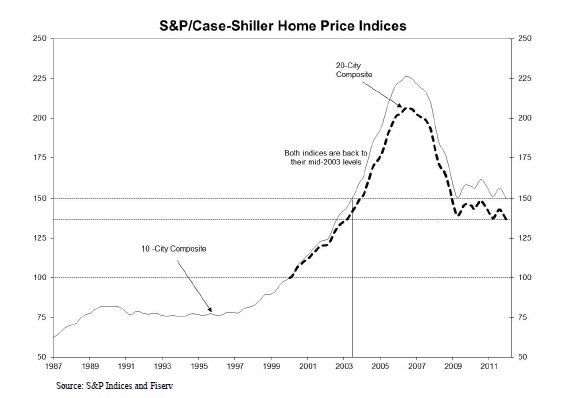 The average home prices in the U.S. are hovering around record lows as measured from their peaks in December, 2006, and have been bounding around 2003 prices for about 3 years. Overall in 2011, prices were down about 4% nationwide, and in the 20 leading cities in the U.S., the yearly price trends ranged from a low of -12.8% in Atlanta to a high (if you can call it that) of 0.5% in (amazingly enough) Detroit, which was the only major city to record positive numbers last year. In December, only Phoenix and Miami were on up-tics.
 One thing struck me as a bit foreboding in the report. While housing doesn’t behave like securitized assets, housing markets are, in fact, influenced by many of the same forces. Historically, one of the big differences was that house prices were always believed to trend positively in the long run, so “bear” markets didn’t really exist in housing. (More on that in a minute). With that in mind, though, w-a-a-y back in my Wall Street days (a LONG time ago!), technical traders — as they were known back then — would have recognized the pricing behavior over the past few quarters as a “head-and-shoulders” pattern. It was the mark of a stock price that kept trying to burst through a resistance level, but couldn’t sustain the momentum. After three such tries, it would collapse due to lack of buyers. I look at the house price performance, and… well… one has to wonder…
As for the teleconference, the catch-phrase was “nervous but hopeful”. There was much ado about recent positive news from the NAHB/Wells Fargo Housing Market Index (refer to my comments about this on February 15 by clicking here.) The HMI tracks buyer interest, among other things, but the folks at S&P C-S were a bit cautious, noting that sales data doesn’t seem to be responding yet.
There are important macro-economic implications for all of this. The housing market is the primary tool for the FED to exert economic pressure via interest rates. Historically (and C-S goes back 60 or so years for this), housing starts in America hover around 1 million to 1.5 million per year. If the economy gets overheated, then interest rates can be allowed to rise, and this number would drop BRIEFLY to around 800,000, then bounce back up. However, housing starts have now hovered below 700,000/year every month for the past 40 months, with little let-up in sight.
Existing home sales are, in fact, trending up a bit, but part of this comes from the fact that in California and Florida, two of the hardest-hit states, we find fully 1/3 of the entire nation’s aggregate home values. The demographics in these two states are very different from the rest of the nation — mainly older homeowners who can afford now to trade up.
An additional concern comes from the Census Bureau. Note that for most of recent history, household formation in the U.S. rose from 1 million to 1.5 million per year (note the parallel to housing starts?). However, from March, 2010, to March, 2011, households actually SHRANK. Fortunately, this number seems to be correcting itself, and about 2 million new households were formed between March, 2011, and the end of the year. C-S note that this is a VERY “noisy” number and subject to correction. However, the arrows may be pointed in the right direction again.
Pricing still reflects the huge shadow inventory, but NAR reports that the actual “For Sale” inventory is around normal levels again (about a 6-month supply). So, what’s holding the housing market back? Getting a mortgage is very difficult today without perfect credit — the private mortgage insurance market has completely disappeared. Unemployment is still a problem, and particularly the contagious fear that permeates the populus. Finally, some economists fear that there may actually be a permanent shift in the U.S. market attitude toward housing. Historically, Americans thought that home prices would continuously rise, and hence a home investment was a secure store of value. That attitude may have permanently been damaged.
“Nervous, but hopeful”
Share this:

Retail and the Internet
First, if you can only read ONE magazine every week, it must be The Economist. If I were to go into hibernation for a year (or 20, for that matter), a cover-to-cover read of the current issue would bring me up-to-date on pretty much every topic of major importance, both in the U.S. and globally. And no, I don’t get a kick-back from them on subscriptions.
The current issue has not one but TWO thoughtful pieces on the impact of the internet on retailing. From a real estate perspective, this is of vital importance for three reasons. First, internet retailers actually DO occupy space, but it’s a very different kind of space than most-bricks-and-mortar retailers occupy. (For more on my perspective on this, read my interview about Amazon in Seattle’s Daily Journal of Commerce this past week.) Second (as the Economist articles point out), many retailers “get it” but many don’t (more on this in a minute). As a result, some retailers thrive (Apple and Disney are two cited examples, but I’d also note Seattle’s Nordstrom as a firm that grasps how to thrive in both markets).
The third reason is a bit more subtle. The Economist quotes Roy Amara, the American futurologist, who says, “We tend to overestimate the effect of technology in the short run, and underestimate the effect in the long run.” As a small-e economist, I would note that in the long run, internet retailing has the very real impact of making American business more productive, in terms of “unit of output” per “unit of cost” (or “unit of labor”), which is a very good thing indeed. Why? Simply put, the developed economies (U.S., Europe, and Japan, for starters) are fighting a demographic battle. Japan and Europe are more-or-less losing. Their populations are becoming increasingly older, and their population growth is basically flat. The U.S. is barely winning the demographic battle, ironically thanks in no small part to immigration (both legal and otherwise). Why is this important? Simply put, increases in GDP are necessary in order to create jobs and to support the increasing costs of an increasingly aging population. There are only two real ways to accomplish this (note the word “real”, as in without inflation): either grow the working-age segment of the population (we’ve already thrown in the towel on that one) or make equal strides in productivity. Hence, the information age allows fewer workers to generate greater productivity in order to support a population in which increasingly large segments are not part of the productive landscape.
As noted, some bricks-and-mortar retailers “get it”. For many segments of the shopping landscape, an on-line substitute just won’t do. Apple figured this out with the Apple Stores, which are slick looking, very efficient, and a far better solution when need instant answers or want to buy something “Apple”. By the way, I have an Iphone which I acquired from an ATT store. I have to go back into that store occasionally for upgrades or accessories — it’s near my house and thus very convenient. I can’t help but notice that they’ve re-done the store in much more of an Apple-esque image. Accident? I don’t think so, plus the shopping experience is much more efficient and enjoyable now.
Borders didn’t make it, but Barnes and Noble seems to be hanging on, in no small part because of the adaptation to the internet. Interestingly enough, many “mom-and-pop” booksellers were predicted to go out of business due to Amazon, yet many of them have thrived by partnering with Amazon and doing what entrepreneurs do best (catering to “niche” needs). Last time I bought a “new” book it was a Christmas present, and I got it at a deep discount at Costco. The last 10 books to come into the Kilpatrick house, though, came from small-town retailers who had partnered with Amazon, and to whom we paid full-retail.
Interesting side note — ONE of these retailers was Seattle’s Goodwill store, who have cataloged their bookshelves and partnered with Amazon to sell used books. (My congratulations to my good friend, Ken Colling, the CEO of Seattle Goodwill, and no, I didn’t get a penny’s worth of discount.) Also, by the way, it was cheaper for me to go on-line to Seattle Goodwill, buy the book, and have them mail it to us, than for us to drive to downtown Seattle and buy the book the old fashion way. Is Goodwill going out of business because of Amazon? Far from it — this is a windfall for them.
As The Economist notes, and I concur, retailers are struggling to figure out this new paradigm. They are also coping with an explosive growth in shopping space — between 1999 and 2009, shopping space in the U.S. ballooned from 18 square feet per person to 23 square feet.
A final note: The Economist deals primarily with the experience in the U.S.. Clearly in Europe and Japan, this is also a struggle and perhaps an even worse one. However, this information-age paradigm shift is occurring right as many developing nations (China in particular) are seeing an emerging middle class, and the retail-therapy that permeates middle-classes everywhere. Retail real estate developers who look at the Chinese economic trends and think that China may need as many square feet of shopping experience as Americans have come to enjoy over our cultural history may need to think again. The simultaneity of the emergence of the information age with the emergence of a Chinese middle class (not to mention the cultural history, which in China may favor small, entrepreneur-driven businesses) may portend a very different retail future.
Share this:
U.S. housing market — good news and bad
The good news, such that it is — home sales are inching up — a 0.7% rise in January from the previous January.
Now, for the bad news — the median home price in America, measured on a January-to-January basis, just hit its lowest point in 10 years, according to a recent announcement from the National Association of Realtors. Indeed, 35% of home sales were “distress sales”, driving the median home price down to $154,000.

- graphic courtesy CNN-Money

This represents a 6.9% price decline from 2011, and a drop of 29.4% since the peak in 2007.
Share this:

Retail — on the mend?
The Marcus and Millichap 2012 Annual Retail Report just hit my desk. It’s a great compendium — one of the best retail forecasts in the industry — and not only looks at the national overview but also breaks down the forecast by 44 major markets.
A few key points:
- What they call “sub-trend” employment growth will prevail until GDP growth surpasses 2.1% (we would add: “…sustainably passes….”) Increased business confidence will continue to transition temporary jobs to permanent ones.
- Most retail indicators performed surprisingly well in 2011, defying a mid-year plunge, a slide in consumer confidence, and a modest contraction in per-capita disposable income.
- The Eurozone financial crisis could undermine the U.S. recovery, but fixed investment will remain a pillar of growth, with capital flowing to equipment and non-residential real estate.
- All 44 markets tracked by M&M are forecasted to post job growth, vacancy declines, and effective rent growth in 2012.
- A rise in net absorption to 77 million square feet in 2012 will dwarf the projected 32 million SF in new supply, with overall vacancy rates tightening to 9.2%.
- However, some major retailers, most notably Sears and Macy’s, will continue to downsize or close stores that fail to meet operational hurdles.
- CMBS retail loans totalling $1.5 Billion will mature in 2012, but many may fail to refinance — about 81% have LTV’s exceeding acceptable levels.
- The limited number of really premier properties in the “right” markets will hit what M&M calls “high-high” price levels, moving some investors into secondary markets as risk tolerance expands and capital conditions become more fluid.
For your own copy of this research report, or to get on M&M’s mailing list, click here.
Share this:
Canada looking more like the US and UK?
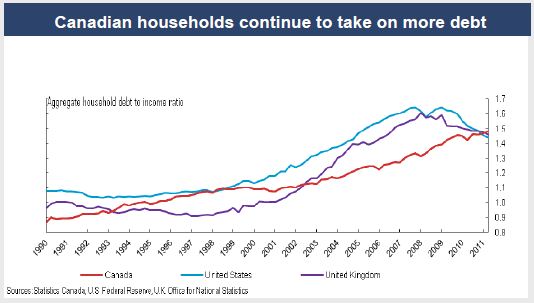
The books are still being written on the causes and effects of the recent recession, but one wide-spread agreement is that aggregate household debt, and particularly the ratio of debt to household income, has been a real problem for developed nations. In the U.S., this ratio hit between 1.6 and 1.7 at the onset of the recession, and then fell to about 1.4 today. In the U.K., the ratio topped out at just under 1.6 in late 2007, and is now down under 1.5. Given the flat-lining of household incomes in the two countries, this constitutes a very significant pay-down in household debt. Note that for most of the 1990’s, this ratio hovered between 1.0 and 1.1 in the U.S., and between 0.9 and 1.0 in the U.K. It wasn’t until the easy money period of the late 1990’s that these ratios started soaring. (In the U.S., this was a gradual rise, really starting about 1990. In the U.K., the rise was more abrupt, beginning about 2001.)
Now we har that our neighbors to the north are trying to copy our bad behaviors. In 1990, the typical Canadian household had a debt/income ratio of about 0.9. This gradually rose to about 1.1 by the late 1990’s, then hovered there for a few years. Over the past 10 years, the Canadian debt ratio has continuously grown, with no “peak” in the early days of the recession, and now sits at about 1.5.
courtesy RICS Global Real Estate Weekly
Share this:

Housing News
I was just at a luncheon (sponsored by the local chapter of the Appraisal Institute) on apartments. One of the speakers noted that a real problem in doing adequate analysis was getting a handle on the single-family housing market — the data simply stinks due to the foreclosure mess, the number of homes being turned into rentals, etc. Thus, as we try to ALSO project the future of the homebuilding industry (really down for the count the last few years), that same dirty-data problem is a real issue.
That aside, the National Association of Homebuilders released a report today noting that the NAHB/Wells Fargo Housing Market Index rose in February for the fifth consecutive month. As I discussed back in November (click here for a link) this index attempt to project home sales based on model home traffic, customer inquiries, and such. Even though the over all stock market was down today, this news sent homebuilder prices higher — indeed, Beazer Homes (BZH) rose by 3.1%, albeit to just over $3/share.
NAHB’s Chief Economist David Crowe said, “this is the longest period of sustained improvement we have seen in the HMI since 2007.” Great news for homebuilders — we hope it stays this way. For a full copy of the article, on Fox Business News, click here.
Share this:
Marcus & Millichap’s Apartment Report
Of the major commercial real estate brokerage firms, Marcus and Millichap seem to consistently do the best job of thoughtful and insightful research. We track their work regularly here at Greenfield. Their 2012 Apartment Report just hit our desks, and it follows our expectations of excellent work on their part.
courtesy Marcus & Millichap
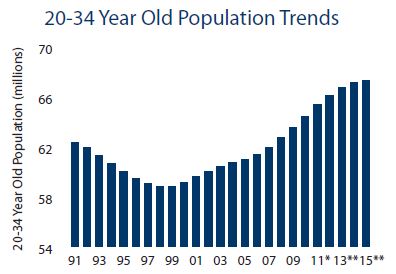
The apartment sector is rebounding nicely, but because of the intersection of favorable demographics and unfavorable economics. It’s driven by pent-up demand among “prime renters” (young adults who want to “unbundle” from parents and roommates) who would potentially have become homeowners a few years ago. Development had been stagnant for a few years, leaving the market with a potential shortage in supply. Developers, lenders, and investors had a brief pause late last year, but M&M expects to see steady additions to supply over the next three years.

courtesy Marcus & Millichap
As a result of all of this, vacancy rates are trending downward, and are expected to hit 5% this year (down from a peak of about 8% in 2009). This has the effect of driving up rents to historically high levels, even after a net decline from 2008 to 2009. With all this, apartment transactions are back up to pre-2009 levels, while the average price per unit is now topping $90,000 (up nearly to the peak of 2006) and cap rates are down in the 6.5% range (still off the trough of about 5.5% seen in the 2006-2006 period).

- courtesy Marcus & Millichap

The surprising upshot of all of this is that apartment cap rates are still at record high spreads over the 10-year Treasury long-term average. Market participants got nervous back in the 2006 period, when the spread had shrunk to 90 basis points (from a more “normal” rage of 380 to 430 basis points experienced since the S&L crisis 15 years earlier). Today, the spread is at 460 basis points, reflecting a bit of continued risk-aversion on the part of market participants, along with historic low rates on treasuries.
Share this:

Proposals for fixing housing
John K. McIlwain is the Senior Resident Fellow/J. Ronald Terwilliger Chair for Housing at the Urban Land Institute (ULI) in Washington, D.C. I don’t necessarily agree with everything he says, but he stimulates some interesting thinking in a piece this week titled “Fixing the Housing Markets: Three Proposals“. (click on the title to link to the article itself.)
In summary, he proposes:
1. Renting federally held REO
2. Creating a mortgage interest credit
3. Divide mortgages for underwater homeowners into a “paying” first and a “delayed” second.
He admits that in the current political climate, none of the above stands a ghost of a chance (nor would any other solution, good or bad), but even though I might disagree with some of what he says, I’m a firm believer in the old In Search of Excellence adage: ready, shoot, aim. Really excellent organizations (and government entities — which are rarely even CLOSE to achieving excellence) have a proclivity for doing SOMETHING. The Marine Corps calls it the “70% solution”, which dictates that you attack as soon as you think you have 70% of the information needed for success. Why not 100%? Because fate favors the side with the initiative and momentum, that’s why.
So, please indulge me for a moment to comment on McIlwain’s proposals, but DON’T take my criticism as an indication that I wouldn’t vote in favor of doing exactly what he proposes, because in the current climate, a half-good idea is probably better than no idea at all.
1. Rent federally held REO — Well, even McIlwain admits (or at least implies) that the government is a terrible landlord, so he would propose turning this over to the private sector via pools of “privatized” REOs. What he’s essentially saying is to sell these REO’s (currently about 250,000, and expected to grow to a million) to investors with the caveats that they be held off the market as rentals for a period of time, AND that there be adequate maintenance to keep them from turning into slums.
My ONE disagreement with this is that less government involvement is usually better than MORE. Plenty of investors stand ready to buy REOs right now, and the resale market is sufficiently poor that these investors recognize they have to be in it for the long haul. Local planning ordinances are usually adequate vis-a-vis slum prevention IF they are enforced properly (as is not always the case). There is no reason to believe that additional Federal caveats would improve the situation. In short, this is actually being accomplished already, and deserves facilitation by the government, not regulation.
2. Mortgage interest credit — McIlwain notes, and we concur, that the current mortgage interest deduction benefits taxpayers earning over $100,000, but hardly those earning less. He suggests replacing this with a flat 15% tax credit, which would have the double-barrelled effect of raising the effective tax rate on those earning over the 15% marginal break-point, but directly benefitting dollar-for-dollar those below that break point. It’s an intriguing idea, but would require the Realtors’ and Mortgage Bankers’ buy-in. In today’s troubled market, it’s difficult to see how they would agree to anything that tinkers with the status quo.
3. Divide mortgages for underwater homeowners into a “paying” first and a “delayed” second. As much as I like this one on the surface, it ONLY works for homeowners who plan to stay in their houses until prices rise (on average) about 20%. We don’t see that happening for quite a few years, so this essentially just kicks the can down the road a bit. Even that, though, is an improvement over the status quo, and keeps homeowners in their homes for the time being. The real problem, of course, is how to deal with the “delayed” paper on banks books.
In short, McIlwain’s proposals at least stimulate some conversation about solutions for the terrific vacant REO problem. One big issue is lack of credit for suitable property managers — banks are loathe to loan on “second” homes today, and investment property (REOs turned into rental homes) is a troublesome loan to get. I would propose that the agencies/banks holding paper on vacant homes simply privatize it immediately — if a bank holds a $100,000 loan on a vacant house, then a reasonably creditworthy investor who is willing to start amortizing that loan should be able to walk in, pick up the keys, and walk out the door. Sure, this would violate all sorts of down-payment caveats in place right now, but it would get interest payments moving again, provide much-needed rental housing, and get some local entrepreneurs busy managing otherwise dead assets.
Share this:
S&P Case Shiller Index
There are two important house price indices in the U.S. — the Federal Housing Finance Authority index (which can be localized down to the SMSA level) and the S&P Case Shiller Index. The latter actually pre-dates the former, and was the source of data for co-founder Robert Shiller (yes, the Nobel Laureate) making his “housing bubble” cries in the wilderness a half-decade ago. If for no other reason, we pay homage to this report, which hit our desks this morning. Additionally, the FHFA index and the C-S index measure house prices somewhat differently, so at a localized level the two indices may say somewhat different things. Here at Greenfield, we often have to cobble together an index for a market that is smaller than an SMSA. Using these two indices in tandem, a researcher is able to discern more subtle issues in a local market. Hence, keeping up with house prices really requires both rather than one or the other.
Bottom line? For the most recent analysis period (October-November, 2011), both their 10-city and 20-city composites showed price declines of 1.3%, and for the second consecutive month, 19 of the 20 cities tracked showed declines. Further, the 10-city and 20-city indices showed annual returns of negative 3.6% and negative 3.7% respectively. Worst city? Atlanta, with a negative 11.8% annual return. The only two cities with positive annual returns were Detroit (+3.8%) and Washington, DC (+0.5%).
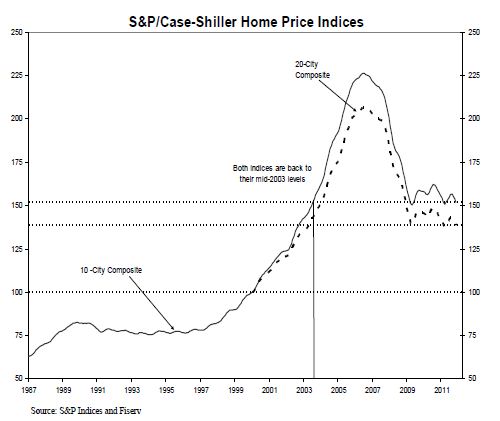 Our own research here at Greenfield suggests that the current “bottom fishing” on house prices will probably sustain until there is some equilibrium in the home ownership rates. One might argue that the stagnation in house prices is indelibly linked to over-supply (the “shadow” inventory in the U.S. equals about a year and a half of sales) and the lack of demand (which is tied to the unemployment rate). Nonetheless, thirty years ago, when interest rates were double what they are today, and the unemployment rate in the U.S. was about the same, home prices were strong and stable.
Why is today different? Three things — first, the home price bubble was caused by the home ownership rate bubble. Until home ownership rates get back to a sustainable level, home prices won’t start behaving. (What is behaving, you might ask? Historically, before the bubble, home prices track very nicely against household income, which means they’re a great inflation hedge.) Second, the recent collapse in home prices has taken the bloom off the rose, so to speak, as American households have lost faith in the “home” as a store-house of value. Finally, the low-down-payment loan was one of the most notable victims of the housing collapse (unfairly, we might add). As such, “starter” home sales are moribund (just look at new home sales for the clue to this one) and if “starter” homes can’t be sold, then “move up” homes can’t be bought.
I hate to be the bearer of bad tidings on a cold, winter day. (Irony — the northwestern U.S., where I live, is the ONLY part of the country not facing unseasonably warm weather this winter.) Unfortunately, housing is just going to limp along for a while.



 From a small northwestern observatory...