Archive for the ‘Valuation’ Category
Real Estate Portfolio Choices
Thanks to my friends at PERENEWS.com for bringing this to my attention. It’s a fascinating story about how two funds can make subtly different choices about real estate investments and end up in two different places.
The two funds are CalPERS and CalSTRS, two of the largest pension funds in America. For those of you not familiar with them, CalPERS is the California Public Employees Retirement System, and CalSTRS is the separate California teachers system. As of March 31, 2012, CalPERS had $237.6 Billion under management, with $21.8 Billion (9.2%) of that in real estate. As of May 31, 2012, (they have slightly different reporting dates) CalSTRS had $146.8 Billion under management, with $21.2 Billion (14.5%) in real estate.
Ironically, both pension funds underperformed their own targets for the year ending June 30, and yet for both of them, real estate was their best performing asset class. Both funds have put emphasis on core, income-producing properties. CalSTRS, however, despite having a fairly good real estate year (9.2% overall return), underperformed their real estate benchmark (the NCREIF Property Index) by a full 4.2 percentage points. Notably, CalSTRS had a much higher return in the 2010-2011 period, enjoying a 17.5% overall real estate return.
CalPERS, on the other hand, enjoyed a 15.9% return, outperforming their goals by 3 percentage points. This represents a much higher return than 2010-2011, when they marked a 10.2% gain, and very much a rebound from their disasterous 37.1% loss in 2009-2010.
Notably, neither fund did poorly this year — there is nothing about CalSTRS 9.2% overall return to scoff at. But, why does CalPERS continue to trend upward while CalSTRS is underperforming? Is there something key to this difference that we should be noting and learning?
Intriguingly, CalPERS devotes more of its attention to core properties — currently at 70% with a goal of 75%. CalSTRS, on the other hand, is evenly split between core and opportunistic. Also, CalPERS is underallocated to real estate and is in a position to make significant core investments, while CalSTRS is overallocated, and is trying to get from 14.5% down to 12% by selling existing opportunistic holdings, likely at a loss. Additionally, CalPERS was aggressive in taking write-downs during the painful 2009-2010 season, but CalSTRS was not, and is thus still feeling the pain.
Finally, CalPERS was quick to move into core assets after the global financial crisis, allowing it to buy quality assets at bargain-basement prices. CalSTRS was not so quick to move, and thus waited until cap rates compressed.
Lessons to be learned? Obviously, in hindsight, cleaning up the messy books and moving forward was a smart thing for CalPERS to do. It gave them the freedom to move forward and take advantage of opportunities. Looking forward, there is clearly a sense that allocation is key.
However, the bigger picture is that two of the nation’s largest investment funds have a major committment to real estate, aiming for 10% and 12% allocations respectively. The fund that is in the accumulation side (growing from 9% up to 10%) is the one making the most money, because it can take advantage of buying opportunities in core assets. The fund that is selling is the underperformer, albeit probably for reasons other than just capital losses on sales.
Share this:

International Financial Reporting Standards
I know I’m sounding like an overly technical geek on these subjects, but as we know from the recent (current?) economic malaise, seemingly back-page issues can have major impacts on large segments of the economy.
Buried deep inside Friday’s issue of the Wall Street Journal (OK, page C1, but that’s pretty deep) was news that the SEC will once again delay implementation of the International Financial Reporting Standards (“IFRS”) for U.S. regulated businesses (from a practical standpoint, essentially all of them). For those who aren’t up on their accounting theory, U.S. accounting standards — generally referred to as “Generally Accepted Accounting Practices” or “GAAP” for short — have been developed over time from essentially three sources: “best practices” which have evolved literally over the centuries, pronouncements of the Financial Accounting Standards Board, or “FASB”, and its predecessors, and adaptations to conform with U.S. tax practice. IFSR is more of a top-down approach, and governs accounting practices pretty much anywhere in the developed world EXCEPT for the U.S. (One might argue, and with some validity, that recent accounting problems among Chinese businesses reveal real problem with IFRS compliance, and one wouldn’t be altogether wrong. That’s a topic for a different day, though.)
American businesses dealing in global commerce (as nearly all big ones do, now-a-days) have been anxious for a unifying accounting paradigm for many years. Indeed, the differences between IFRS and GAAP are significant, and in fact adoption of IFRS in the U.S. may cost many businesses quite a bit in tax penalties, since IFRS doesn’t recognize certain tax avoidance strategies (e.g. — last-in-first-out inventory accounting) that are common in the U.S. Nonetheless, American businesses are willing to suffer the tax pain in order to get a common accounting language globally.
From an accounting perspective, this delay by the SEC is a royal pain in the neck, but that too is a topic for another day. The reason I bring it up today is the implicit impact on real estate appraisal standards. I’ve noted, with some interest, that appraisal standards are increasingly derivative of accounting practices. Back when America’s Uniform Standards of Professional Appraisal Practice (“USPAP”) was developed, accountants could barely care about appraisal standards. Today, a close examination of the International Valuation Standards Council (IVS) reveals a substantial degree of input from the accounting and banking fields, much more than we saw 25-ish years ago when USPAP was first codified.
In my own observation, this SEC delay gives the appraisal profession another year or so to decide if they want a top-down or bottoms-up approach to appraisal standards in the U.S. Do appraisers want to be driving the truck or riding in the back? I’ve observed that the three constituent “regulatory” bodies (the professional organizations, such as the Appraisal Institute and RICS, the Appraisal Foundation, and the state and federal regulators) seem to be of three different minds on the subject. The constituent bodies seem to be more proactive and ready to move forward with IVS adoption. The Foundation seems to have been constantly playing damage control in the past couple of years over the mortgage market meltdown and the resultant sturm-and-drang from the Federal regulatory bodies. None of those regulatory bodies seemed to have a dog in this hunt, so haven’t appeared to care. I will say, however, that proposed changes to USPAP 2014, which are currently being circulated in draft form, are very forward-looking, albeit with baby steps.
Finally, state regulators are almost 100% reactive. Some are very good at reacting, and some are very bad. Currently, they are all overwhelmed with the double-whammy of very real budget cuts and very real appraisal standards violations problems emanating from the mortgage market meltdown. As such, a major paradigm shift in appraisal standards will be difficult for them to swallow.
This all seems to be back-page stuff, but in fact these issues have very real implications for the way “business does business”, particularly in the real estate valuation world. We’ll keep you posted.
Share this:
State of Alaska v Wold, take 2
I’ve received an amazing amount of response on this post! Several of you have requested copies of the ruling, and others have asked that it be posted here on the blog. So, here ’tis:
Enjoy!
Share this:
State of Alaska v. Wold
On Friday, the Alaska State Supreme Court issued a ruling on an appraisal standards case which is already having national — even international — implications. (I’ve already received e-mails from as far away as Australia about this!).
To synopsize, I was the testifying expert on appraisal standards for Wold’s attorneys. For a couple of decades, Wold has been a successful and highly respected appraiser, real estate expert, and investor in Ketchikan, Alaska. Back in the 1990’s, he testified on a pair of court cases, and the opposing expert in one of the cases was a member of the Alaska Appraisal Licensing Board. (You can see where this is going, right?) The Board filed a number of charges against Wold, and as is usual in such matters, the charges went before an Administrative Law Judge. The Board did not accept the Judge’s findings, and decided to adjudicate the case themselves. (You CAN see where this is going, right?). The Board found against Wold on all 8 charges and Wold naturally appealed to the District Court. That Court not only overturned 7 of the 8 charges, but ordered the Board to reimburse half of Wold’s fairly significant legal fees. Wold appealed the 8th charge to the State Supreme Court, which not only handed Wold a decisive victory (in the only USPAP case ever heard by that Court) but also remanded the case to the lower court for consideration of reimbursement of the REST of Wold’s legal fees.
As the testifying expert who advised Wold’s attorneys, I’m naturally pleased at the outcome. That having been said, I’m concerned about the bigger picture. Appraisal licensing boards around the country have a record number of complaints filed against appraisers today, and in many of these matters, sifting through the truth as opposed to the fiction is an increasing challenge. Clearly, some appraisal mistakes were made in the recent housing finance debacle, not to mention appraisal review and underwriting. The job now is understanding when and how those mistakes were made, and approaching these matters objectively, credibly, and in an unbiased fashion.
Share this:
American Real Estate Society annual meetings
ARES is one of the two primary real estate academic organizations in the U.S. (The other is the American Real Estate and Urban Economics Association, “AREUEA”). While most real estate academics are members of both, ARES also attracts a significant number of practitioners (typically ex-professors who are now in the consulting or investments business) plus has a great relationship with such practitioner organizations as the Appraisal Institute and the Royal institution of Chartered Surveyors. ARES publishes several of the top real estate academic journals, including the Journal of Real Estate Research (for which I’m a reviewer), the Journal of Real Estate Literature, the Journal of Real Estate Practice and Education, the Journal of Real Estate Portfolio Management, the Journal of Housing Research, and the Journal of Sustainable Real Estate (for which I’m on the editorial board).
ARES holds its annual meeting in April, usually in a coastal city on alternating sides of the US. This year’s meeting was last week at St. Pete Beach, Florida (an island just off the St. Petersburg coast), and we believe we set a record for attendance at a real estate academic conference. Several hundred working papers and panel presentations dominated the program, along with sessions featuring research from doctoral students, and a well-attended, day-long “Critical Issues Seminar” on Wednesday co-sponsored by the Appraisal Institute and the CCIM Institute.
I presented papers in sessions, including one I chaired (“Real Estate Cycles”) and participated in an excellent panel discussion on Friday on “Real Estate Failure”, chaired by my good friend Dr. Gordon Brown of Space Analytics (and featuring Dr. Larry Wofford of U. Tulsa, Dr. Richard Peiser of Harvard, and myself).
I’m still digesting the huge volume of intellectual content that came out of ARES, and I’ll probably discuss some of these papers in future blog posts. More later!
Share this:
Real Estate Marketing Focus
I’ve observed over the years that real estate investors, developers, and such try to aim for the “middle”. It’s a defensive strategy. Lots of community shopping centers got built before the recession hit, not because they were hot or trendy or even hugely profitable, but because they were generally considered to be “safe”. The same was true with single family subdivisions, all of which looked pretty much alike by 2006. Lots of “average” apartments were built, Class B to B+ office buildings (some of which marketed themselves at Class A, but could get away with that only because of demand), and plain, vanilla warehouses were added to the real estate stock.
Now that we’re (hopefully!) coming out of a recession, it may be a good time to dust off some basic truths about business in general as it applies to real estate. Sure, there’s a very strong temptation to rush to the middle again, and in the case of apartments (for which there is a demonstrably strong demand right now), that may not be a bad idea. Nonetheless, I recall one of the great pieces of advice from Peters and Waterman’s In Search of Excellence: “average” firms achieve mediocre results. The same is frequently true in real estate.
Case in point — there was a great article on page B1 of the Wall Street Journal yesterday titled “The Malaise Afflicting America’s Malls”. by WSJ’s Kris Hudson. (There’s a link to the on-line version of the article on the WSJ Blog.) Using Denver, Colorado, as an example, they note how the “high end” mall (Cherry Creek Shopping Center), with such tenants as Tiffany and Neiman Marcus is enjoying sales of $760/SF. At the other end of the spectrum, Belmar and the Town Center at Aurora are suffering with $300/SF sales from lower-end tenants. Other malls in Denver are shut-down or being demolished and redeveloped. For SOME consumers and SOME kinds of products, in-person shopping is still the normal. It’s hard to imagine buying a truck load of lumber from Home Depot on-line (and Home Depot has done very well the past few years), although even they have a well-functioning web presence for a variety of non-urgent, easily shipped items.
I noted recently that some private book sellers are actually doing well in this market, and have partnered with Amazon to have a global presence. (We buy a LOT of books at Casa d’Kilpatrick, and nearly all of them come from private booksellers VIA Amazon’s web site.) On the other hand, it’s hard to imagine buying couture fashion over the web. Intriguingly, Blue Nile, the internet-based jeweler, notes that their web-sales sales last year (leading up to Christmas) were great at the both ends of the spectrum, but lousy in the middle. Stores like Dollar General, who aim for a segment of the market below Wal Mart, have done quite well in this recession (the stock has nearly doubled in price in the past two years). Ironically, Wal Mart, which is increasingly being viewed as a middle-market generalist retailer, hasn’t fared as well. Target, which seems to aim for the middle of the middle of the middle, has seen it’s stock price flat as a pancake for the past two years, and Sears, the butt of so many Tim Allen jokes, is trading at about half of where it was two years ago. These lessons are being lost on some retail developers, but being heeded by others. Guess who will come out on top?
So, who needs offices, warehouses, and other commercial real estate? Businesses at the top, middle, or bottom? If we follow the adages of Peters and Waterman, we’ll expect the best growth — and hence the most sustained rents — at the top and bottom of the spectrum. (Indeed, even in apartments, one might build a great case that the best demand today is at the low end and high end). However, we’re willing to bet that developers will aim for the middle, as always.
Share this:
Latest from S&P Case Shiller
The always excellent S&P Case Shiller report came out this morning, followed by a teleconference with Professors Carl Case and Bob Shiller. First, some highlights from the report, then some blurbs from the teleconference.
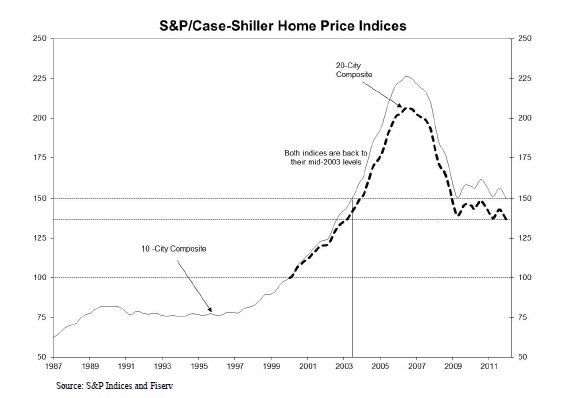 The average home prices in the U.S. are hovering around record lows as measured from their peaks in December, 2006, and have been bounding around 2003 prices for about 3 years. Overall in 2011, prices were down about 4% nationwide, and in the 20 leading cities in the U.S., the yearly price trends ranged from a low of -12.8% in Atlanta to a high (if you can call it that) of 0.5% in (amazingly enough) Detroit, which was the only major city to record positive numbers last year. In December, only Phoenix and Miami were on up-tics.
 One thing struck me as a bit foreboding in the report. While housing doesn’t behave like securitized assets, housing markets are, in fact, influenced by many of the same forces. Historically, one of the big differences was that house prices were always believed to trend positively in the long run, so “bear” markets didn’t really exist in housing. (More on that in a minute). With that in mind, though, w-a-a-y back in my Wall Street days (a LONG time ago!), technical traders — as they were known back then — would have recognized the pricing behavior over the past few quarters as a “head-and-shoulders” pattern. It was the mark of a stock price that kept trying to burst through a resistance level, but couldn’t sustain the momentum. After three such tries, it would collapse due to lack of buyers. I look at the house price performance, and… well… one has to wonder…
As for the teleconference, the catch-phrase was “nervous but hopeful”. There was much ado about recent positive news from the NAHB/Wells Fargo Housing Market Index (refer to my comments about this on February 15 by clicking here.) The HMI tracks buyer interest, among other things, but the folks at S&P C-S were a bit cautious, noting that sales data doesn’t seem to be responding yet.
There are important macro-economic implications for all of this. The housing market is the primary tool for the FED to exert economic pressure via interest rates. Historically (and C-S goes back 60 or so years for this), housing starts in America hover around 1 million to 1.5 million per year. If the economy gets overheated, then interest rates can be allowed to rise, and this number would drop BRIEFLY to around 800,000, then bounce back up. However, housing starts have now hovered below 700,000/year every month for the past 40 months, with little let-up in sight.
Existing home sales are, in fact, trending up a bit, but part of this comes from the fact that in California and Florida, two of the hardest-hit states, we find fully 1/3 of the entire nation’s aggregate home values. The demographics in these two states are very different from the rest of the nation — mainly older homeowners who can afford now to trade up.
An additional concern comes from the Census Bureau. Note that for most of recent history, household formation in the U.S. rose from 1 million to 1.5 million per year (note the parallel to housing starts?). However, from March, 2010, to March, 2011, households actually SHRANK. Fortunately, this number seems to be correcting itself, and about 2 million new households were formed between March, 2011, and the end of the year. C-S note that this is a VERY “noisy” number and subject to correction. However, the arrows may be pointed in the right direction again.
Pricing still reflects the huge shadow inventory, but NAR reports that the actual “For Sale” inventory is around normal levels again (about a 6-month supply). So, what’s holding the housing market back? Getting a mortgage is very difficult today without perfect credit — the private mortgage insurance market has completely disappeared. Unemployment is still a problem, and particularly the contagious fear that permeates the populus. Finally, some economists fear that there may actually be a permanent shift in the U.S. market attitude toward housing. Historically, Americans thought that home prices would continuously rise, and hence a home investment was a secure store of value. That attitude may have permanently been damaged.
“Nervous, but hopeful”
Share this:

U.S. housing market — good news and bad
The good news, such that it is — home sales are inching up — a 0.7% rise in January from the previous January.
Now, for the bad news — the median home price in America, measured on a January-to-January basis, just hit its lowest point in 10 years, according to a recent announcement from the National Association of Realtors. Indeed, 35% of home sales were “distress sales”, driving the median home price down to $154,000.

- graphic courtesy CNN-Money

This represents a 6.9% price decline from 2011, and a drop of 29.4% since the peak in 2007.
Share this:

S&P Case Shiller Index
There are two important house price indices in the U.S. — the Federal Housing Finance Authority index (which can be localized down to the SMSA level) and the S&P Case Shiller Index. The latter actually pre-dates the former, and was the source of data for co-founder Robert Shiller (yes, the Nobel Laureate) making his “housing bubble” cries in the wilderness a half-decade ago. If for no other reason, we pay homage to this report, which hit our desks this morning. Additionally, the FHFA index and the C-S index measure house prices somewhat differently, so at a localized level the two indices may say somewhat different things. Here at Greenfield, we often have to cobble together an index for a market that is smaller than an SMSA. Using these two indices in tandem, a researcher is able to discern more subtle issues in a local market. Hence, keeping up with house prices really requires both rather than one or the other.
Bottom line? For the most recent analysis period (October-November, 2011), both their 10-city and 20-city composites showed price declines of 1.3%, and for the second consecutive month, 19 of the 20 cities tracked showed declines. Further, the 10-city and 20-city indices showed annual returns of negative 3.6% and negative 3.7% respectively. Worst city? Atlanta, with a negative 11.8% annual return. The only two cities with positive annual returns were Detroit (+3.8%) and Washington, DC (+0.5%).
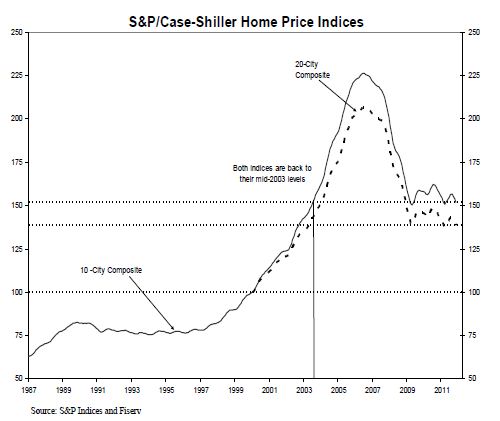 Our own research here at Greenfield suggests that the current “bottom fishing” on house prices will probably sustain until there is some equilibrium in the home ownership rates. One might argue that the stagnation in house prices is indelibly linked to over-supply (the “shadow” inventory in the U.S. equals about a year and a half of sales) and the lack of demand (which is tied to the unemployment rate). Nonetheless, thirty years ago, when interest rates were double what they are today, and the unemployment rate in the U.S. was about the same, home prices were strong and stable.
Why is today different? Three things — first, the home price bubble was caused by the home ownership rate bubble. Until home ownership rates get back to a sustainable level, home prices won’t start behaving. (What is behaving, you might ask? Historically, before the bubble, home prices track very nicely against household income, which means they’re a great inflation hedge.) Second, the recent collapse in home prices has taken the bloom off the rose, so to speak, as American households have lost faith in the “home” as a store-house of value. Finally, the low-down-payment loan was one of the most notable victims of the housing collapse (unfairly, we might add). As such, “starter” home sales are moribund (just look at new home sales for the clue to this one) and if “starter” homes can’t be sold, then “move up” homes can’t be bought.
I hate to be the bearer of bad tidings on a cold, winter day. (Irony — the northwestern U.S., where I live, is the ONLY part of the country not facing unseasonably warm weather this winter.) Unfortunately, housing is just going to limp along for a while.
Share this:

Global R.E. Perspective
The Royal Institution of Chartered Surveyors (RICS, for short), with over 100,000 members throughout the world, is the largest real estate organization of its type. Their quarterly Global Property Survey gives a great snap-shot into the world-wide investment market. (Full disclosure — I’m a Fellow of the RICS Faculty of Valuation, and a contributor to this survey.)
The headline really captures the big picture — Weaker economic picture takes its toll on real estate sentiment. Not every region feels the same pain — Canada, Brazil, Russia, China, and others continue to buck the trend and record positive net balance readings. Nonetheless, in some of the most economically significant regions, at least from an investment perspective, expectations continue to be weak. Obvious problem areas are the troubled spots in the Euro zone, but negative expectations are also reported in the U.S., India, Singapore, the U.K., Scandinavia, and Switzerland (among others). However, despite a weak real estate market, investment demand is expected to grow in the U.S. and even in the Republic of Ireland, which is one of the Euro trouble-spots. China, despite value-growth expectations, is among the weakest regions of those expecting positive investment growth, behind South Africa in total investment expectations.
One of the more telling studies compares expectations of demand for commercial space and expectations of available space. Among major markets, only Canada, Poland, Russia, and Hong Kong expect meaningful decreases in supply coupled with increases in demand. Not unexpectedly, most of the trouble-spots reflect increases in supply significantly outstripping increases in demand, with the most notable gaps expected in the UAE, the Euro trouble spots (plus, interestingly, the Netherlands, France, Scandinavia, and Switzerland), India, and the U.K. Expectations for the U.S., China, Brazil, Hungary, Japan, and Thailand all appear healthy, with increases in demand expected to exceed increases in supply.
The survey is available on the RICS website, which you can access by clicking here.


 From a small northwestern observatory...