Archive for the ‘Real Estate Investments’ Category
Proposals for fixing housing
John K. McIlwain is the Senior Resident Fellow/J. Ronald Terwilliger Chair for Housing at the Urban Land Institute (ULI) in Washington, D.C. I don’t necessarily agree with everything he says, but he stimulates some interesting thinking in a piece this week titled “Fixing the Housing Markets: Three Proposals“. (click on the title to link to the article itself.)
In summary, he proposes:
1. Renting federally held REO
2. Creating a mortgage interest credit
3. Divide mortgages for underwater homeowners into a “paying” first and a “delayed” second.
He admits that in the current political climate, none of the above stands a ghost of a chance (nor would any other solution, good or bad), but even though I might disagree with some of what he says, I’m a firm believer in the old In Search of Excellence adage: ready, shoot, aim. Really excellent organizations (and government entities — which are rarely even CLOSE to achieving excellence) have a proclivity for doing SOMETHING. The Marine Corps calls it the “70% solution”, which dictates that you attack as soon as you think you have 70% of the information needed for success. Why not 100%? Because fate favors the side with the initiative and momentum, that’s why.
So, please indulge me for a moment to comment on McIlwain’s proposals, but DON’T take my criticism as an indication that I wouldn’t vote in favor of doing exactly what he proposes, because in the current climate, a half-good idea is probably better than no idea at all.
1. Rent federally held REO — Well, even McIlwain admits (or at least implies) that the government is a terrible landlord, so he would propose turning this over to the private sector via pools of “privatized” REOs. What he’s essentially saying is to sell these REO’s (currently about 250,000, and expected to grow to a million) to investors with the caveats that they be held off the market as rentals for a period of time, AND that there be adequate maintenance to keep them from turning into slums.
My ONE disagreement with this is that less government involvement is usually better than MORE. Plenty of investors stand ready to buy REOs right now, and the resale market is sufficiently poor that these investors recognize they have to be in it for the long haul. Local planning ordinances are usually adequate vis-a-vis slum prevention IF they are enforced properly (as is not always the case). There is no reason to believe that additional Federal caveats would improve the situation. In short, this is actually being accomplished already, and deserves facilitation by the government, not regulation.
2. Mortgage interest credit — McIlwain notes, and we concur, that the current mortgage interest deduction benefits taxpayers earning over $100,000, but hardly those earning less. He suggests replacing this with a flat 15% tax credit, which would have the double-barrelled effect of raising the effective tax rate on those earning over the 15% marginal break-point, but directly benefitting dollar-for-dollar those below that break point. It’s an intriguing idea, but would require the Realtors’ and Mortgage Bankers’ buy-in. In today’s troubled market, it’s difficult to see how they would agree to anything that tinkers with the status quo.
3. Divide mortgages for underwater homeowners into a “paying” first and a “delayed” second. As much as I like this one on the surface, it ONLY works for homeowners who plan to stay in their houses until prices rise (on average) about 20%. We don’t see that happening for quite a few years, so this essentially just kicks the can down the road a bit. Even that, though, is an improvement over the status quo, and keeps homeowners in their homes for the time being. The real problem, of course, is how to deal with the “delayed” paper on banks books.
In short, McIlwain’s proposals at least stimulate some conversation about solutions for the terrific vacant REO problem. One big issue is lack of credit for suitable property managers — banks are loathe to loan on “second” homes today, and investment property (REOs turned into rental homes) is a troublesome loan to get. I would propose that the agencies/banks holding paper on vacant homes simply privatize it immediately — if a bank holds a $100,000 loan on a vacant house, then a reasonably creditworthy investor who is willing to start amortizing that loan should be able to walk in, pick up the keys, and walk out the door. Sure, this would violate all sorts of down-payment caveats in place right now, but it would get interest payments moving again, provide much-needed rental housing, and get some local entrepreneurs busy managing otherwise dead assets.
Share this:

Global R.E. Perspective
The Royal Institution of Chartered Surveyors (RICS, for short), with over 100,000 members throughout the world, is the largest real estate organization of its type. Their quarterly Global Property Survey gives a great snap-shot into the world-wide investment market. (Full disclosure — I’m a Fellow of the RICS Faculty of Valuation, and a contributor to this survey.)
The headline really captures the big picture — Weaker economic picture takes its toll on real estate sentiment. Not every region feels the same pain — Canada, Brazil, Russia, China, and others continue to buck the trend and record positive net balance readings. Nonetheless, in some of the most economically significant regions, at least from an investment perspective, expectations continue to be weak. Obvious problem areas are the troubled spots in the Euro zone, but negative expectations are also reported in the U.S., India, Singapore, the U.K., Scandinavia, and Switzerland (among others). However, despite a weak real estate market, investment demand is expected to grow in the U.S. and even in the Republic of Ireland, which is one of the Euro trouble-spots. China, despite value-growth expectations, is among the weakest regions of those expecting positive investment growth, behind South Africa in total investment expectations.
One of the more telling studies compares expectations of demand for commercial space and expectations of available space. Among major markets, only Canada, Poland, Russia, and Hong Kong expect meaningful decreases in supply coupled with increases in demand. Not unexpectedly, most of the trouble-spots reflect increases in supply significantly outstripping increases in demand, with the most notable gaps expected in the UAE, the Euro trouble spots (plus, interestingly, the Netherlands, France, Scandinavia, and Switzerland), India, and the U.K. Expectations for the U.S., China, Brazil, Hungary, Japan, and Thailand all appear healthy, with increases in demand expected to exceed increases in supply.
The survey is available on the RICS website, which you can access by clicking here.
Share this:
Korpacz Survey
The quarterly PriceWaterhouse Cooper’s real estate survey is now known as the PWC Real Estate Investor Survey. However, those of us who have used and trusted it for so many years will always think of it as the Korpacz Survey, named after its founder Peter Korpacz, MAI, and former active member of the Real Estate Counseling Group of America. The latest issue (4th Quarter, 2012) just hit my desk, and as always, it’s a great snap-shot into the current thinking of real estate investors in the U.S.
The headline pretty much says it all, “Buying beyond core remains tricky.” The principle problem is the protracted recovery. Investors are still attracted to core assets for the yield, but are skittish on anything not bought for income. Particularly favored are community shopping centers with grocery anchors, apartments, offices in tech centers, and port-oriented industrial.
However, a growing number of investors are looking at secondary markets, but expecting returns that are a “multiple of core deals.” Part of the challenge here is bank underwriting standards, which can really hinge on the finer points of a deal.
Among investment sub-sectors, cap rates have declined across the board this past quarter, with the exception of warehouse (+4) and flex/R&D (+3). The most notable decline was in the net lease sub-sector (-54 points). Apartments continue to “lead” with the lowest overall cap rate of 5.8% (down another 18 basis points from the previous survey).
Not withstanding my comments about the the survey’s founder, Susan Smith, the Director of Real Estate Business Advisory Services at PwC, does a great job putting this survey together every quarter. The quality and quantity of information continues to grow, and its usefulness to real estate decision makers cannot be over-stressed. For more information, or to subscribe to the survey, visit pwc.com.
Share this:
And a bit more about Archstone
Private Equity Real Estate reports this morning that the Estate of Lehman is challenging Equity Residential’s proposed acquisition of BofA’s 26.5% stake with protests to the Securities Exchange Commissions.
PERE reports that Lehman, which owns 47% of Archstone and serves as manager (the remainder is owned by Barclays) had filed a plan to emerge from Chapter 11 by paying $65 Billion to pay creditors, who hold about $450 Billion in claims. Selling Archstone (they actually proposed an IPO) would have helped raise this sum (Lehman currently only has about $23 Billion), but Sam Zell’s move has left this idea hanging out to dry.
It’s going to be fun to watch. We’ll keep you posted.
Share this:
Lehman back in the news
This is really an update to my recent post about BofA and Sam Zell’s acquisition of Archstone (http://wp.me/pqerO-7k). As it turns out, the remnants of Lehman had HOPED to do an IPO on Archstone, something that BofA and Barclays had opposed. Now, with Zell’s acquisition of BofA’s share, he has both put a stake in the heart of that hope, but also set a value for the assets at about $16 Billion. Given the convoluted ownership structure of Archstone, Zell has a veto over any of Lehman’s restructuring plans.
Elliott Brown and Robbie Whelan have a great piece on this in tomorrow’s Wall Street Journal. (http://tinyurl.com/749ffa4). Zell wants all of Archstone, and with Equity Residential would be America’s largest apartment landlord, with stakes in more than 190,000 units. Technically, Lehman could block Zell’s offer by coming up with the cash, and they’ve been talking with both Blackstone and Brookfield. However, part of Lehman’s accounting was a valuation of Archstone’s management and “brand” at around $1 Billion. With Zell already owning Equity Residential, that brand value is negligible to him. In short, Zell is in a fairly strong bargaining position to get what he wants.
Share this:
Mueller’s Market Cycle Monitor
Dr. Glenn Muller of Dividend Capital Research has one of the more intuitive “takes” on the commercial real estate market. His Market Cycle Monitor is based on a piece he wrote for the journal Real Estate Finance back in 1995. It notes that a given type of real estate (office, industrial, etc.) in a particular geographic market (New York, Seattle, etc.) moves through a cycle which can be broken down into four phases: expansion, hypersupply, recession, and recovery. The driving force through these cycles is property occupancy — when occupancy levels rise, developers are encouraged to build new product, which leads into a hypersupply situation where occupancies fall and properties go into recession. For a more detailed look at his model, click on the link above, which will take you to the Dividend Capital website where you can view the 3rd Quarter report.
In short, he finds that as of the 3rd quarter, 2011, most property types in most markets are in the early stages of recovery. The office market nationally, as well as in about a third of the cities he follows, is still in the late stages of recession (except Sacramento, which is in the early recession stage). Austin and Salt Lake seem poised to break out into expansion.
In the industrial market, every region is in recovery, with Pittsburgh, Riverside, and San Jose the furthest along. However, none of these markets evidence being close to expansion at this time. As for apartments, every market is in some stage of recovery, with Austin close to breaking out into expansion. Lagging the recovery are New Orleans, Norfolk, and Richmond. Nationally, the apartment market is right in the middle of recovery, with expansion still a few steps in the future. The retail market is in about the same position as apartments, but with Long Island, San Diego, and San Francisco furthest along. Nationally, we’re still close to the beginning of a retail recovery and not very far along. Hotels seem to be slightly further along than regail, with Honolulu, New York, and San Francisco leading the pack (and poised to break out into expansion).
Share this:
Hard to feel sorry for Bank of America…
….but let’s try, just this once. As pretty much everyone knows, over the past few years, they’ve repeatedly shot themselves in the foot, then reloaded, then opened fire again. Public displays of embarassment like the $5 debit card fee are just the tip of the iceberg (and, indeed, helped them shed a lot of low-return or even negative-return depositors who could and should be better handled by credit unions).
More interesting has been their acquisition of Countrywide a few years ago, which everyone agrees was a debacle, and their subsequent messy handling of CW’s meltdown. However, now that they’re in such a fiscal and regulatory mess, BofA is having to shed itself of assets — at firesale prices — that in good years they’d want to keep. The latest example is BofA’s interest in Archstone Residential, one of the biggest apartment owners in the U.S. with 78,000 units. Recall that apartments are doing VERY well today, and are the one sector of the real estate industry which weathered the recession storm nicely. Indeed, given the trend in apartment valuation, BofA would be well advised to hang onto this asset for dear life.
BofA and Barclays acquired a 53% interest in Archstone Residential via a Lehman Brothers-led acquisition. The original purchase price in 2007 was $22 Billion. That works out to about $282,000 per apartment, which is pretty darned high, admittedly. Let’s suggest that a reasonable value would be in the range of $200,000 per apartment, or about $15 Billion. Of course, REITs often sell for a premium over net asset value, so the $22 Billion acquisition price probably wasn’t terribly off the mark at the time. Thus, the total net asset value $15 to $16 Billion, which indeed is close to Dow Jones’ current estimate of $18 Billion.
However, who has $15 to $16 Billion laying around? (Or, to be specific, 53% of $15 to $16 Billion, or about $8 Billion?) Up to the plate steps Sam Zell — yes the same guy who gave us Equity Office Properties. He now owns Equity Residential, which is making a bid for the 53% at….. (drum roll, please)….. $2.5 Billion in cash and stock. In general, this works out to about $64,000 per apartment, which is painfully low. Note also, that Zell is the winning bidder, having out-bid AvalonBay, Blackstone, and Brookfield.
Why is BofA letting this go so cheap? For one thing, they don’t have much choice. The regulators are making them dump whatver they can at Craigslist prices to generate cash and cash-equivilents. For another, the nasty market we’re in makes cash king — no one is financing this sort of deal, not even at these firesale prices.
In some ways, Sam Zell is a lot like Warren Buffett. Often it’s said — mistakenly — that you could do worse than simply buying stock in whatever Buffett buys. That’s true, but only if you pay the prices (usually deeply discounted) that Buffett pays. Now, the same appears to be true with Zell.
Share this:
Now for a little good news….
Globe Street has a great piece about the self storage market, which is doing very nicely lately. Top firms in the fiele had revenue growth of 4% to 5.8% in the 3rd quarter, with net operating income growing 7.3% to 8.6%. ranged as high as 91.7% at Public Storage. The article properly notes that this sector is now joining apartments in strong, positive territory. Overall REIT share performance, as noted in the chart below, certainly underscores this (YTD as of October 2011, data courtesy NAREIT).
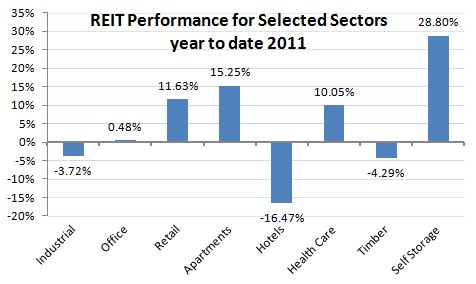
While the article correctly notes the strength in this market segment, it doesn’t connect the dots vis-a-vis why. Some of this is obvious, but it bears noting due to the very signficant long-range implications. The more-or-less simultaneous strength of the apartment sector and the self storage sector isn’t coincidental — the popularity of apartments for households which WOULD HAVE been in the owner-occupied housing market is driving the need for self storage. Anecdotal evidence of late suggests that the trend is toward smaller apartments — studios, efficiencies, and one-bedrooms seem to be in higher demand lately, although I haven’t seen this formally quantified as of yet. Given that, not only is there a need for self-storage, there will also be an increased need for SMALLER self-storage units as opposed to larger ones, urban infill units (or at least units near apartment communities) and even self-storage as an adjunct to apartment communities themselves.
Long term? This market risks getting over-build whenever the housing market stabilizes. However, that seems to be several years out. In the intermediate term, one would suspect a strong demand for more units paralleling the demand for apartments.
Share this:

The housing market — Damning with faint praise
Sorry we’ve been absent for so long — it’s been a terrifically busy summer and early fall here at Greenfield. Hopefully, we’ll be back in the saddle more frequently for the rest of this year.
From an economist’s perspective, there’s plenty to talk about — Euro-zone debt crisis, job growth (or lack thereof), Federal and state debt, etc., etc., etc. My own focus is the mixed-message on the housing market, which continues in the doldrums. If you listen to the reports from the National Association of Realtors, you get some positive headlines followed by fairly depressing details. Existing home sales are better than forecasted, mainly due to great borrowing rates and the influx of “investor-buyers”. Lots of single family homes and condos are being turned into rental property or held “dark” for the economic lights to come back on. A surprisingly large number of homes are purchased for all-cash, since if you believe that housing prices are near their bottom, then residential real estate may be more stable — and potentially have better returns — than equities.
On the other hand, new home sales continue to languish at their lowest levels since we started keeping score in 1963.
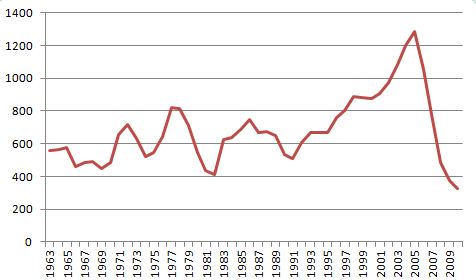
Intriguingly, if you ignore the post-2003 “bubble” period, and trendline the data (which grows over time, to account for the increasing population), you end up with about 900,000 new home sales in 2011. As it happens, we’re actually around 300,000, reflective of a significant decline in home ownership rates — now down to about 66%.
The real question is whether or not this change in home ownership rates is temporary or permanent. We happen to think it’s permanent. That’s not all bad news, but it means that when new home sales come back on-line (eventually getting back to somewhere short of 900,000, but certainly higher than 300,000), we won’t see a return to bubble-statistics.
Share this:

A Movie Review of Sorts
I just saw HBO’s “Too Big To Fail”, staring a whole host of Hollywood “names” (James Woods, John Heard, William Hurt, Paul Giamatti, Cynthia Nixon, Topher Grace, Ed Asner etc.). Sadly, it’s a fairly boring movie, albeit about a terrifically exciting piece of near-term history. It focuses on the collapse of Lehman Brothers, mostly through the eyes of Treasury Secretary Hank Paulson (played spot-on by William Hurt). Asner does a wonderful Warren Buffett (who almost, albeit reluctantly, came to Lehman’s rescue) and Giamatti is a wonderful Ben Bernake. (As an aside — Bernake is the most dead-pan person I’ve ever met. Giamatti’s version of Bernake is even more deadpan than reality.)
The movie gets one thing right and one thing wrong. First, the wrong, and then the right.
The movie keeps referring to Lehman’s “real estate”. No one will buy Lehman if they have to buy its real estate holdings, too. Lehman’s real estate “problem” is at first estimated at $40 Billion, then $70B, then “who knows”. The truth, of course, was “who knows”. Cynthia Nixon plays Paulson’s press secretary, who serve as an amiable foil to allow Paulson and his Chief-of-Staff Jim Wilkinson (Topher Grace) to explain the nature of the crisis to her (and thus to the viewer). Unfortunately, Lehman’s “real estate” isn’t “real estate” but “real estate mortgages”. More to the point, they have “tranches” of real estate mortgage pools, and to understand what a “tranche” is would be well beyond the capacity of a two-hour movie. Tranche, by the way, comes from the French word for “slice”. Imagine we pool $100 million or so in mortgages, then split up the ownership into three equal parts — an “A” tranche which will get paid in full, including interest, before anyone else gets paid; a “B” tranche which gets paid next, and a “Z” tranche which only gets paid after everyone else gets paid.
In theory, all three tranches should be good securities, since the underlying mortgages are pretty safe bets, and in practice the “A” and “B” tranches really were pretty good. However, the “Z” tranches will bear all the default risks. Banks (both mortgage and investment) made tons of money on these things, because the default risks could be “priced” as long as market continued to rise. Various investment banks then borrowed money to buy “Z” tranches, and coupled with credit-default swaps (essentially, a mutual insurance pact among investment banks), they were able to borrow huge amounts of money with very little capital.
The Paulson/Wilkinson explanation in the movie makes it sound like the whole problem came from mortgage defaults and foreclosures. In reality, mortgage defaults DO cycle up when a recession comes along, but these are usually predictable cycles. The REAL problem came from borrowing huge amounts of money — with almost no capital — to buy “Z” tranches that didn’t reasonably price the increased in defaults. A slight up-tick in defaults sent everyone to the emergency room, and when owners couldn’t sell or re-finance, the whole market went down the tubes. THAT was the “real estate” problem which plagued Bear Sterns, Lehman Brothers, Salomon Brothers, Morgan Stanley (my old alma-mater) and all the others. Sadly, the movie perpetuates the myth that the real estate down-turn was an exogenous event, and fails to discuss the sins of the secondary mortgage market which took a simple, cyclical downturn and turned it into a long-term, world-wide crisis.
But, even with that, the movie got one thing so very right that made up for the mistakes. In one pivotal scene, Paulson and his team are presenting the TARP idea to the leaders of Congress. (Central Casting found some excellent look-alikes for Pelosi, Dodd, Shelby, Frank, and the rest.) Note that this comes very late in the movie, well after Paulson (an almost billionaire, who really didn’t sign on for this level of stress) and his team have tried ever possible solution to stem the crisis. The movie does a great job of playing Paulson up as the unsung hero who really saved the world’s economic life, by the way. Anyway, the leaders of Congress don’t “get it” until Giamatti’s Bernake gives the most important 2-minute economic lecture in history. He notes that while the Great Depression started with a stock market crash, it was the failure of the credit markets which made the depression last so long. The current crisis, if left un-solved, would spin the world into a much worse, much longer economic depression. Giamatti really nails the tone of the reality which was facing the nation’s top economic thinkers at the time.
Anyway, I don’t watch very many movies. I saw Adam Sandler and Jennifer Anniston in “Just Go With It” on an airplane last week, and thought it was a hoot. As movies come-and-go, “Too Big To Fail” doesn’t even rise to the entertainment level of “Just Go With It”, but as an educational piece, it’s a must-see, even with its critical flaws.


 From a small northwestern observatory...