Archive for the ‘Mortgage Lending’ Category
JPMorgan-Chase settles military class action
This is a little bit off-topic (just a little), but the case of Marine Corps Capt. Jonathon Rowles, and the class-action suit which he began, has been a particular burr under my saddle since I first heard of it. Apparently, JPM-C has finally done the right thing and offerred to settle, but the fact that they got into this mess in the first place says a lot about their practices.
In short, the Servicemens Civil Relief Act provides for certain protections against overcharging, fraud, and egregious foreclosure during periods when the servicemember is fighting overseas and unable to defend him or herself in the normal due process. Note that debts aren’t forgiven, but mortgage loan interest cannot exceed 6% during such time of service, and certain collection and foreclosure actions are prohibited.
To say that JPM-C ignored the SCRA is apparently an understatment. Capt. Rowles repeatedly informed the bank of his active duty status, and made timely payments based on JPM-C’s own 6% calculations. Nonetheless, they apparently failed to credit him with the proper payments he made, and initiated collection and foreclosure actions against him and his family. For more details on the issue, read the court filings here.
Fortunately, Marines don’t scare easily, and Capt. Rowles and his attorney filed a class action suit on behalf of all service members similarly treated by JPM-C. Seeing the handwriting on the wall (the suit was filed in South Carolina — one of the most pro-military states imaginable), a settlement was forthcoming. For details on the settlement, click here.
Sadly, this class action ONLY covers servicemembers. One has to wonder how many similar stories come from the civilian population?
Share this:

Second quickie from the WSJ
On the same page (C-1), Nick Timiraos contributes “Critical Signs in Foreclosure Talks”. This is the followup to issues I discussed a few months ago regarding the botched foreclosure processes at many banks. Regulators had hoped to put in place a far-reaching settlement, to forestall many state Attorneys General from filing state suits which would put all of this in a variety of courtrooms (probably ultimately in a multi-district litigation in the Federal Courts, and from there… no one knows…). The regulators and the AG’s are on opposite sides, although both seem to agree that the banks need to be taken out back of the woodshed and given a good spanking.
I have zero sympathy for the banks — it’s one thing to create a high-speed mortgage assembly line, but even the auto makers have figured out how to keep track of the documentation on each car they make. Bankers (and the thousands of lawyers they employ) are supposed to be good at this stuff. If they can’t keep track of a $100,000 mortgage, how exactly do they keep track of a $100 checking account balance? (They do seem to be great at keeping track of every $1 I owe on my visa card.)
However, from a market perspective, this all has extremely serious implications. As I discussed some weeks ago, if the foreclosure log-jam isn’t fixed, the home credit market won’t get fixed either. Housing starts, existing home sales, and millions of jobs depend on straightening out this problem. Hence, this is not just a trivial argument about who gets to spank the bankers.
Share this:
The death of the fixed rate mortgage
It might also be called the “death of the easy mortgage”, and will almost certainly be the death of the small-town lender….
The Obama Administration today outlined the broad-stroke strategy for dealing with Fannie Mae and Freddie Mac. They suggest three solutions, all of which basically call for a multi-year wind-down of the two troubled institutions, which have cost taxpayers about $150 Billion in recent years to bail out.
How we got this way has been covered in thousands of articles, blog posts, and even text books. FNMA and FHLMC were set up to provide liquidity to small mortgage lenders (primarily, small-town S&L’s, of which there aren’t many now-a-days). A small-town S&L had a fairly finite pool of deposits, and once they made a few home loans (which were very long in duration), they simply couldn’t loan anymore until those mortgages were paid-off. Worse still, in times of rapidly changing interest rates, low-rate, fixed-rate mortgages didn’t get paid off, but depositors ran for higher-rate money funds. S&L’s were caught in a liquidity trap, and crisis after crisis ensued.
Today, of course, the mortgage lending business is filled with several thosand-pound gorillas with names like Wells Fargo, BofA, and JPMorgan/Chase. These institutions have the muscle to package mortgage pools and sell them off to investors. Why, then, do we have/need FNMA and FHLMC?
Congress is firmly on the hook for this one. Over the past decade and a half, the F’s were encouraged by Congress to morph into investors of last resort for mortgages that the securities market didn’t want. (It was actually a lot more complicated than that, but you get the general picture, right?) Why didn’t the private sector want these mortgages? Because they knew eventually many of them would go bad — and they did. Congress essentially got what it wanted, a subsidy of home ownership which, unfortunately, wasn’t sustainable.
This deal isn’t done yet, of course. Wait for the long-knives to come out from the Realtors and Home Builder’s lobbies. The current proposal would privatize all housing lending with the exception of FHA/VA lending. To put this in a bit of perspective, today, FHA loans constitute over 50% of housing lending. Back in the “hey-day” of the liquidity run-up, FHA loans were down around 4%. Without the F’s, we’re looking at a privatized mortgage market not far different from what we see out there right now, and that’s fairly unsustainable for the homebuilding industry.
Share this:
Housing equilibrium — part 3
The Economist is simply the most informative magazine in the world today. If I came out of a coma, I’d want it as the first thing I read. One issue, and I’d feel fairly well caught up. The on-line version is an extraordinary supplement to the print edition, and may very well be a one-stop shop for economic research.
With all the obvious sucking-up out of the way (and no, I don’t get a free subscription — I pay for mine just like everyone else), the current issue has a stellar article titled “Suspended Animation” about America’s Housing Market. In prior missives on this blog, I’ve drawn linkages between the home ownership rate (currently at about 66%) and the housing bubble (best visualized with the Case-Shiller Index). The article makes that same comparison, without drawing the conclusions I do (see below).
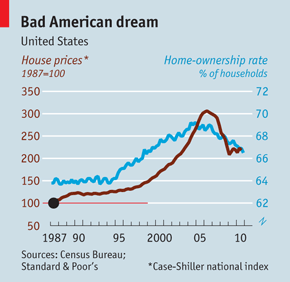
When visualized this way, the linkage becomes fairly clear and obvious. Nonetheless, the real question is “where is the bottom”. There is significant anecdotal evidence to suggest we may be closing in on it right now, but then again, there’s some evidence to the contrary. On the plus side, a LOT of speculative cash is entering the marketplace right now, and about a quarter of all home sales in America are cash-only (see the front page of the February 8, 2011, Wall Street Journal). More interestingly, in the hardest-hit places, such as Miami, this percentage is approaching 50%. From a pure chartist perspective, we note that the C-S index has been “hovering” around 2003 prices for several quarters now. Back in my Wall Street days (LONG before the movie of the same name), the technical analysts would talk about “bottoms” and “breakouts” and such. Of course, residential real estate is not a security, per se (although mortgages are), and the comparisons fall apart at the granular level.
On the down side, the Fannie Mae/Freddie Mac controversies continue to simmer. The Obama Administration and the Republicans in Congress are finding common ground hard to find. The “Tea Party” Republicans want the government out of the home lending business entirely, which means privatizing the F’s. This idea is getting no traction at all among the Realtors and the Homebuilders, two typically “Republican” groups who generally sound like Democrats on this issue. One might blame this on grid-lock, but these are fundamental issues regarding the government’s role in the housing market which date back to the Roosevelt administration. Congress — both Republicans and Democrats — emphatically wanted to goose the home-ownership rate over the last twenty years, and empowered the F’s to do that. After that, the Law of Unintended Consequences got us where we are today. Now, in the words of Keenan Thompson on Saturday Night Live, everyone wants congress to “just fix it!” but with no solution in sight. Until this gets “fixed”, house prices will, at best, probably bounce along where they are today.
Share this:

Housing equilibrium — part 2
My meanderings on housing equilibrium are about to become even more muddled, in a way, and clearer in others.
To wit… in the middle of the just-past decade, before the market started melting down, it was already apparent to researchers that the housing market looked decidedly different than it had before. It was clear that prior to about 1994, the homeownership rate had hovered around 64% for many years. Why, then, did it apparently take-off to higher ground and make a nearly non-stop upward run from then until about 2004?
The “run up” was the topic of a great paper by Matthew Chamber, Carlos Garriga, and Don Schlagenhauf of the Atlanta Federal Reserve Bank, produced as part of their working paper series in September, 2007. For a copy of it, go here.
Their focus was on the “run-up”. Our focus today is on the “run-down”. In short, if they can explain why ownership rates ballooned up in the past decade, then perhaps we’ll have some idea of how far down they will drop in the coming decade.
They find that as much as 70% of the change in homeownership rates can be explained by new mortgage products which came on the market during that period. “Easy money”, which is how this has been described in the press, made homeownership possible for millions of new owners. The remainder of the changes, in their study, are explained by demographic shifts.
There is some intuitive logic in all of this (as there usually is, ex-post, in good empirics). The American population got a bit older during the period in question, as the baby-boomers came into their own and also into an age bracket when homeownership makes a lot of estate and tax planning sense. Since these demographic shifts are still with us, and indeed continue to move in ownership-positive directions, it would suggest that a new equilibrium will probably fall out somewhere higher than the old one.
As of the most recent American Housing Survey, the current homeownership rate in America is 66.7% (down from 69.8% at the peak a few years ago). During the 80’s and 90’s (the boom which followed the 80’s recession), the rates held nearly constant at 64%. The FRB-Atlanta study thus suggests a new equilibrium somewhere between 64% and 66.7% (where we are today). In fact, if you concur that 70% of the boom came from mortgage products (which are no longer available) and the remainder from factors which ARE still at play, then one might surmise that the new equilibrium is close at hand.
Share this:
Housing equilibrium — part 1
This is going to be a bit convoluted, so bear with me.
This week, I’ve been at Renaissance Weekend, an annual gathering of top minds in a variety of fields (Nobel laureates, authors, actors, CEOs, etc) and I’ve been asked to make several presentations on real estate finance and economics. It’s a pretty heady experience, but more on that later.
One of the principle questions thrown my directions is, ‘When will real estate bottom?’ One might argue that commercial real estate has already bottomed, and there’s a fair amount of data to support that. (A weak “bottom”, I’ll grant you, but a bottom, none-the-less.) Apartments are coming back particularly strong, but even hotels and industrial are showing positive gains this year.
Owner-occupied residential is a completely different story. We’ve really never had a phenomenon like this, and according to both the Federal Housing Finance Authority and Case-Shiller, housing prices continue to collapse all across the country. Indeed, C-S just released a report two days ago indicating that new lows were hit in 6 out of 20 top markets. Overall, housing prices have been downtrending every quarter since mid-2007.
When will this bottom? I’m toying with a set of models which suggest that the pricing market won’t bottom until the ownership rate reaches an equilibrium. Heuristically, that optimal rate appears to be around 64%. Why? I’m looking at the last time ownership rates ballooned, which was at the end of the hyper-inflation period of the late 1970’s. Pricing markets stabilized after the ownership rates stabilized.
This posting is a deviation from my normal routine — My thinking on this topic is evolving, and I’m hoping to trace that evolution here on the blog until I reach something that I can actually flesh out into a paper. I’d appreciate any comments you have, either added as a comment here on the blog or, if you’d like privacy, e-mail them directly to me (john@greenfieldadvisors.com)
Share this:
Post Thanksgiving, time to go back to work…
In past years (say, pre-2008), the Thanksgiving thru New Years period at Greenfield was always slow, as clients and projects seemed to hunker down for the holiday season. Naturally, 2008 was an aberration on a number of levels — the real estate let-down was in full force, and while our business flow was down, we were busy “hunkering down” for what we projected would be a long recession trough.
Last year (2009) was unpredictable. The first half of the year was dreary, but the last half was a rebuilding period for us, as has been 2010. We’re not yet where we want to be (that is to say, back on our pre-recession growth curve), but the accumulations of lessons-learned have put us in a great position for the future.
I’m commenting on our specific experience at Greenfield for a reason. I think our own company experiences are emblematic of what is happening at tens of thousands of other businesses across the U.S. and other countries, and has significant implications for the future of real estate, the economy, and finance for the next few years. I’m always reluctant to get into the prediction business (I’ll leave that up to Faith Popcorn and her ilk), but I can make a few generalizations, particularly as the parallel what I saw back in the 1970’s —
1. Business profits (and valuations — as we see from the stock market) are headed upward, not so much from increased sales (flat across the board) but also thru extraordinarily increased efficiency. One might wonder, if firms are so doggone efficient today, why weren’t they acting efficiently a few years ago? Simply put, “efficient” firms don’t grow very well. Growth usually requires a significant degree of wastage. Hewlett Packard was famous for this — they would budget engineers a certain amount of time and support to just tinker with things, knowing that the sort of Edison-esque profitability that came out of such tinkering. At one time, Xerox was so inventive that they thru away lots of great ideas, the Graphical User Interface being the best known example. Additionally, efficient firms cut wa-a-a-a-a-y back on hiring, training, and marketing. We see this now on college campuses, as new graduates (even in the “vocational” schools like business and engineering) are getting no offers or offers far beneath what their big brothers and big sisters got a few years ago.
2. This “hunkering down” not only cuts the demand for commercial real estate, but also means we may have a substantial excess supply of offices, warehouses, and shopping centers for some time to come. Ironically, business travel is coming back (as executives work harder to sell the same amount as before) but everyone is going “down” a notch on the hotel food chain — executives who used to stay at a Ritz Carleton are now at Marriotts, and former Marriott customers are now at Courtyard Marriotts. (Intriguingly, the Marriott organization is highly vertically integrated, and so actually takes great advantage of this phenomenon). The interesting off-shoot is that while aggregate hotel room counts are up, hotel employment lags (as customers move from “full-service” to “limited service” stays). The same is true with hotel restaurants, as dining-out budgets get slashed.
3. The “trainee” employment picture is worsening in some ways, but may actually improve in others. As noted, new graduates are having real problems getting placed, and are having to accept entry-level jobs far below expectations. I spoke with a young woman recently who graduated in 2010 in Finance. She had great grades and a stellar resume, and fully expected to get an entry-level job commensurate with her expectations. Guess what? No one is hiring. After several frustrating months, she accepted a job as a teller at a Credit Union at about half the starting salary she’d previously expected. Is there a silver lining in this? Yes, two. From the business’ perspective, they’re getting entry-level talent at bargain basement prices, and if they’re willing to mentor and foster these kids, they’ve got talent who will have a much greater familiarity with the nuts-and-bolts of the business once expansion does return. From the “hiree’s” perspective, a foot in the door builds experience and puts her at the starting gate ahead of the rest of the pack.
4. The early 1980’s recession was actually the last of a series dating back to the late 1960’s (the period was called “stag-flation”). While the early-80’s recession was the worst of the bunch, it seemed to have wrung the last of the “bad stuff” out of the economy, and set the stage for two decades of nearly continuous growth. Many credit the pro-business agenda of the Reagan Administration, but that ignores the tremendous pent-up inventiveness which had been waiting for an opportunity. Gates, Allen, Jobs, and Wozniak had been tinkering with computers and software for a decade, but needed a business expansion to really get themselves going. Sam Walton had great ideas about merchandising, but the explosive growth of WalMart depended in no small part on the availability of cheap construction and development credit to build mega-stores at seemingly every street corner. We decry the sloppiness of the mortgage market of the past few years, but no one seems to complain about the millions of construction workers and realtors who rode from apprenticeship to retirement on the wave of the housing boom. Recessions do not last forever, although this one does have the symptoms of lasting for a while longer. When 4% GDP growth returns (and remember, folks, that’s really all it takes), we should be poised for a period of expansion not-unlike the one that started in the mid-1980’s.
Well, folks, that’s really it. Like most of you, I have a lot to be thankful for. I live in a fairly free country, with an economy that considers 9% unemployment and 2% GDP growth to be unacceptable. I get the opportunity to interface with students and young folks on a daily basis, and they constantly refresh my positive outlook for the future.
Share this:
It’s been a busy couple of weeks
Two quickies, and then I’m off to give a talk at Clemson University in South Carolina.
First, I had the pleasure of speaking at yet another Gulf Coast Oil Spill Litigation conference, this one last week at the Fountainbleu Hotel in Miami Beach. First, a brief shout-out for the venue — a great hotel, now elevated to one of my favorites in the world. Seriously. I can’t speak to highly of it. Imagine the Bellagio, but without the casino, and a perfect view of the ocean.
But, back to the subject at hand. I’ve also given a couple of private talks to groups of attorneys in recent weeks, but this was my first “public” forum since back in the summer. A lot has changed, not the least of which is the apparent decision by the Gulf Coast Claims Facility that they will not pay property diminution claims (despite what their documents say). This will unfortunately leave claimants with no choice but to pursue in the courts. Many of the smaller (i.e. — single residential and condos) will need to band together in class actions and mass torts under the MDL. Larger claimants (and we’ve been talking to nearly all of those) will have other options.
On a different topic, the news about the mortgage foreclosure mess just gets worse and worse (see my October 18 link to John Stewart for a funny but spot-on analysis of this). The most recent turn of events is comes from the 50 state Attorneys General, all of whom are elected officials, and many of whom have names like Andrew Cuomo and Jerry Brown. Yeah. These are not wallflowers, and many (most?) AG’s find that the post can be a great stepping stone to higher office (like… Jerry Brown and Andrew Cuomo). By the way, it’s a great year to be a populist, and no one ever lost votes by beating up on Bank of America and Wells Fargo, so out come the long knives.
Seems that the banks forgot that foreclosure is essential a state action, not a Federal one, and so falsifying evidence in state court can get you in a whole heap of trouble. The Wall Street Journal has had several great articles about this in recent weeks, perhaps the best being a piece by Robbie Whelen on page B-1 in the Sat/Sun, Oct. 30-31 edition.
This is going to get worse before it gets better. Best case scenario is that the cost of servicing (ultimately borne as a cost to borrowers) will increase dramatically, as the linkage between the “mortgage” and the “note” will need to be better maintained in the future. Worse and Worst Case Scenarios are hard to plumb, and could include severe state court sanctions against major banks, gumming up the mortgage process for months and years to come.
Foreclosure isn’t anyone’s dream. Banks lose, buyers lose, and in today’s market, even post-foreclosure investors are taking risky positions. However, just like getting an absessed tooth pulled (or root-canalled), the foreclosure process is necessary to get bad loans off bank books and get assets back into productivity. With foreclosure rates running 500% of just a couple of years ago, and with something like 25% of home mortgages “under water”, banks can ill afford to keep huge chunks of assets out of play while this gets adjudicated. Worse still, the cost of this mess, currently, is being borne by the servicing agents, who are seeing no new paper come IN the door, but they’re having to expend huge resources dealing with old, dead paper. The legal fees alone are enough to drown these thin-margin firms. Everyone who’s consulting on this mess is going to want to get paid, and yet there’s no new money coming in the door to pay those bills.
Yep, it’s a mess. It may actually be, in the end, the worst spill-over of the mortgage crisis.
Share this:
Foreclosure fiasco, redux
It’s not normally my practice to imbed other people’s videos, but this is absolutely a hoot, and frankly quite informative. Sad, but true.
http://www.thedailyshow.com/watch/thu-october-7-2010/foreclosure-crisis
Share this:
October 10 — Update #1
It’s a rainy Sunday here in the ‘burbs of the Emerald City, and I have a LITTLE bit of time to catch up on things. First thingie on my mind is the somewhat back-page article in many newspapers recently about Bank of America forstalling the foreclosure process until they get the legality of certain title problems straightened out. The Washington Post syndicate had a pretty good article by Brady Dennis and Ariana Eunjung Cha on Thursday that was carried widely, including by our local Seattle Times and the Mortgage Bankers Association.
Recall that home ownership and mortgage lending (or specifically, the act of pledging a home as collateral in a lending transaction) is LEGALLY a state-governed issues. The Federal government regulates banking and the lending process, but the actual pledging of a home (or any real estate, for that matter) is strictly a state issue (subject, of course, to certain Federal oversight.) Thus, if a nationwide lender like Bank of America (or Countrywide, which it bought) wants to make loans across the U.S., it still has to get permission in each and every state in which it does business, and the lending process needs to be tailored to each state’s peculiar laws.
As it happens, property ownership had a somewhat different emphasis from one state to the next. In South Carolina, where I used to live (and for that matter, in about half the states), foreclosing on a home is a very difficult process. The lender has to go to court and prove that the mortgage is in default, and further prove that the lender has the right to foreclose. In those states, the foreclosure process simply cannot proceed without a judge’s orders. In other states (my current home of Washington, for example), the process is much easier and does not require a judge.
The distinction is less important than the fact that there is a variance in processes among the states. When you are BofA (or Wells, or Chase, or any big lender), you want to bundle the loans together and sell them as pools. The pool actually WANTS loans from different parts of the country, to benefit from diversification. To facilitate this, and to make mortgage pools fungible and tradeable, the various lenders started subscribing to a service about 10 years ago called the Mortgage Electronic Registry Service (MERS), in Reston, VA. MERS separates the “real estate pledge” (that’s what the mortgage actually is) from the promissory note (which is what investors actually want to buy). In theory, MERS wouldn’t be an issue in an individual loan unless that loan went into foreclosure.
Now, in any given mortgage pool, even in GOOD years, a few of the loans will go into foreclosure. Fortunately enough, in “good” years, there are enough foreclosure buyers out there to keep the mortgage pool solvent, and no one really cares if every “i” wasn’t dotted and every “t” wasn’t crossed in the process.
But… sigh… these are anything but normal or GOOD times, and apparently bankers are churning ou the foreclosure doc’s so fast they’re getting carpel-tunnel from filling out paperwork. Guess what? If the mortgages were made slopily in the first place (as many were), and if the mortgage-note bifurcation was handled too rapidly (as most apparently were) and if the foreclosure applications are coming out of the bank like a firehose, then… well, remember that about half of the states require a judge to sign off on each and every foreclosure, right? And judges just HATE sloppy paperwork, right?
With THAT in mind, the foreclosure process is quickly grinding to a halt. In some states, the courts have ruled that MERS does not have a valid standing to initiate foreclosure proceedings. Class action suits have been filed in California and Nevada, no doubt with more to follow. The nightmare scenario for banks is that not only are foreclosures invalid because of sloppy paperwork (let’s don’t forget the sloppy underwriting that got us in this mess in the first place) but also one might argue that any foreclosure initiated in the past 10 years is also invalid. Thus, if you lost your house at the leading edge of this mess, two years ago, assuming the statute of limitations is still in effect, you may have a case.
Sadly, the vast majority of these foreclosurse are probably valid, albeit that may be difficult to substantiate with the sloppy paperwork. Homeowners who can’t make their payments anymore need closure so they can move on with their lives. Lenders (and mortgage pool investors) need to get assets redeployed. Neighborhoods with boarded up homes need families living in those homes again, whether they are homeowners (who frequently buy “fixer-upper” foreclosures) or renters. The system is not served at all by dragging this process out.
On the other hand, we constantly teach students that one of the strengths of the western economy is the rule of law. Contracts mean something, and badly drawn or poorly executed contracts cannot have the same legal standing as good ones. To allow such in the name of expediency puts us pretty far down the slippery slope.
I’ll be following this story. This is a complicated story, and newspapers, sadly, end up putting complex stuff on the back pages. This issue, however, deserves some front page attention.
EDIT #1 —
Since I wrote this, Foxnews.com published a very good synopsis of the problem.


 From a small northwestern observatory...