Archive for the ‘Finance’ Category
Proposals for fixing housing
John K. McIlwain is the Senior Resident Fellow/J. Ronald Terwilliger Chair for Housing at the Urban Land Institute (ULI) in Washington, D.C. I don’t necessarily agree with everything he says, but he stimulates some interesting thinking in a piece this week titled “Fixing the Housing Markets: Three Proposals“. (click on the title to link to the article itself.)
In summary, he proposes:
1. Renting federally held REO
2. Creating a mortgage interest credit
3. Divide mortgages for underwater homeowners into a “paying” first and a “delayed” second.
He admits that in the current political climate, none of the above stands a ghost of a chance (nor would any other solution, good or bad), but even though I might disagree with some of what he says, I’m a firm believer in the old In Search of Excellence adage: ready, shoot, aim. Really excellent organizations (and government entities — which are rarely even CLOSE to achieving excellence) have a proclivity for doing SOMETHING. The Marine Corps calls it the “70% solution”, which dictates that you attack as soon as you think you have 70% of the information needed for success. Why not 100%? Because fate favors the side with the initiative and momentum, that’s why.
So, please indulge me for a moment to comment on McIlwain’s proposals, but DON’T take my criticism as an indication that I wouldn’t vote in favor of doing exactly what he proposes, because in the current climate, a half-good idea is probably better than no idea at all.
1. Rent federally held REO — Well, even McIlwain admits (or at least implies) that the government is a terrible landlord, so he would propose turning this over to the private sector via pools of “privatized” REOs. What he’s essentially saying is to sell these REO’s (currently about 250,000, and expected to grow to a million) to investors with the caveats that they be held off the market as rentals for a period of time, AND that there be adequate maintenance to keep them from turning into slums.
My ONE disagreement with this is that less government involvement is usually better than MORE. Plenty of investors stand ready to buy REOs right now, and the resale market is sufficiently poor that these investors recognize they have to be in it for the long haul. Local planning ordinances are usually adequate vis-a-vis slum prevention IF they are enforced properly (as is not always the case). There is no reason to believe that additional Federal caveats would improve the situation. In short, this is actually being accomplished already, and deserves facilitation by the government, not regulation.
2. Mortgage interest credit — McIlwain notes, and we concur, that the current mortgage interest deduction benefits taxpayers earning over $100,000, but hardly those earning less. He suggests replacing this with a flat 15% tax credit, which would have the double-barrelled effect of raising the effective tax rate on those earning over the 15% marginal break-point, but directly benefitting dollar-for-dollar those below that break point. It’s an intriguing idea, but would require the Realtors’ and Mortgage Bankers’ buy-in. In today’s troubled market, it’s difficult to see how they would agree to anything that tinkers with the status quo.
3. Divide mortgages for underwater homeowners into a “paying” first and a “delayed” second. As much as I like this one on the surface, it ONLY works for homeowners who plan to stay in their houses until prices rise (on average) about 20%. We don’t see that happening for quite a few years, so this essentially just kicks the can down the road a bit. Even that, though, is an improvement over the status quo, and keeps homeowners in their homes for the time being. The real problem, of course, is how to deal with the “delayed” paper on banks books.
In short, McIlwain’s proposals at least stimulate some conversation about solutions for the terrific vacant REO problem. One big issue is lack of credit for suitable property managers — banks are loathe to loan on “second” homes today, and investment property (REOs turned into rental homes) is a troublesome loan to get. I would propose that the agencies/banks holding paper on vacant homes simply privatize it immediately — if a bank holds a $100,000 loan on a vacant house, then a reasonably creditworthy investor who is willing to start amortizing that loan should be able to walk in, pick up the keys, and walk out the door. Sure, this would violate all sorts of down-payment caveats in place right now, but it would get interest payments moving again, provide much-needed rental housing, and get some local entrepreneurs busy managing otherwise dead assets.
Share this:

Global R.E. Perspective
The Royal Institution of Chartered Surveyors (RICS, for short), with over 100,000 members throughout the world, is the largest real estate organization of its type. Their quarterly Global Property Survey gives a great snap-shot into the world-wide investment market. (Full disclosure — I’m a Fellow of the RICS Faculty of Valuation, and a contributor to this survey.)
The headline really captures the big picture — Weaker economic picture takes its toll on real estate sentiment. Not every region feels the same pain — Canada, Brazil, Russia, China, and others continue to buck the trend and record positive net balance readings. Nonetheless, in some of the most economically significant regions, at least from an investment perspective, expectations continue to be weak. Obvious problem areas are the troubled spots in the Euro zone, but negative expectations are also reported in the U.S., India, Singapore, the U.K., Scandinavia, and Switzerland (among others). However, despite a weak real estate market, investment demand is expected to grow in the U.S. and even in the Republic of Ireland, which is one of the Euro trouble-spots. China, despite value-growth expectations, is among the weakest regions of those expecting positive investment growth, behind South Africa in total investment expectations.
One of the more telling studies compares expectations of demand for commercial space and expectations of available space. Among major markets, only Canada, Poland, Russia, and Hong Kong expect meaningful decreases in supply coupled with increases in demand. Not unexpectedly, most of the trouble-spots reflect increases in supply significantly outstripping increases in demand, with the most notable gaps expected in the UAE, the Euro trouble spots (plus, interestingly, the Netherlands, France, Scandinavia, and Switzerland), India, and the U.K. Expectations for the U.S., China, Brazil, Hungary, Japan, and Thailand all appear healthy, with increases in demand expected to exceed increases in supply.
The survey is available on the RICS website, which you can access by clicking here.
Share this:
The death of defined benefit plans
Actually, this is old news. It’s fairly well accepted now that, at least here in the U.S. and in the U.K., the only jobs with defined benefit retirement plans (or nearly so) are in the public sector — government employees, military, and the like. There are a few union-specified plans still out there, but given the dearth of union-members outside government service, these are waning away, as well.
For the uninitiated, employer-funded retirement plans basically fall into two categories (separate and apart from individual retirement plans, or IRAs): defined benefit and defined contribution. In the former (DB), the employment agreement includes a provision that after a certain date (say, 30 years of employment), the employee may retire with a lifetime of pay equal to some percentage of, say, the last year’s salary, or the average of the last five years, or something like that. In a defined contribution (DC) plan, the company agrees to make annual contributions toward a retirement plan via some formula, and upon retirement, the employee will receive whatever is there. The 401-K is the most popular type of DC plan here in the U.S.
This topic came to my attention due to an article in Institutional Investor a few days ago titled “Shell Is Last FTSE 100 Company to Close DB Plan.” We have to remind ourselves that Shell isn’t an American company, but rather a decidedly European one, (“Royal Dutch Shell”), headquartered in The Hague but registered in London with 101,000 employees world-wide. This is confusing sometimes, because Shell-US has a headquarters in Houston and employs 22,000 here in America.
But, back to the subject at hand. Shell just announced that it will accept no further new members into its DB plan, becoming the last FTSE company to do so. Thus, in the U.K. at least, the DB plans are no more.
The economic implications of this are fascinating, and can only be viewed in longer-term perspectives. Post WW-II saw the emergence of a wide-spread middle-class in the developed world, and much of this was linked to job-loyalty. Much of that job-loyalty stemmed from the idea that if a person worked for a particular firm for an entire career, that person would be “set for life”. Of course, stock market hems-and-haws coupled with rapidly changing demographics and mergers/dissolutions of old, well-established names cast significant doubt on the ability of most of these 30-year horizons to actually come to fruition. Nonetheless, that was part of the American (and elsewhere) post WW-II middle-class dream.
With the dissolution of DB plans, everyone is more-or-less on his or her own. A well-managed and well-funded 401-K, coupled with a near-religious funding of an IRA can do pretty much the same thing as a DB plan, although it requires a substantial degree of discipline, financial acumen, and planning on the individual’s part. Sadly, we have to remember that exactly half the people in any society are below average. Hence, cradle-to-grave self discipline, while it sounds like fun in a Ron Paul speech, none-the-less has serious societal implications when put to the test.
I’m on the Board of one of those “dissolved” DB plans that isn’t taking any more new members. Actuarily, it’s a royal pain in the neck. No “new” money is coming in for new employees, but the old employee’s aren’t fully funded yet and the stock market sufferings, coupled with demographic shifts, has turned all of us on the board into actuaries cum soothsayers. Fortunately, the sponsor organization has the resources to fix any unfunded problems, but I’m sure there are plenty of other DB plans out there with funding issues. Indeed, plenty has been written in recent months about very real shortfalls in public (state and municipal) DB plans.
As our population gets older, this shift from DB to DC plans will get more interesting. Recall that the Chinese have a curse, “May you live in interesting times.”
Share this:
Korpacz Survey
The quarterly PriceWaterhouse Cooper’s real estate survey is now known as the PWC Real Estate Investor Survey. However, those of us who have used and trusted it for so many years will always think of it as the Korpacz Survey, named after its founder Peter Korpacz, MAI, and former active member of the Real Estate Counseling Group of America. The latest issue (4th Quarter, 2012) just hit my desk, and as always, it’s a great snap-shot into the current thinking of real estate investors in the U.S.
The headline pretty much says it all, “Buying beyond core remains tricky.” The principle problem is the protracted recovery. Investors are still attracted to core assets for the yield, but are skittish on anything not bought for income. Particularly favored are community shopping centers with grocery anchors, apartments, offices in tech centers, and port-oriented industrial.
However, a growing number of investors are looking at secondary markets, but expecting returns that are a “multiple of core deals.” Part of the challenge here is bank underwriting standards, which can really hinge on the finer points of a deal.
Among investment sub-sectors, cap rates have declined across the board this past quarter, with the exception of warehouse (+4) and flex/R&D (+3). The most notable decline was in the net lease sub-sector (-54 points). Apartments continue to “lead” with the lowest overall cap rate of 5.8% (down another 18 basis points from the previous survey).
Not withstanding my comments about the the survey’s founder, Susan Smith, the Director of Real Estate Business Advisory Services at PwC, does a great job putting this survey together every quarter. The quality and quantity of information continues to grow, and its usefulness to real estate decision makers cannot be over-stressed. For more information, or to subscribe to the survey, visit pwc.com.
Share this:
Economy set to improve?
Neat article in CNN Money this morning titled “Economists a Bit More Optimistic”. To read in its entirety, click here.
In short, economists are a bit surprised — pleasantly so, I might add — at economic results thus-far in the 4th quarter. CNN’s survey of 20 economic forecasters finds a consensus sentiment of GDP growth at 3.3% this quarter, substantially higher than where it’s been thus-far in the past several quarters, and with perhaps some momentum to carry forward into 2012.
Now, 3.3% isn’t quite as good as we’d like to see — 4% would be even better. However, as I’ve been noting for some months, GDP growth in the 2% – 3% range would barely be enough to keep us at status-quo, much less get job growth to the levels needed to cure unemployment problems. Hence, if this survey and forecast are correct, it is indeed very good news for the holidays.
Share this:
FDIC — Supervisory Insights
The latest issue of the FDIC’s Supervisory Insights (Winter, 2011) just hit my desk. (If you really have plenty of time to kill, you’re welcomed to download your own copy, for free, from here.)
The focus of this issue is on appraisal problems, particularly re-inventing the review appraisal supervision role. This issue — which is ongoing — is a matter of considerable discussion and debate within the appraisal community. I’ll leave that matter to other pundits, but with the caveat no solution on the drawing board today will make everyone happy.
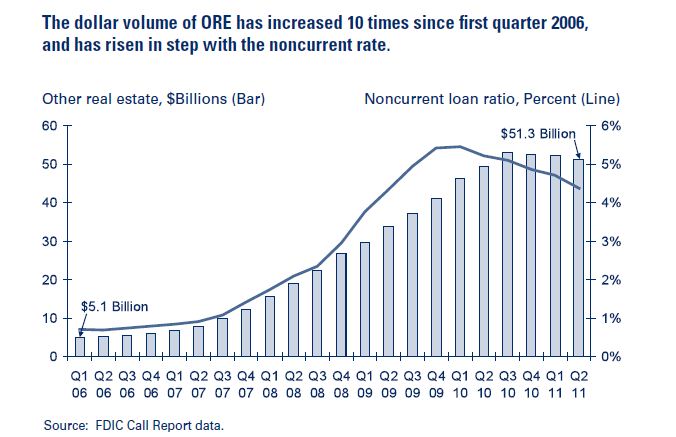
It may be a bit more interesting to examine the underlying arguments within the FDIC, to gain some insight in to where that agency is “coming from”. First, Table Four from the publication really sets the stage with the overarching problems facing the FDIC.
graphic courtesy FDIC
Notably, while the non-current loan ratio is slightly down from two years ago (although, terrifically higher than before the current crisis began), the dollar figure of “other real estate” (FDIC code for “real estate owned” or REO) hovers about 10 times as high as in 2006, with no end in sight.
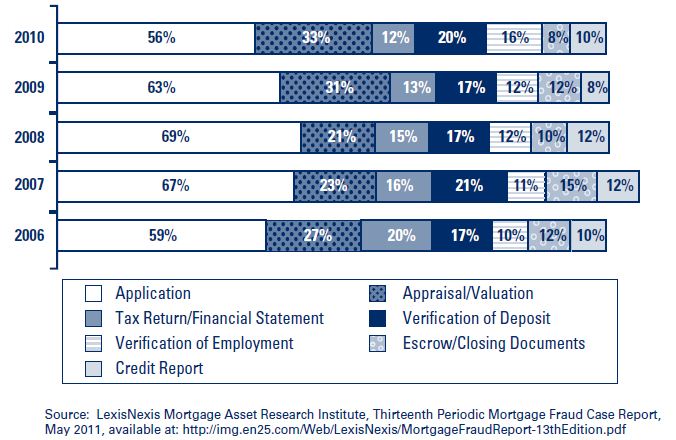
So, the FDIC is challenged not only with fixing the CURRENT problem, but laying blame — so as to presumably prevent the NEXT crisis. Peeling back the layers of the onion, Table Three from that same report give significant insight into their perspective on the problem.
Courtesy FDIC
This data comes from LexisNexis, and the percentages do not total to 100% because many cases have multiple sources of problems. Nonetheless, since 2006, the trends for all categories have been flat or trending positively except for appraisal problems, which are now significantly higher than at the beginning of the crisis. One might argue that the increasing percentage of cases with appraisal problems is a manifestation of increased investigation in that realm, but that would be damning with faint praise, since it implies that oversight was lacking in the past.
Share this:

Musings about the real estate market — part 2
A few days ago, I kicked off this series with some comments about the asset side of the residential market. Today, I’ll discuss the finance side of that market. Later on (parts 3 and 4) I’ll talk about the asset and financial side of the commercial market. Keep in mind that these markets are all very different, albeit intertwined.
A quick caveat — don’t use ANY of this to answer Econ 101 exam questions. I’ve over simplified nearly all of this to make it readable.
If you watched the really excellent HBO movie, Too Big to Fail, you saw and heard the actors talk about huge losses in “real estate”. While many of these players actually owned real estate assets (see my commentary about Archstone), the real thing that brought them down was their ownership of real estate derivatives. Now, this may sound like I’m side tracking, but it’s very helpful to understand how we got here, if we’re going to understand how to fix it.
Imagine John and Jane America go to Main Street Bank (MSB) and borrow $100,000 to buy a house. In the course of a year, Main Street Bank may make 100 of such loans, totaling $10,000,000. In a typical pool of 100 loans, two of them will go bust, resulting in $200,000 in “paper” losses to MSB. Now, before you start feeling sorry for the depositors and shareholders of MSB, it’s important to note three things:
1. This was a fairly predictable set of losses. Hence, every borrower paid a slight premium on their loan to “share the burden” of everyone else.
2. The bank has the house as collateral. While foreclosure sales rarely fully compensate the bank for the losses, they really do cut the pain down to a small headache, and then #1 above kicks in.
3. Many mortgages have private mortgage insurance, etc., to compensate even further.
Hence, in a normal year, a small number of foreclosures is expected and manageable. However, the period leading into this recession was anything but normal. House prices peaked, and actually started tumbling downward, meaning that #2 wasn’t working very well. The losses started bankrupting the PMI companies, thus making #3 ineffective. Finally, foreclosure rates got up to huge levels.
Still, you might say, these numbers should have been reasonably manageable, right? Well, not so quick, partner. Now we need to introduce two new concepts: the mortgage backed security (MBS) and the default swap. An MBS is a really strange, hybrid, derivative instrument. Fully explaining it here is nearly impossible, but let’s take a stab. Remember the $10m in mortgages? (In actuality, we were usually dealing with pots of loans that were ten times that big.) Let’s say the average yield on that pool was 6%. Now, I’ll chop and dice that pool three ways. First, I’ll sell $5 million of it to widows and orphans, and promise them AAA safety by giving them first crack at the principal and interest. However, their yield will only be, say, 4%. Next, I’ll sell some speculators the next $2.5 million of AA rated paper, and give them the NEXT crack at the payments but only a 5% return. The last $2.5 million will get all the residual returns, which should work out to an 11% yield if nothing goes wrong (see numbers 1 – 3 above). However, everything went wrong, and these last slices of the pie went down the tubes.
Now, if you’re Lehman Brothers, you take that last slice, and sell IT off in slices to investors. However, you promise THEM AAA security by entering into a credit default swap. Essentially, you’re getting Bear Stearns to guarantee YOUR pools, and you guarantee theirs. To find out how that worked in reality, go see the movie.
Unfortunately, so much of our investment banking establishment was hinged on these derivatives, and the underlying asset values went so far down, that the system totally broke down. It’s very close to broken today, which is why getting low-down-payment loans is nearly impossible now-a-days (in effect, the default rate on 80% LTV loans is nearly zero, so that’s the only part of the system that’s working fairly well now).
Fannie-Mae and Freddie Mac had Congressional mandates to buy tons of these mortgages. While they were not in the MBS and credit default swap business, they were in the business of borrowing money to invest in loans. A default rate of 6% or more might have been manageable if the values of the underlying assets hadn’t fallen by 20% – 40% in some parts of the country. Note that 6% of several trillion dollars is a lot of money when the short-sale only recovers 60 to 80 cents on the dollar. There is also a huge shadow inventory of properties (by some estimates, 5 million homes with a potential loan overhang of a trillion dollars) that haven’t yet even been foreclosed on but the loans are either non-performing or in serious arrears.
How do we fix it? The system depends on a complex network of institutional trust coupled with complex insurance and hedges (essentially, a credit default swap was an insurance policy). Most of that system is irreparably broken. Following the Savings and Loan Crisis of the late 1980’s, the nature of residential mortgage lending was significantly changed in the U.S. and many other countries. This situation is far, far more complex than that one, and probably calls for the same level of overhaul we saw in the Great Depression, when the very nature of home mortgages was completely stood on its head. Unfortunately, we’ve wasted several good years with no settlement in sight. My guess is that the rest of this decade will be wasted, at the pace we’re currently seeing.
Any good news? I think so. There are some great private sector minds who are currently realizing that the Federal Government is NOT going to step up to the plate with a solution like it did in the 1930’s. Hopefully, the pace will pick up as the market starts realizing that it needs to find new financing instruments to satisfy the demand for housing and restore health to this sector of the economy.
Share this:
And a bit more about Archstone
Private Equity Real Estate reports this morning that the Estate of Lehman is challenging Equity Residential’s proposed acquisition of BofA’s 26.5% stake with protests to the Securities Exchange Commissions.
PERE reports that Lehman, which owns 47% of Archstone and serves as manager (the remainder is owned by Barclays) had filed a plan to emerge from Chapter 11 by paying $65 Billion to pay creditors, who hold about $450 Billion in claims. Selling Archstone (they actually proposed an IPO) would have helped raise this sum (Lehman currently only has about $23 Billion), but Sam Zell’s move has left this idea hanging out to dry.
It’s going to be fun to watch. We’ll keep you posted.
Share this:
Musings about the real estate market — part 1
When we say the “real estate market” we’re really talking about four distinct but somewhat inter-related components: housing sales (and values), housing finance, commercial real estate (starts, occupancy, etc.), and commercial finance. Each of these components has plenty of sub-groupings. For example, commercial apartment development is going well, although commercial apartment finance still has some problems. Housing development finance is on life support. Many aspects of commercial development (e.g. – hotels) are moribund.
I’ll start today with the most significant problem in the housing sector — the one which may take the longest to fix — and that’s housing starts. The market is worse than it’s been since we’ve been tracking data (40+ years) and certainly the worst in my experience. The attached graphic comes from the National Association of Homebuilders, and shows their tracking of both housing starts as well as the NAHB/Wells Fargo Housing Market Index (HMI).
 The HMI is based on a survey of current new home sales, prospective sales in the next six months, and “traffic” of prospective buyers (seasonally adjusted). While the two graphs seem to track one another, as you can see, the HMI is a bit of a leading indicator of the direction of housing starts. On a historic basis, this makes sense, since homebuilders will “start” houses they think will be sold six months from now, and they will heuristically base that on traffic from prospective buyers. (Back when I was in the game, we talked about a “qualified buying unit” being a prospective buyer or housing unit — such as a family — who actually had the capacity to buy a home and were actively in the market for a new home.)
As you can see, back during a period of relative housing stability (1985 – 2005), housing starts generally cycled between 1 million and 1.4 millin per year. With the bubble in home ownership rates, starts got up to 1.8 million for a short period then collapsed. More interestingly is the period between 1989 and 1993, when home starts dipped to about 600,000 per year, then rapidly bounced back to a healthy level. That was a period marked by real problems with acquisition, development and construction (ADC) loans, but the underlying demand and value equations still held firm. Thus, when the market cleared (when demand sapped up any supply overhang), the homebuilding community was ready to go back to work.
Today, it’s VERY different. ADC lending is still nearly non-existent (compared to a half-decade ago). The decline in values means that in many markets, it’s difficult to build a home for less than the selling prices. Further, the permanent lending market is also problematic. A big chunk of homebuilding is the “move-up” market, with a secondary chunk in the vacation or second-home market. Down payments for “move-ups” and second-homes traditionally come from equity in existing homes. However, a substantial proportion of homes in America have no net-equity. Reports talk about the high percentage of homes which are “under water” (that is, the value is less than the mortgage. However, for a home to have positive “net equity”, the value needs to exceed both the mortgage as well as anticipated selling costs. A handy rule-of-thumb in many markets is that a home needs to be valued around 110% of the mortgage for a seller just to break even on a sale. Worse, for there to be sufficient equity to “move up”, the home needs to be valued more like 120% to 130% of the mortgage. That simply doesn’t exist in most of America right now — trillions of dollars in paper equity disappeared over the past few years.
Additionally, there is a huge overhang in shadow inventory. As I noted in a recent blog post, Americans are currently buying under 5 million homes per year (new plus re-sale) and in a healthy market, the inventory for sale is about a six-month supply. However, the shadow inventory alone is close to 6 million right now (and that doesn’t include “regular” homes on the market). Thus, we’re looking at a couple of years of absorption just to get the market back to some level of stability. Even THAT presumes that the home ownership rate will stabilize right where it is (it’s been falling precipitously for several years). Bottom line, I wouldn’t be betting on home construction any time in the near future.
This is important for several reasons. First, home construction is a very big chunk of the economy. When homes aren’t getting built, lots of carpenters, plumbers, electricians, materials suppliers, real estate agents, bulldozer operators, bricklayers, and such don’t have work. Second, these are skills which are being lost to the economy. Further, if America is going to get the employment picture fixed, these people have to get back to work.
Good news — such as it is — is that the HMI is trending upward, ever so slightly. It’s currently standing at 20, up from a bottom below 10 about 3 years ago (and a near-term bottom of about 15 earlier this year). It needs to bounce all the way back up in the 50 range if the leading-indicator relationship holds true for it to point toward a healthy housing market. It actually went that far in the 1991 – 1993, range, when it bounced from 20 to 70 in about 3 years. However, that was a market with pent-up demand, good values, and a healthier lending climate.
Share this:

S&P Case Shiller Report
The latest Case-Shiller analysis hit my desk today, looking at housing prices through the 3rd quarter of 2011. Their headline says it all: Home Prices Weaken as the Third Quarter 2011 Ends.

Chart Courtesy S&P - Case Shiller
Their overall national index was declining at a 3.9% annual rate as of the end of the 3rd quarter. Looking for faint hope in the data, this is actually an improvement over the 5.8% decline rate measured at the end of the 2nd quarter. Home prices continue to cycle around (and mainly slightly below) their 2003 levels, which they’ve been doing for quite some time. For more information, visit the Standard and Poors web site.



 From a small northwestern observatory...