Archive for the ‘Economy’ Category
Fiscal cliff and other mental meanderings
Happy New Year! It’s been a very busy month, evidenced by the lack of blog posts the past few weeks. The holidays, coupled with a mind-numbing travel schedule (and a broken lap-top! This is a new one!) kept me off the internet more than usual. In fact, I’m writing this from my hotel room in Charleston, SC, where Lynnda and I go every year to join our great friends and extended, adopted family at Renaissance Weekend.
As an economist, I’m terrifically concerned with the Fiscal Cliff. I know it has dominated the media the past few weeks, and should certainly be on the minds of every thinking person, both in American and abroad. As I write this, the Senate has apparently passed some stop-gap measures which now require action by the House. (As one participant here at Renaissance put it — “They didn’t just kick the can down the road, they kicked the whole store.”) Nonetheless, as serious as everyone (except, apparently, Congress) realizes it is, I’m afraid that most folks probably don’t fully understand how bad it really can become. Perhaps I can illustrate.
I think most folks would agree that government spending at all levels must be reigned in. The exact mix of cuts and taxes will differ between those on the left and those on the right, but all agree that the Federal deficit (both funded and unfunded liabilities) can’t go on at these levels for much longer. However, some politicians — who apparently flunked Econ 101 — think that the best way to cure the problem is to let the car drive off the Fiscal Cliff. They would use the analogy of a spend-thrift prodigal child, who needs “tough love” by simply being cut off from Mom and Dad’s largess.
Economists, on the other hand, see two outcomes from this, both of which will almost certainly happen, and both of which are devastating. First, any system which is “shocked” will react in uncertain but probably negative ways. Markets and market participants loathe uncertainty, and we can already see pull-backs in durable goods and investments as both businesses and consumers demonstrate a liquidity preference in anticipation of the anticipated meltdown. The better analogy is like stopping or slowing a car — you can do it two ways. First, you can apply a slow and steady braking (the way they taught you in Drivers Ed), maintaining control of the vehicle until the car comes down to the desired speed or until it stops completely. Alternatively, you can drive head-long into a brick wall. Pretty much everyone can guess what happens under the second alternative, which makes Fiscal Cliff seem to be a very apt descriptor.
The second outcome — which is the least understood by the layperson, and is surprisingly poorly understood by public policy “types” — derives from the secondary and tertiary impacts. Imagine, if you will, a small town which is dependent on a factory for its “base” employment. The factory suddenly transfers a significant portion of its workforce and production to another plant many miles away. Those workers had been spending their paychecks locally, for groceries, haircuts, dental services, and the like. The plant had been buying local supplies, such as fuel, tools, and repair services. The loss of these ancillary benefits reverberate through the local economy, and are called “secondary” losses. Now, the grocer, the barber, and the dentist can no longer pay THEIR bills, and these are “tertiary” losses.
With the advent of the Fiscal Cliff, very sudden secondary and tertiary impacts will be felt throughout the economy. Lockheed, for example, will suddenly be told that certain Federal contracts will no longer be honored. They will lay-off tens of thousands of employees, who in turn will — ironically — look for welfare and unemployment assistance and will no longer pay taxes. These employees and Lockheed itself, for example, will quit buying things, and the list goes on.
Of course, the Devil is in the Details, as they say, and the exact set of ramifications won’t be known until payroll taxes go up, layoff notices go out, and certain government services cease. I would fully agree — and encourage — that our Federal government needs to be re-sized. Liberals and Conservatives may disagree on the exact degree of re-sizing, the appropriate mix of revenue and expense cuts to get to that new size, and the “things” which constitute necessary and fundamental government services. Indeed, this re-sizing and realignment should be the central theme of President Obama’s second term. I would posit that all of the other good things he wants to accomplish will be enabled by that sort of transformation. Nonetheless, driving the economy over a cliff is not the way for Congress to provide us with the leadership that we pay them to provide.
Share this:

Tea Leaves and Such
Flying back from Milwaukee to Seattle last night, I sat next to a fellow who owns several big truck dealerships in the mid-west. (Seattle, famed for Boeing and Microsoft, is the lesser-recognized headquarters of Paccar, the world’s third largest maker of heavy trucks, after Daimler and Volvo. Last year, they made and sold over $16 Billion worth of Kenworths and Peterbilts.)
ANYWAY, after the usual “how’s business?” question, I got an earful. Turns out no one’s buying heavy trucks right now, even though financing is historically affordable, and customers have cash. Why? Simply put, his customers are scared of the fiscal cliff. (We also talked about customers deferring potential acquisitions until after/if tax rates go up, but he said that this wasn’t a big issue in his surveys of customer sentiments.) He noted that demand for long-haul trucking was down, and noted that his trucking-company customers were reporting a lower volume of hauling for consumer retailers.
Now, if this was an isolated incident, we could write it off. However, the danger of the fiscal cliff isn’t just what will happen after January 1. Much like an impending hurricane, people are already packing their bags and getting out of the way or hunkering down and bolting the doors.
What is the impact on real estate? While it’s too early to completely quantify, clearly there is reluctance right now to make new investments in office, industrial, and retail. Add to this the realization that the apartment boom may have leveled off, and we have a fairly flat new development market on the horizon. This doesn’t bode well for real estate private equity firms that are focused on development profits or capital gains, but it does mean that income-oriented real estate (publicly traded REITs for example) may exhibit some buying opportunities due to both their tax advantaged nature. The most recent Current Market Commentary from NAREIT shows slight downward trends in apartment, office, and retail vacancy, with all three sectors showing positive rental rate growth (albeit at lower levels than earlier this year). The three-year moving average for renter household formation continues to trend upward, while the owner-occupied household formation is in negative territory (despite recent gains in home sales and housing starts).
Notwithstanding the dangers of the fiscal cliff, changes in non-farm payrolls have been strong and positive every month since mid-2010, and even though unemployment is higher than anyone wants to see it, the trend has been solidly downward since the peak of late 2009. As such, the fiscal cliff is the most significant economic problem on the horizon today. Fix it, and we continue on the track to full recovery. Let us drive off the cliff, and…. well, that’s a pretty good mental picture, eh?
Share this:
“5 Economic Trends to be Thankful For”
First, I hope everyone had a great Thanksgiving! For those of you who in countries that don’t share our festival of thanks, I hope you had a great Thursday!
Kuddos to Neil Irwin, writing in the Washington Post yesterday. I agree 100% with his list, and wanted to reproduce it here:
1. Household debt is way down. Neil lists this as his first item, but I would suggest it has plusses and minuses to it. On the plus column, we really WERE over-debted as a society. On the minus side, changes household debt carries with it complex implications for the consumption side of GDP, as well as corporate investment (see my prior blog post) and even trade relationships. Nonetheless, this is, on net, a good thing.
2. The cost of servicing that debt is way down — as Neil points out, from 14% of disposable income in 2007 to 10.7% today. Of course, remember that one person’s interest EXPENSE is another person’s interest INCOME. Nonetheless, this constitutes a significant wealth transfer from people who HAVE money back to people who NEED TO BORROW money.
3. Electricity and natural gas prices are falling. It’s hard to find a downside to this one. From last year, consumer natural gas prices are down 8.4%, and electric rates are down 1.2%. I would add to Neil’s analysis that more of this money is staying at home — the U.S. is well on its way to being import-neutral on energy. Of course, this has some geopolitical implications, which we’ll deal with on another day.
4. Businesses aren’t firing people. While unemployment remains high at 7.9%, at least the arrows are pointed in the right direction.
5. Housing is dramatically more affordable. Neil points out that in 2006, the typical homebuyer faced a payment equal to 41% of the average wage of a private-sector worker. Today that’s 26%. This is a combination of both lower house prices (which proportionally lowers down payment requirements) and lower mortgage interest rates.
Congrats to Neil Irwin and the Washington Post for an insightful and timely article!
Share this:
Corporate Investment — Much ado about…. something
I can’t believe it’s been a month since I posted — I’ve been traveling almost constantly the past few weeks, and between that and the elections, my dance card has been fairly full.
The trigger for day’s post was an article in the Wall Street Journal on Monday, “Investment Falls off a Cliff”, with obvious homage to the impending fiscal cliff. I don’t want to minimize the danger of the “FC”, and in fact all bets are really off if the worst case scenarios come to pass. Here at Greenfield, we don’t really believe Congress and the White House will both fail to blink. Nonetheless, “keeping your powder dry” is always good advise in perilous times.
I’d like to comment on two things, though. First, while direction of corporate investment isn’t good, it’s not quite “double dipping” just yet. Indeed, one might argue that the current downswing in investment is nothing more than seasonal backing-and-filling.
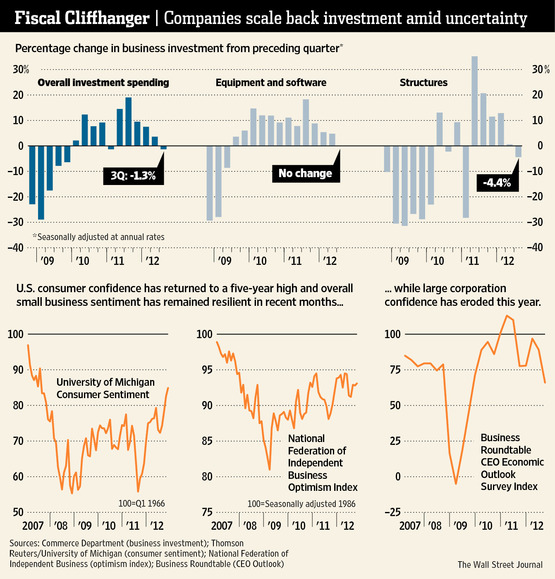
courtesy, Wall Street Journal
Note that after coming out of the recession, overall investment spending took a brief respite in early 2011, as well. Of course, equipment and software appear to continue healthy, but structures are dragging the overall index down. Part of this can be explained by the relaxation of the apartment construction surge that we saw over the past several quarters. Many analysts now believe the demand-overhand in apartments is close to saturation (or at least satisfaction) and this sort of slow-down is neither unusual nor unhealthy. Note that the NFIB optimism survey is still trending upward, although the Business Roundtable CEO survey (which surveys heads of larger firms than the NFIB does) had turned downward. I suspect that’s a rebound effect — small businesses are still clawing their way out of the recession, and are less affected by what may happen if the FC becomes reality. The larger firms were the first to enjoy the fruits of the recovery, and would be the worst hurt by tax increases and the FC cutbacks (particularly in defense). Nonetheless, both of these sentiment measures are well off their 2009 bottoms. Consumer sentiment, which ultimately drives much of this, is as good as its been since before the recession.
Second, I’m concerned about the negativity spreading to real estate. Note that real estate investment comes in three flavors — development, capital gains, and income. The downturn in investment has SOMEWHAT negative implications for the first. Real estate developers will have to be more careful in a slow-down environment, but that’s been true throughout this recovery. Financing is difficult, even in the “hot” apartment market, and so admittedly the commercial real estate developers may be in for a tough run. (Residential development, on the other hand, is rebounding nicely.) Capital gains is a “long game” anyway. Certainly the tax changes which seem inevitable in 2013 and beyond have negative implications for the buy-and-sell crowd, but the returns to those who can hold thru cyclical downturns have always been healthy even after tax considerations.
Real estate income (primarily REITs) may actually be benefitted by a slight retrenchment in development. If and as the economy continues to rebound, offices, warehouses, and shopping malls continue to fill up. Lack of new supply (from a cyclical downturn in development) benefits the sort of existing structures which are typically part of a REIT portfolio. As always, investors will be benefitted from looking at good managers with top-drawer properties and a history of increasing FFO.
Share this:

European Real Estate Funding Gap
Property Investor Europe sent me a report today about the shortfall in real estate funding in Europe. The implications are a bit nerve wracking.
First, some background — European commercial real estate investors place significantly more emphasis on “traditional” bank lending than Americans. As such, the sort of private-debt network that exists in the U.S. has not grown in Europe.
According to a report by the research firm Swisslake, central bank liquidity flows gave been directed at small and diversified loans, which are in high demand. However, commercial lending in Europe is actually facing cuts of €500 Billion or so. In addition, banks are increasing equity requirements, leaving real estate with large financing gaps, Swisslake calculates that only about $3.8 Billion headed towards Europe in the last year from non-bank lenders.
However, this is creating a market opportunity for private debt funds. Reportedly, 30 new funds have been launched in 2012, adding to the 20 new funds created in 2011. These funds have increased their market share to 20%, up from 15% at the beginning of 2012. Intriguingly, many former equity fund managers are now shifting to private debt funding.
Share this:
Economic outlook — fundamentals and shocks
I love boating, I really do. To quote from Grahame’s famous The Wind in the Willow, “…there is NOTHING–absolute nothing–half so much worth doing as simply messing about in boats.” However, any experienced sailor has had one of those days when the water was perfect, the wind was with you, but off on the horizon a storm cloud lurked. “Will it head our way, or pass us by?” is the key to whether the fun cruise continues or not.
Today, and for the next few weeks, the economy is like that. The wind is definitely at our backs, and things are generally looking up. That having been said, the fiscal cliff continues to loom on the not-too-distant horizon.
First, the good news, and there’s plenty of it. I’m on the Board of an investment fund (and in fact just got named chairman of the board this month, for a two-year stint). We had a great briefing yesterday from our lead fund manager, and macroeconomic news was as good as I’ve seen it in a while. Corporate profits are at near-record levels as a percentage of GDP, and non-financial interest expense as a percentage of profits is at a near-record low. Lending is back up, although corporate lending isn’t quite as robust as consumer lending, and current stock market price-earnings ratios (measured on a 12-month trailing basis) are at levels usually associated with strong intermediate-term (5-year) market returns. Equity risk premia tell the same story.
On the real estate side, everyone’s seen the news that the S&P Case Shiller index is trending back up, and this morning’s news report puts current housing starts above an 800,000 annualized level (note that we’re hoping for a million, and at the trough of the recession we were at a record low 300,000-ish). Manufacturing has added about a half-million jobs since the trough of the recession (early 2010), and is about 300,000 above where it stood in July, 2009.
The implications for real estate investment are clear, and as I reported earlier this week, the total return on U.S. REITs has exceeded 30% in the past year, besting the S&P 500.
With that in mind, though, the fiscal cliff continues to trouble us all. If you’re not familiar, on January 1, the Bush Tax Cuts will expire and mandated federal spending cuts are scheduled. Together, these two will hit the economy to the tune of about 4% of GDP (yes, driving us into a second recession). Sadly, the solution is political, and this is all coming at a time when Congress and the White House are totally focused on the impending election.
We’ll keep you posted, and we’re preparing some private white papers on this subject for our clients as the season moves forward.
Share this:
REITs — good news trumps “iffy” news
The “headline” in Erika Morphy’s piece in GlobeSt.Com this morning was that was that REITs underperformed the S&P 500 for August and September. Specifically, REITs were up 1.85% in the 3rd quarter this year, compared to 6.35% for the S&P 500. You have to dig a little deeper to get to the heart of the matter, though.
First, let’s remember that investors by-and-large buy REITs as an income vehicle with equity up-side. The current average REIT yield is 3.88% — not bad, compared to corporate bonds or preferred stocks, and more targeted income seekers can go after single tenant retail with a yield of 5.9%. (For a great review of this, see a piece by Brad Thomas in Forbes.com from September 10). Couple those sorts of dividend yields with any upside equity potential, and you have a real investment powerhouse in today’s market. For comparison, the current yield on the S&P 500 is 1.97%.
But, the news gets better. For the 12-months ending September 30, the NAREIT index was up 33.81%, compared to 30.2% for the S&P. Do the math — the total return for a portfolio of REIT shares for the past year would have been (33.81% + 3.88% = ) 37.69%. The total yield for the S&P 500 would have been (30.2% + 1.97% = ) 32.17%. Thus, slightly more than a 500 basis point return advantage to REITs.
Of course, (and this goes without saying), past performance doesn’t translate into future returns…..
Share this:
Rays of sunshine
Fall isn’t usually the time we talk about rays of sunshine, particularly not here in Seattle where we all “hunker down” this time of year for the long, dark, wet winter. Plus, I just came back from three weeks on the road (nine hotels, 4 time zones, two rental cars with a combined 2,000 miles, and four plane flights). One of the first things to hit my in-box was the periodic Real Estate Investment SmartBrief from the National Association of Real Estate Investment Trusts with the headline “Hopes for U.S. Rebound Fade as Global Trade Slips”. Sigh….. not a really nice headline, eh?
Now, I have the greatest respect for NAREIT, and out of fairness, they lifted this story from the Wall Street Journal. Nonetheless, when the market opened this morning, it actually darted into positive territory, with the S&P hovering above 1450 as I write this. (I hope I don’t jinx it!). Of course, the stock market has risen for the past three Octobers, and in fact the market had a significant rally in September — a rarity for a month that’s usually fairly flat — with the S&P gaining almost 3% and the Dow picking up about 2% during the month. The “rally” this morning was triggered by two things. First, the ISM report (Institute for Supply Management) came out in positive territory for the first time in four months, confounding analysts who thought it was continuing downward. Second, this caused the short-sellers, who have banking on a negative October, to re-think their positions. Hence, the really great bounce this morning was, in no small part, a lot of short-covering.
No question about it — a shrinkage in global trade is an unsettling thing, for three big reasons. First, it signals that the net importer regions (particularly Europe) are continuing in the doldrums. Second, healthy economies which are heavily trade based (such as the U.S.) depend on trade to stimulate GDP growth. Finally, China is the world’s biggest manufacturing floor right now, and depends on trade to provide full-employment — nothing frightens Chinese officials more than unhappy workers with no jobs. Thus, from both an economic perspective as well as a geopolitical perspective, a shrinkage in trade — or even a shrinkage in the growth of trade — is a bad thing.
Notably, also, while manufacturing is only 20% of the U.S. economy, it is 40% of the profits of the S&P 500. Pundits are already noting that the ISM report is just one data point, but it’s a very important one. In the next few days, we’ll see if the good news from ISM is sustained by other sectors of the economy.
Share this:
Sustainability — Follow the Money
Sustainability seems to be the real estate buzz word du jour. A “google” of “sustainable real estate” brings me slightly over 56 million hits. Number two on the list is the Journal of Sustainable Real Estate, (a more-or-less joint presentation of the American Real Estate Society and CoStar) of which I’m apparently on the editorial committee. Go figure.
I don’t want to sound too cynical here, but as a “finance guy” in the real estate field, I tend to follow the money. A lot of what’s going on in real estate, particularly at the individual building-level, has a lot to do with sustainable energy (e.g. — LEED Certification, Energy Star) or sustainable architecture. There was a nice paper out of Clemson University by David Heuber and Elaine Worzala recently on sustainable golf course development (click here for a link) which begins with the irony that no one is building golf courses today. Scott Muldavin has a great book on underwriting and evaluation sustainable financing (reviewed here) which gets close to the heart of the matter.
However, Ben Johnson, writing for the current issue of Real Estate Forum, seems to have caught the scent, to use a hunting dog analogy. In his article, “When CalPERS Talks, People Listen”, he notes that this mega-pension fund n($228 billion) has about 8% of its total invested in real estate. (My own estimate is a bit higher and more current than that — see here for details.) The noteworthy thing, however, is that CalPERS just made a $100 million stake in Bentall Kennedy outt of Toronto. B-K is one of North America’s largest real estate investment advisors, resulting from the 2010 merger of the Canadian firm Bentall with Seattle’s own Kennedy Associates.
Two things make this all very interesting. First, B-K earned the top spot this year on the Global Real Estate Sustainability Benchmark Foundation’s ranking of fund managers in the Americas. This ranking, covering 340 of the world’s largest funds, measures social and environmental performance. (Given B-K’s Pacific Northwest and Canadian pedegrees, this doesn’t surprise me at all.)
Second — and this may be the biggie — as CalPERS goes, so goes the industry. The focus of Mr. Johnson’s article was to note that now every pension fund in the known universe will need to consider using an advisor like B-K. Johnson notes that this deal “gives the largest public institutional player in the US a deeper investment in understanding real estate as an asset class and a unique insider’s view of the industry’s dynamics.” More interestingly, I would posit, it puts a leader in sustainable real estate front-and-center in the view of the sorts of pension managers who, until now, have very little cross-pollination with the real estate industry. In short, as institutions look to find good real estate partners, sustainability will be a key element of consideration.
Share this:
The right number of new homes?
Much has been said in recent days about the Census Bureau’s August 23rd announcement about new residential home sales in July. To summarize, 372,000 new homes were sold last month, which is 25.3% above the July, 2011. This is good news for a lot of reasons — construction workers get jobs, banks get new loans, etc., etc.
Naturally, it begs the question, “what’s the right number of homes?”. Here at Greenfield, we’ve posited that the U.S. housing price “bubble” was really a demand bubble, fueled by easy money, which led to an artificial inflation of the nation’s home ownership rate. (Housing bubbles in other countries were fueled by similar problems.) We’ve also suggested that the market won’t get healthy again until several things happen, including a stabilization of the homeownership rate at long-term equilibrium levels, a restoration of “normal” conventional lending (both for home mortgages as well as for development financing) and a restoration of the housing infrastructure (development lots in the pipeline, local regulatory department staffing, hiring & training skilled construction workers, etc.) . It is highly doubtful that we’ll see housing starts and new home sales “bounce back” to normal levels anytime soon, and our own projections suggest several years before we get back to “normal”.
But this begs the question: What’s normal? (A great t-shirt from the Broadway play, “Adams Family” simply said, “Define Normal”.) Anyway, as new home sales go, it’s helpful to glance at the experience over time. It may surprise you.

One might actually expect the graph to be less erratic, but there are good explanations for the “bobbing and weaving” you see from year to year. During recessions, new home sales decline, and then bounce-back afterwards. During periods of economic overheating, the FED tightens the money supply, thus causing home starts/sales to decline. (In practice, this is a major tool in the FED’s toolkit, simply because it has a great multiplier effect on the economy.) Of course, the bubble is quite apparent, and following it the inevitable decline.
With all that in mind, though, we can see that there is a decided upward trend in the chart — that makes sense, since a growing population, coupled with a fairly consistent homeownership rate, will generally demand more new homes each year than it did the year before.
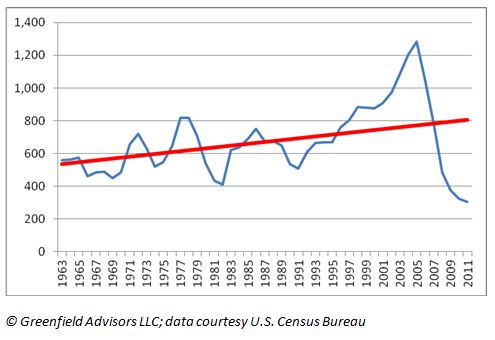
The second graphic adds a simple linear trend line for simplicity sake, which is not far removed from the actual household formation trend line during that same period. Note that from the beginning of the chart until about 2001, we had a nice cycle going, and in fact around 2001, the blue line should have turned negative to account for the recessionary impacts. However, money got very loose during the early part of the last decade, and rather than housing starts serving its normal “pressure relief” role, it was driven into a counter-cyclical path. This created the oversupply we are now trying to work through (often referred to as the “shadow inventory”) and we won’t see a healthy market until this inventory is mopped up.
Good news, though — if you glance quickly at the second chart, it becomes clear — albeit from a very simple visual perspective — that we must be close to a spot where an up-turn in the chart would give us as much negative area red line as we had during the previous cycle above the red line. In short, we’re not at the end of the tunnel yet, but this simple way of looking at things suggests we may be able to SEE the end of the tunnel in the not-too-distant future.



 From a small northwestern observatory...