Sustainability — Follow the Money
Sustainability seems to be the real estate buzz word du jour. A “google” of “sustainable real estate” brings me slightly over 56 million hits. Number two on the list is the Journal of Sustainable Real Estate, (a more-or-less joint presentation of the American Real Estate Society and CoStar) of which I’m apparently on the editorial committee. Go figure.
I don’t want to sound too cynical here, but as a “finance guy” in the real estate field, I tend to follow the money. A lot of what’s going on in real estate, particularly at the individual building-level, has a lot to do with sustainable energy (e.g. — LEED Certification, Energy Star) or sustainable architecture. There was a nice paper out of Clemson University by David Heuber and Elaine Worzala recently on sustainable golf course development (click here for a link) which begins with the irony that no one is building golf courses today. Scott Muldavin has a great book on underwriting and evaluation sustainable financing (reviewed here) which gets close to the heart of the matter.
However, Ben Johnson, writing for the current issue of Real Estate Forum, seems to have caught the scent, to use a hunting dog analogy. In his article, “When CalPERS Talks, People Listen”, he notes that this mega-pension fund n($228 billion) has about 8% of its total invested in real estate. (My own estimate is a bit higher and more current than that — see here for details.) The noteworthy thing, however, is that CalPERS just made a $100 million stake in Bentall Kennedy outt of Toronto. B-K is one of North America’s largest real estate investment advisors, resulting from the 2010 merger of the Canadian firm Bentall with Seattle’s own Kennedy Associates.
Two things make this all very interesting. First, B-K earned the top spot this year on the Global Real Estate Sustainability Benchmark Foundation’s ranking of fund managers in the Americas. This ranking, covering 340 of the world’s largest funds, measures social and environmental performance. (Given B-K’s Pacific Northwest and Canadian pedegrees, this doesn’t surprise me at all.)
Second — and this may be the biggie — as CalPERS goes, so goes the industry. The focus of Mr. Johnson’s article was to note that now every pension fund in the known universe will need to consider using an advisor like B-K. Johnson notes that this deal “gives the largest public institutional player in the US a deeper investment in understanding real estate as an asset class and a unique insider’s view of the industry’s dynamics.” More interestingly, I would posit, it puts a leader in sustainable real estate front-and-center in the view of the sorts of pension managers who, until now, have very little cross-pollination with the real estate industry. In short, as institutions look to find good real estate partners, sustainability will be a key element of consideration.
Share this:

Expert Witness Testimony
Deviating a bit from my normal blogging, I’m reminded that a fair number of us who do what I do end up on the witness stand testifying about economic and financial problems. Given the after-shocks of the recent recession, there is no shortage of opportunity to put on a coat and tie and drink bad courthouse cafe coffee for those of us who dabble in that sort of thing.
That having been said, surprisingly few “experts” have a stomach for sitting in the witness box (and all of the lead-up to it). Indeed, the actual testimony itself is a bit of a let-down usually (particularly when it goes well). It’s the lead-up and preparation for the testimony which causes all the acid indigestion.
For readers who have been approached to potentially serve as an expert in a litigious matter (I call it that, because in my experience fewer than 10% of such disputes actually end up in a courtroom), there is an excellent article in the current issue of The Appraisal Journal by a real estate appraisal-expert, David C Lennhoff, MAI, SRA, and an attorney, James P. Downey, JD. Titled “Litigation Lessons: A Practical Guide to Expert Testimony”, the article focuses on the real estate valuation expert. Nonetheless, the advise transcends any of the professions or disciplines which might be called on to offer expert testimony on complex matters.
The article is broken down into two parts — the appraiser’s perspective and the attorney’s. Without reviewing point-by-point, several ideas stood out, and I believe there may have been a few items left out:
Preparation — Both preparing the expert and jointly preparing the expert/attorney relationship.
A confident attitude — Not to be confused with arrogance. The former is necessary, while the latter is the death-knell.
Clarity — Think, write, and speak to translate complex topics into simple language.
Familiarity with the terminology — Both the legal terms and the “expert” terms. To a large extent, the expert is there to translate complex litigious issues into simple terms for the Court. (See “clarity” above.) With that in mind, the “expert” needs to be the Judge’s and Jury’s walking, talking dictionary, to explain what these complex issues are all about. This requires that the “expert” actually be “VERY expert” in the topic at hand, both in the jargon and what the jargon actually means.
I would suggest that one important topic was not covered well in the article. One critically important role for the expert witness is explaining the case to the attorney/clients. These attorneys frequently come to the expert with an idea of what the case is all about. Of course, only the most experienced attorney will have a grasp of the nuances of the expert’s field, and more often than not the attorney will have an “idea” about the direction of the expert analysis and testimony which needs to be molded into something slightly different (or, in some cases, something RADICALLY different). Since 9 out of 10 cases seem to settle before getting to the courthouse (at least in my experience), the expert really earns his or her fee by helping the attorney craft a case that can be successfully settled before actual testimony is needed.
Share this:
The right number of new homes?
Much has been said in recent days about the Census Bureau’s August 23rd announcement about new residential home sales in July. To summarize, 372,000 new homes were sold last month, which is 25.3% above the July, 2011. This is good news for a lot of reasons — construction workers get jobs, banks get new loans, etc., etc.
Naturally, it begs the question, “what’s the right number of homes?”. Here at Greenfield, we’ve posited that the U.S. housing price “bubble” was really a demand bubble, fueled by easy money, which led to an artificial inflation of the nation’s home ownership rate. (Housing bubbles in other countries were fueled by similar problems.) We’ve also suggested that the market won’t get healthy again until several things happen, including a stabilization of the homeownership rate at long-term equilibrium levels, a restoration of “normal” conventional lending (both for home mortgages as well as for development financing) and a restoration of the housing infrastructure (development lots in the pipeline, local regulatory department staffing, hiring & training skilled construction workers, etc.) . It is highly doubtful that we’ll see housing starts and new home sales “bounce back” to normal levels anytime soon, and our own projections suggest several years before we get back to “normal”.
But this begs the question: What’s normal? (A great t-shirt from the Broadway play, “Adams Family” simply said, “Define Normal”.) Anyway, as new home sales go, it’s helpful to glance at the experience over time. It may surprise you.

One might actually expect the graph to be less erratic, but there are good explanations for the “bobbing and weaving” you see from year to year. During recessions, new home sales decline, and then bounce-back afterwards. During periods of economic overheating, the FED tightens the money supply, thus causing home starts/sales to decline. (In practice, this is a major tool in the FED’s toolkit, simply because it has a great multiplier effect on the economy.) Of course, the bubble is quite apparent, and following it the inevitable decline.
With all that in mind, though, we can see that there is a decided upward trend in the chart — that makes sense, since a growing population, coupled with a fairly consistent homeownership rate, will generally demand more new homes each year than it did the year before.
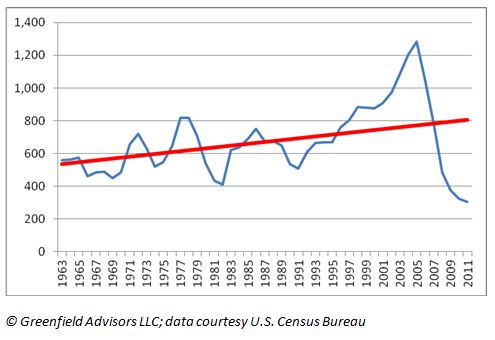
The second graphic adds a simple linear trend line for simplicity sake, which is not far removed from the actual household formation trend line during that same period. Note that from the beginning of the chart until about 2001, we had a nice cycle going, and in fact around 2001, the blue line should have turned negative to account for the recessionary impacts. However, money got very loose during the early part of the last decade, and rather than housing starts serving its normal “pressure relief” role, it was driven into a counter-cyclical path. This created the oversupply we are now trying to work through (often referred to as the “shadow inventory”) and we won’t see a healthy market until this inventory is mopped up.
Good news, though — if you glance quickly at the second chart, it becomes clear — albeit from a very simple visual perspective — that we must be close to a spot where an up-turn in the chart would give us as much negative area red line as we had during the previous cycle above the red line. In short, we’re not at the end of the tunnel yet, but this simple way of looking at things suggests we may be able to SEE the end of the tunnel in the not-too-distant future.
Share this:

REIT Fundraising on the Rise
According to SNL Financial, U.S. Equity REITs have raised $35.27 Billion through August 10th, over 10% more than was raised during the similar period last year. Continuing with the debt/equity theme we noted in a recent post, senior debt only constituted about 38% of this total ($13.53 B) with the remainder coming from common equity ($14.72 B) and preferred equity ($7.02 B).
Interestingly enough, Health Care REIT had the largest stock offering at $810.8 million, followed by Kilroy at $230.5 million and Taubman Centers at $281.5. All three of these are notable, as none of them are in the “hot” apartment sector. Indeed, of all of the sectors, health care raised the most at $7.7 Billion, followed by retail at $7.61 B.
The bigger question, of course, is what does this say about the real estate market? REITs buy cash flow, not capital growth, and respond to investor demand for something to take the place of flat-lined bonds. Given the risk of holding long-term bonds in an up-ticking interest rate market, compared to the yield margin and inflation hedge of REITs, this may be less a commentary on the quality of the property market and more a comment on the demand for REIT shares.
Share this:
Tightened appraisal standards?
Federal regulators have proposed new rules for “risky” mortgages, including tightened appraisal standards. The proposed new rules are open for comment until October 15.
The Federal Reserve, the Consumer Financial Protection Bureau and other Federal regulators have proposed that all risky mortgages have appraisals performed by licensed or certified real estate appraisers. Intriguingly, similar regulations were put in place two decades ago for all Federally insured mortgages by the Financial Institutions Reform, Recovery, and Enforcement Act (“FIRREA”). This act essentially created the appraisal license laws that exist in the 50-states today, but over the years, the appraisal requirements have been diluted to the point where many loans are made without an appraisal. These proposed regulations recognize the problems caused in the banking system by un-supported mortgage loans.
In an effort to prevent the use of fraudulent appraisals in illegal “flipping”, the regulations would also require a second appraisal if the seller had purchased the home at a lower price during the prior six months.
A mortgage would be deemed “higher risk” if the interest rate was significantly above the Average Prime Offer Rate, survey weekly survey from the Federal Financial Institutions Examination Council. As of last week, the AOPA stood at 3.64%for 30-year “conforming” loans, and under the proposed rules, a higher-risk loan would be one carrying a rate of 5.14% or higher. For “jumbo loans” (generally those exceeding $417,000), the threshold would be 6.14%.
Share this:
REIT Valuations — Looking Forward
We’re still picking thru the immense amount of information that came out of REIT week back in June. Paul Whyte, a managing director at Credit Suisse in charge of their investment banking sector, is looking for “continued growth in valuations and operating income in the commercial real estate industry during the second half of 2012,: according to an article posted by REIT.com writer Matt Bechard last week.
Whyte says investors will continue the “flight to quality” in terms targeting trophy assets, noting that “In uncertain times, capital tends to go where they see long-term opportunity.” Whyte singled out two sectors, retail and data centers, for particular attention. In the retail arena, investors appear to be looking for higher-quality class-A mall properties rather than suburban investments. He suggested that data centers are “intriguing,” and that with continued movement to cloud computing and social media, “there’s just enormous demand there.”
Reflecting our own sentiments here at Greenfield, Whyte has deep concerns about property investments in the Eurozone. “I think that what Europe lacks is a comprehensive, long-range plan for fiscal unity,” Whyte said. “Without it, we’re just really putting Band-Aids on the patient.” He also noted, “From a headline perspective, Europe is influencing the markets more so than I think anybody had ever imagined,” he said.
As for the U.S., he concurs that we are in a recovery mode, and projects investment interest in energy, health care and technology sectors.
REITWeek was held June 12 – 14 at the New York Hilton. It is the annual investor forum sponsored by the National Association of Real Estate Investment Trusts.
Share this:
Louisiana, oil spills, and the Atchafalaya
I spent most of last week based out of New Orleans, with trips north (into St. Tammany Parish) and southwestward into the Atchafalaya Basin. It’s this latter foray that I wanted to discuss today — probably one of the most significant and rich ecosystems in the U.S., and yet one that hardly anyone knows about. From a real estate perspective, it’s both beautiful and critically important.
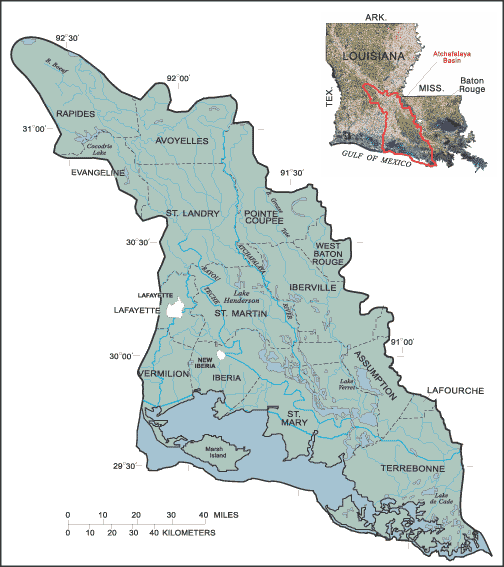
Courtesy USGS
The Atchafalaya is the largest swamp in the United States, located basically where the Atchafalaya River pours into the Gulf. It spans all or part of 15 parishes (Louisiana has “parishes” rather than “counties”). The Atchafalaya has a growing delta system and fairly stable wetlands, which is significant for several reasons. Louisiana, believe it or not, has 25 percent of the forested wetlands and 40 percent of the coastal wetlands in the 48 contiguous States but accounts for 80 percent of wetlands losses according to the USGS. The State’s coastal area (wetlands, estuaries, and barrier islands) is under stressed conditions resulting from a complex array of adverse natural environmental processes and human-related activities. Every year, the Louisiana coastal area, one of the world’s most productive ecosystems, loses as much as 20 to 25 square miles of land. Thus, about 1,000 to 1,500 square miles of Louisiana’s coastal wetlands have been converted to open water during the past half century. The processes and activities that have contributed to this conversion include long-term erosion and land subsidence (sinking of the land) caused, in part, by compaction of Mississippi River Delta sediments and by large storms that strike the area about every 5 years, rising sea levels, changes in human population, energy development, flood control, and maintenance of navigation channels. As wetlands, estuaries, and barrier islands vanish, the State loses important natural buffers protecting New Orleans and other populated coastal areas from storms and flooding.
As you might guess, what with Hurricane Katrina, various oil field contamination disputes, and the BP Oil Spill, I’ve spent a fair amount of time in and around the Atchafalaya. If you ever get the chance to go, don’t miss it! Nonetheless, we’re still assessing the damages resulting from the oil spill and resultant economic effects. Stay tuned — this research continues!
Share this:

Appraisal Institute meeting in San Diego
I had the pleasure of being invited to speak at the Appraisal Institute’s annual meeting in San Diego last week, which brought together many of the top minds in the valuation field for three days of seminars and business meetings. While AI is fairly small (only about 23,000 members globally), its influence in the real estate field cannot be understated. In the U.S., appraisal license law and standards (the Uniform Standards of Professional Appraisal Practice, commonly known as USPAP) owe their genesis to work done by AI back in the 1980’s during the Savings and Loan Crisis, and possession of an AI designation (either MAI or SRA) is frequently cited in real estate contracts as required for establishing lease renewal rates or other contractual matters. Courts throughout the land routinely accept testimony from AI members without question. Real estate regulatory bodies throughout the U.S. are populated by AI members, and rare is the state legislature that will make changes to real estate law without the consultation of AI members. The AI’s government affairs team in D.C. has influence throughout the real estate arena, which of course today transcends traditional boundaries and includes regulatory efforts of the GAO and SEC, among others.
I was asked asked to deliver an address on advanced statistical methods. I’ll leave that discussion for another day, and focus on what I learned there — which was significant — rather than what I said. Other sessions dealt with meaty topics like the attorney/appraiser interface and the complexity of real estate valuation in the financial reporting arena. Not unexpectedly, there was a tremendous amount of attention paid to technology, which is really leading to an interface between “automated valuation model”-type tools and the individual appraiser. In short, we may be very close to a day, thanks to technology, when the individual home appraiser is tapping into a more robust set of analytical tools in order to produce collateral valuations with strong statistical support. Anyone who has been following the mortgage meltdown news for the past few years will understand the significance.
The keynote speaker was Dylan Taylor, CEO/USA of Colliers International. He riffed off of the title of the book “The Earth is Flat”, and talked about barriers to globalization in the real estate biz which he called “rounders”. The two principle ones for our field are regulatory barriers (licensure problems, even across 50 states, much less across countries) and capital needed to grow businesses (technology, etc.) He notes that in most professions, there is a tipping point to consolidation, and uses CPA firms as examples. The total billings of U.S. CPA firms last year was about $120 Billion, and the big 4 accounted for $80 Billion of that. The need for technology, increased specialization, etc., will probably stimulate that in appraisal firms (which currently have world-wide billings on the order of $3 Billion, but the top few only account for a small fraction of that). He says that in the future, there will be a handful of very large appraisal firms plus “boutiques”. In his view, the boutiques will do quite nicely, but the middle-market appraisal firms will die on the vine.
Taylor notes that USPAP will be generally moving toward International Valuation Standards (“IVS”) in the same way Generally Accepted Accounting Practice (“GAAP”) is moving toward International Financial Reporting Standards (“IFRS”). The latter sets of standards provide much more “client defined” reporting standards. He notes, for example, that several aspects of IFRS will cause “disruptive change” in American real estate, such as the way the two different paradigms treat carried interest.
As noted, a separate session dealt with the interface between appraisal and financial reporting. Earlier this year, the SEC “kicked the can” toward 2013 for U.S. adoption of IFRS. It was noted that while 90% of GAAP and IFRS are functionally identical, the changes needed to adopt the remaining standards could be so costly and disruptive as to dwarf the problems following adoption of Sarbanes-Oxley. Nonetheless, some movement in that direction is inevitable. From a real estate perspective, this may include the elimination of depreciation for financial reporting, substituting annual “mark-to-market” valuations instead. That is a very different paradigm for property valuation in the U.S.
Other sessions included a presentation from the FDIC’s General Counsel’s office, a presentation on standards and practices for Federal land acquisition, and a VERY informative presentation on “getting published”.
Share this:
Real estate and the “long game”
The two big economic stories right now — and probably for the rest of the year — will be the impact of the Euro problems and the impact of the impending “fiscal cliff” in the U.S. We don’t want to minimize the significance of either of these impending problems on the financial world in general and real estate in specific. Indeed, either of these problems has the potential to bring down the global house of cards.
Nonetheless, it’s important to keep our eyes on the longer trends within which these crises exist. The exit strategy for either of these crises depends heavily — maybe even totally — on the trajectory of these longer-term trends.
A very brief article in the current issue of The Economist caught our eye this week. The article was about the disparity between the median population age of various countries and the average age of that country’s cabinet ministers. The goal was to show that in the “rich” world (e.g. — Germany), the cabinets more closely resembled the general population, while in the “emerging” world (e.g. — India, China) there was a large disparity, with attendant potential instability. In that context, however, the article wasn’t very compelling — the U.S. has a huge disparity, while Russia has a high degree of alignment. Go figure. What caught our eye, though, was the variation in population age among various countries, and the implications for long-term growth. Quite a few years ago, I was at an academic conference which discussed the increasing age of the population in Europe, and in that context how Europe had the potential to be the next Japan. An aging population has very significant implications for real estate — particularly in the commercial sector. As a decreasing portion of the population is working to support a larger and larger retired segment, there is both a generic malaise inherent in the economy (unless high increases in productivity are induced) and a decreasing need for commercial real estate space (particularly in offices, warehouses, and manufacturing).

In that context, the emerging nations of the world have an edge — note the low median ages in India, China, Brazil, and Canada. Ironically, the U.S. is also in that mix, and to a lesser extent Australia and Russia. At the other end of the spectrum, Japan and Germany have nearly the same median age problems. The latter is most problematic, since the German economy has been entrusted with bringing the Euro zone out of its doldrums. Clearly, a rapidly aging German population has less need for commercial real estate, but also less ability to drag the ox cart of Europe along the road to recovery. Britain, solidly part of Europe but outside the Euro, has a somewhat younger population — indeed slightly closer to the U.S. than Germany and about equal to economically stalwart Canada. The short-term horizon will continue to fuel real estate challenges and opportunities, but the “long game” context needs to be taken into account as opportunity-seekers consider down-the-road exit strategies for today’s purchases.
Share this:

REIS reports on the office market
Got an early peek this morning at the forthcoming office market report from ReisReports. Like everything else in the economy today (except apartments), the operative word is “sluggish”. Indeed, even in the bullish apartment market, the core driver is the sluggish economy turning “owners” into “renters”.
On the surface, the facts aren’t all that bad. Office vacancy rates topped out above 17.5% in mid-2010, and have been on a slow trend downward. However, for the last two quarters, the rate has stalled at 17.2%. Quarterly absorptions have been in positive territory since early 2011, totalling about 4 millions square feet nationally in the 2nd quarter 2012, even in the face of the lowest office completions level since REIS began tracking data in 1999. Rents remain at 2007 levels, with 0.3% gains in both asking and effective averages.
The reasons are obvious — continued fears from Europe (which may be abating, given very recent pronouncements from European central bankers), the close presidential election, and the very real fear of of the “fiscal cliff” in early 2013 contribute to an anemic jobs recovery. Without new jobs, there is no demand for office space. You do the math.
In most American cities, the stark reality on the skyline is the absence of high-rise cranes. Given the very long pipeline for office construction, coupled with the difficulty financing in this sector, and it may be many years before we see this market turn fully around.