Corporate Investment — Much ado about…. something
I can’t believe it’s been a month since I posted — I’ve been traveling almost constantly the past few weeks, and between that and the elections, my dance card has been fairly full.
The trigger for day’s post was an article in the Wall Street Journal on Monday, “Investment Falls off a Cliff”, with obvious homage to the impending fiscal cliff. I don’t want to minimize the danger of the “FC”, and in fact all bets are really off if the worst case scenarios come to pass. Here at Greenfield, we don’t really believe Congress and the White House will both fail to blink. Nonetheless, “keeping your powder dry” is always good advise in perilous times.
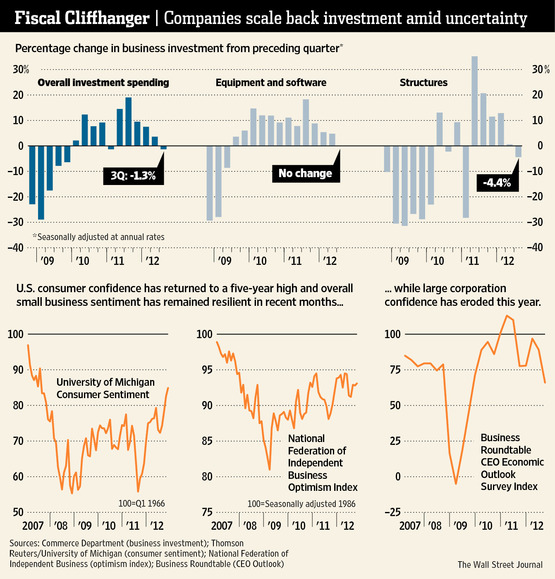
I’d like to comment on two things, though. First, while direction of corporate investment isn’t good, it’s not quite “double dipping” just yet. Indeed, one might argue that the current downswing in investment is nothing more than seasonal backing-and-filling.
courtesy, Wall Street Journal
Note that after coming out of the recession, overall investment spending took a brief respite in early 2011, as well. Of course, equipment and software appear to continue healthy, but structures are dragging the overall index down. Part of this can be explained by the relaxation of the apartment construction surge that we saw over the past several quarters. Many analysts now believe the demand-overhand in apartments is close to saturation (or at least satisfaction) and this sort of slow-down is neither unusual nor unhealthy. Note that the NFIB optimism survey is still trending upward, although the Business Roundtable CEO survey (which surveys heads of larger firms than the NFIB does) had turned downward. I suspect that’s a rebound effect — small businesses are still clawing their way out of the recession, and are less affected by what may happen if the FC becomes reality. The larger firms were the first to enjoy the fruits of the recovery, and would be the worst hurt by tax increases and the FC cutbacks (particularly in defense). Nonetheless, both of these sentiment measures are well off their 2009 bottoms. Consumer sentiment, which ultimately drives much of this, is as good as its been since before the recession.
Second, I’m concerned about the negativity spreading to real estate. Note that real estate investment comes in three flavors — development, capital gains, and income. The downturn in investment has SOMEWHAT negative implications for the first. Real estate developers will have to be more careful in a slow-down environment, but that’s been true throughout this recovery. Financing is difficult, even in the “hot” apartment market, and so admittedly the commercial real estate developers may be in for a tough run. (Residential development, on the other hand, is rebounding nicely.) Capital gains is a “long game” anyway. Certainly the tax changes which seem inevitable in 2013 and beyond have negative implications for the buy-and-sell crowd, but the returns to those who can hold thru cyclical downturns have always been healthy even after tax considerations.
Real estate income (primarily REITs) may actually be benefitted by a slight retrenchment in development. If and as the economy continues to rebound, offices, warehouses, and shopping malls continue to fill up. Lack of new supply (from a cyclical downturn in development) benefits the sort of existing structures which are typically part of a REIT portfolio. As always, investors will be benefitted from looking at good managers with top-drawer properties and a history of increasing FFO.
Share this:

European Real Estate Funding Gap
Property Investor Europe sent me a report today about the shortfall in real estate funding in Europe. The implications are a bit nerve wracking.
First, some background — European commercial real estate investors place significantly more emphasis on “traditional” bank lending than Americans. As such, the sort of private-debt network that exists in the U.S. has not grown in Europe.
According to a report by the research firm Swisslake, central bank liquidity flows gave been directed at small and diversified loans, which are in high demand. However, commercial lending in Europe is actually facing cuts of €500 Billion or so. In addition, banks are increasing equity requirements, leaving real estate with large financing gaps, Swisslake calculates that only about $3.8 Billion headed towards Europe in the last year from non-bank lenders.
However, this is creating a market opportunity for private debt funds. Reportedly, 30 new funds have been launched in 2012, adding to the 20 new funds created in 2011. These funds have increased their market share to 20%, up from 15% at the beginning of 2012. Intriguingly, many former equity fund managers are now shifting to private debt funding.
Share this:

Economic outlook — fundamentals and shocks
I love boating, I really do. To quote from Grahame’s famous The Wind in the Willow, “…there is NOTHING–absolute nothing–half so much worth doing as simply messing about in boats.” However, any experienced sailor has had one of those days when the water was perfect, the wind was with you, but off on the horizon a storm cloud lurked. “Will it head our way, or pass us by?” is the key to whether the fun cruise continues or not.
Today, and for the next few weeks, the economy is like that. The wind is definitely at our backs, and things are generally looking up. That having been said, the fiscal cliff continues to loom on the not-too-distant horizon.
First, the good news, and there’s plenty of it. I’m on the Board of an investment fund (and in fact just got named chairman of the board this month, for a two-year stint). We had a great briefing yesterday from our lead fund manager, and macroeconomic news was as good as I’ve seen it in a while. Corporate profits are at near-record levels as a percentage of GDP, and non-financial interest expense as a percentage of profits is at a near-record low. Lending is back up, although corporate lending isn’t quite as robust as consumer lending, and current stock market price-earnings ratios (measured on a 12-month trailing basis) are at levels usually associated with strong intermediate-term (5-year) market returns. Equity risk premia tell the same story.
On the real estate side, everyone’s seen the news that the S&P Case Shiller index is trending back up, and this morning’s news report puts current housing starts above an 800,000 annualized level (note that we’re hoping for a million, and at the trough of the recession we were at a record low 300,000-ish). Manufacturing has added about a half-million jobs since the trough of the recession (early 2010), and is about 300,000 above where it stood in July, 2009.
The implications for real estate investment are clear, and as I reported earlier this week, the total return on U.S. REITs has exceeded 30% in the past year, besting the S&P 500.
With that in mind, though, the fiscal cliff continues to trouble us all. If you’re not familiar, on January 1, the Bush Tax Cuts will expire and mandated federal spending cuts are scheduled. Together, these two will hit the economy to the tune of about 4% of GDP (yes, driving us into a second recession). Sadly, the solution is political, and this is all coming at a time when Congress and the White House are totally focused on the impending election.
We’ll keep you posted, and we’re preparing some private white papers on this subject for our clients as the season moves forward.
Share this:
REITs — good news trumps “iffy” news
The “headline” in Erika Morphy’s piece in GlobeSt.Com this morning was that was that REITs underperformed the S&P 500 for August and September. Specifically, REITs were up 1.85% in the 3rd quarter this year, compared to 6.35% for the S&P 500. You have to dig a little deeper to get to the heart of the matter, though.
First, let’s remember that investors by-and-large buy REITs as an income vehicle with equity up-side. The current average REIT yield is 3.88% — not bad, compared to corporate bonds or preferred stocks, and more targeted income seekers can go after single tenant retail with a yield of 5.9%. (For a great review of this, see a piece by Brad Thomas in Forbes.com from September 10). Couple those sorts of dividend yields with any upside equity potential, and you have a real investment powerhouse in today’s market. For comparison, the current yield on the S&P 500 is 1.97%.
But, the news gets better. For the 12-months ending September 30, the NAREIT index was up 33.81%, compared to 30.2% for the S&P. Do the math — the total return for a portfolio of REIT shares for the past year would have been (33.81% + 3.88% = ) 37.69%. The total yield for the S&P 500 would have been (30.2% + 1.97% = ) 32.17%. Thus, slightly more than a 500 basis point return advantage to REITs.
Of course, (and this goes without saying), past performance doesn’t translate into future returns…..
Share this:
Comments to the Appraisal Foundation Strategic Plan
Appraisal standards and licensure qualification in the U.S. are promulgated by the Appraisal Foundation in Washington, D.C., a private organization which receives oversight from the Congressionally-established, inter-agency Appraisal Subcommittee.
This summer the Foundation issued a request for comments on a sweeping update to their strategic plan. I, along with many others, have submitted comments to the proposed updates, and my comments will soon be published on the Foundation’s website. I’m also presenting my comments here, verbatim, for discussion and input from colleagues and friends (see below).
Enjoy!
Comments to Appraisal Foundation Strategic Plan
Share this:
Rays of sunshine
Fall isn’t usually the time we talk about rays of sunshine, particularly not here in Seattle where we all “hunker down” this time of year for the long, dark, wet winter. Plus, I just came back from three weeks on the road (nine hotels, 4 time zones, two rental cars with a combined 2,000 miles, and four plane flights). One of the first things to hit my in-box was the periodic Real Estate Investment SmartBrief from the National Association of Real Estate Investment Trusts with the headline “Hopes for U.S. Rebound Fade as Global Trade Slips”. Sigh….. not a really nice headline, eh?
Now, I have the greatest respect for NAREIT, and out of fairness, they lifted this story from the Wall Street Journal. Nonetheless, when the market opened this morning, it actually darted into positive territory, with the S&P hovering above 1450 as I write this. (I hope I don’t jinx it!). Of course, the stock market has risen for the past three Octobers, and in fact the market had a significant rally in September — a rarity for a month that’s usually fairly flat — with the S&P gaining almost 3% and the Dow picking up about 2% during the month. The “rally” this morning was triggered by two things. First, the ISM report (Institute for Supply Management) came out in positive territory for the first time in four months, confounding analysts who thought it was continuing downward. Second, this caused the short-sellers, who have banking on a negative October, to re-think their positions. Hence, the really great bounce this morning was, in no small part, a lot of short-covering.
No question about it — a shrinkage in global trade is an unsettling thing, for three big reasons. First, it signals that the net importer regions (particularly Europe) are continuing in the doldrums. Second, healthy economies which are heavily trade based (such as the U.S.) depend on trade to stimulate GDP growth. Finally, China is the world’s biggest manufacturing floor right now, and depends on trade to provide full-employment — nothing frightens Chinese officials more than unhappy workers with no jobs. Thus, from both an economic perspective as well as a geopolitical perspective, a shrinkage in trade — or even a shrinkage in the growth of trade — is a bad thing.
Notably, also, while manufacturing is only 20% of the U.S. economy, it is 40% of the profits of the S&P 500. Pundits are already noting that the ISM report is just one data point, but it’s a very important one. In the next few days, we’ll see if the good news from ISM is sustained by other sectors of the economy.
Share this:
And now for something completely different…..
All work and no play makes John a dull boy, I guess, so Tuesday evening, I enjoyed a great dinner at the Cosmos Club in DC with Amanda Smith to celebrate her new book, Newspaper Titan: The Infamous Life and Monumental Times of Cissy Patterson. For a bit more about Amanda and her book, click here or keep reading.
First, about Amanda — you may know her better as the biographer and granddaughter of Joe Kennedy (Hostage to Fortune: The Letters of Joseph P. Kennedy), who of course was the Ambassador to the Court of St. James under FDR in the 1930’s, and perhaps even better known as the Father of JFK, RFK, Teddy, and the like. Amanda’s mom is Jean Kennedy Smith, no slouch in her own right, who is the last surviving child of Joe and Rose Kennedy and was Ambassador to Ireland under President Clinton. Amanda holds her doctorate from Harvard.
Joe Kennedy, of course, was one of the great isolationists during the interwar years, and when Amanda was researching her granddad, she was drawn to the stories behind the other isolationists of the day. Cissy Patterson is one of the most interesting women — nay, most interesting people — of the middle years of the 20th Century. In 1946, Colliers magazine called her the most powerful woman in America, and perhaps the most hated. She was the granddaughter of Joseph Medill, one of the founders of the Republican Party (and the man who delivered the decisive Ohio delegation to Abraham Lincoln at the 1860 convention), and after an amazingly adventurous life, became publisher of the Washington Times Herald, taking it from the 5th rank among papers in the nation’s capital to number one in both circulation and influence during World War II.
Presenting a book about Cissy Patterson at the Cosmos Club was not without irony (and regular readers of this blog know how much I love irony). Cissy Patterson was an early supporter of FDR, but became a big critic of his administration over its foreign policy. The wonderful headquarters of the Cosmos Club, on Massachusetts Avenue, was the former home of FDR’s under-secretary of state, the famed Sumner Welles, who was one of the great architects of modern-day interventionist U.S. foreign policy and the designer of the United Nations.
Of course, attending a dinner to honor Amanda Smith and her new book wasn’t the ONLY reason I was in DC this week, but it’s the only one I can talk about right now. More on the other things later.
Share this:
REIT Research — Real Estate in Volatile Times
The National Association of Real Estate Investment Trusts (NAREIT) recently commissioned Morningstar to study the role of securitized real estate in the well-balanced portfolio, with a particular eye to the investor attitudes regarding risk, as well as the actual performance of markets. Both of these two concepts — risk and investor attitudes — are less well understood than researchers seem to think. In the first, market models assume a degree of normalcy in the distribution of market returns. However, empirical evidence seems to contradict this, and in fact market volatility is significantly greater (and of greater magnitude) than models would predict.
In the second case — investor attitudes — traditional models suggest that rational investors react to “up” markets in the same way as “down” markets. More recent behavioral models recognize the fallacy in this — rational investors relish “up” volatility, but loathe down markets.
The results of the research were published in an excellent new research piece from NAREIT titled “The Role of Real Estate in Weathering the Storm” (click on the title for a copy of the paper). Some high-points from the study:
- Since 1929, the S&P 500 has had 10 months with declines of 15.74% or more — which is eight more than would be predicted by a normal distribution.
- Recent studies by James Xiong of Ibbotson Research show that the log-normal distribution fails to account for this down-side volatility.
- From 2000 – 2009 (often called the “lost decade”), the cumulative return on large-cap stocks was negative 0.95%.
Morningstar then crafted portfolios under the “theoretical” model (normal distribution) versus a more realistic model of volatility, with alternative structures for risk-averse investors and more risk-tolerant investors. Investment returns were measured over the period 1990 – 2009, which notably included the recent market melt-down.
Under normal distribution assumptions, an optimum risk-averse portfolio would allocate about 6% to securitized real estate and theoretically enjoy a return of 7.6%. Under more realistic volatility assumptions, the risk-averse portfolio would allocate 14% to securitized real estate and would have returned 8.2%.
A more risk-tolerant investor would have allocated 18% to 20% in securitized real estate, and would have enjoyed a return of 9.7%, with volatility (standard deviation of portfolio returns) of 10%.
The most striking finding of the study was the consistent role played by securitized real estate in all four of the models (normal versus non-normal, risk-averse versus risk-tolerant) and particularly thru the market melt-down. While this may seem counter-intuitive, given the roller-coaster ride of REIT prices, investors need to realize that REIT shares paid relatively high dividends through this period, thus ameliorating the downward price movements. In short, the gains from real estate holdings pre-meltdown, coupled with the dividends, more than made up for the price bounce over the past few years. Further, REIT prices have rebounded better post-recession than have other S&P shares.
Share this:
Sustainability — Follow the Money
Sustainability seems to be the real estate buzz word du jour. A “google” of “sustainable real estate” brings me slightly over 56 million hits. Number two on the list is the Journal of Sustainable Real Estate, (a more-or-less joint presentation of the American Real Estate Society and CoStar) of which I’m apparently on the editorial committee. Go figure.
I don’t want to sound too cynical here, but as a “finance guy” in the real estate field, I tend to follow the money. A lot of what’s going on in real estate, particularly at the individual building-level, has a lot to do with sustainable energy (e.g. — LEED Certification, Energy Star) or sustainable architecture. There was a nice paper out of Clemson University by David Heuber and Elaine Worzala recently on sustainable golf course development (click here for a link) which begins with the irony that no one is building golf courses today. Scott Muldavin has a great book on underwriting and evaluation sustainable financing (reviewed here) which gets close to the heart of the matter.
However, Ben Johnson, writing for the current issue of Real Estate Forum, seems to have caught the scent, to use a hunting dog analogy. In his article, “When CalPERS Talks, People Listen”, he notes that this mega-pension fund n($228 billion) has about 8% of its total invested in real estate. (My own estimate is a bit higher and more current than that — see here for details.) The noteworthy thing, however, is that CalPERS just made a $100 million stake in Bentall Kennedy outt of Toronto. B-K is one of North America’s largest real estate investment advisors, resulting from the 2010 merger of the Canadian firm Bentall with Seattle’s own Kennedy Associates.
Two things make this all very interesting. First, B-K earned the top spot this year on the Global Real Estate Sustainability Benchmark Foundation’s ranking of fund managers in the Americas. This ranking, covering 340 of the world’s largest funds, measures social and environmental performance. (Given B-K’s Pacific Northwest and Canadian pedegrees, this doesn’t surprise me at all.)
Second — and this may be the biggie — as CalPERS goes, so goes the industry. The focus of Mr. Johnson’s article was to note that now every pension fund in the known universe will need to consider using an advisor like B-K. Johnson notes that this deal “gives the largest public institutional player in the US a deeper investment in understanding real estate as an asset class and a unique insider’s view of the industry’s dynamics.” More interestingly, I would posit, it puts a leader in sustainable real estate front-and-center in the view of the sorts of pension managers who, until now, have very little cross-pollination with the real estate industry. In short, as institutions look to find good real estate partners, sustainability will be a key element of consideration.
Share this:
Expert Witness Testimony
Deviating a bit from my normal blogging, I’m reminded that a fair number of us who do what I do end up on the witness stand testifying about economic and financial problems. Given the after-shocks of the recent recession, there is no shortage of opportunity to put on a coat and tie and drink bad courthouse cafe coffee for those of us who dabble in that sort of thing.
That having been said, surprisingly few “experts” have a stomach for sitting in the witness box (and all of the lead-up to it). Indeed, the actual testimony itself is a bit of a let-down usually (particularly when it goes well). It’s the lead-up and preparation for the testimony which causes all the acid indigestion.
For readers who have been approached to potentially serve as an expert in a litigious matter (I call it that, because in my experience fewer than 10% of such disputes actually end up in a courtroom), there is an excellent article in the current issue of The Appraisal Journal by a real estate appraisal-expert, David C Lennhoff, MAI, SRA, and an attorney, James P. Downey, JD. Titled “Litigation Lessons: A Practical Guide to Expert Testimony”, the article focuses on the real estate valuation expert. Nonetheless, the advise transcends any of the professions or disciplines which might be called on to offer expert testimony on complex matters.
The article is broken down into two parts — the appraiser’s perspective and the attorney’s. Without reviewing point-by-point, several ideas stood out, and I believe there may have been a few items left out:
Preparation — Both preparing the expert and jointly preparing the expert/attorney relationship.
A confident attitude — Not to be confused with arrogance. The former is necessary, while the latter is the death-knell.
Clarity — Think, write, and speak to translate complex topics into simple language.
Familiarity with the terminology — Both the legal terms and the “expert” terms. To a large extent, the expert is there to translate complex litigious issues into simple terms for the Court. (See “clarity” above.) With that in mind, the “expert” needs to be the Judge’s and Jury’s walking, talking dictionary, to explain what these complex issues are all about. This requires that the “expert” actually be “VERY expert” in the topic at hand, both in the jargon and what the jargon actually means.
I would suggest that one important topic was not covered well in the article. One critically important role for the expert witness is explaining the case to the attorney/clients. These attorneys frequently come to the expert with an idea of what the case is all about. Of course, only the most experienced attorney will have a grasp of the nuances of the expert’s field, and more often than not the attorney will have an “idea” about the direction of the expert analysis and testimony which needs to be molded into something slightly different (or, in some cases, something RADICALLY different). Since 9 out of 10 cases seem to settle before getting to the courthouse (at least in my experience), the expert really earns his or her fee by helping the attorney craft a case that can be successfully settled before actual testimony is needed.
 From a small northwestern observatory...