Archive for the ‘Uncategorized’ Category
And now for something completely different…..
All work and no play makes John a dull boy, I guess, so Tuesday evening, I enjoyed a great dinner at the Cosmos Club in DC with Amanda Smith to celebrate her new book, Newspaper Titan: The Infamous Life and Monumental Times of Cissy Patterson. For a bit more about Amanda and her book, click here or keep reading.
First, about Amanda — you may know her better as the biographer and granddaughter of Joe Kennedy (Hostage to Fortune: The Letters of Joseph P. Kennedy), who of course was the Ambassador to the Court of St. James under FDR in the 1930’s, and perhaps even better known as the Father of JFK, RFK, Teddy, and the like. Amanda’s mom is Jean Kennedy Smith, no slouch in her own right, who is the last surviving child of Joe and Rose Kennedy and was Ambassador to Ireland under President Clinton. Amanda holds her doctorate from Harvard.
Joe Kennedy, of course, was one of the great isolationists during the interwar years, and when Amanda was researching her granddad, she was drawn to the stories behind the other isolationists of the day. Cissy Patterson is one of the most interesting women — nay, most interesting people — of the middle years of the 20th Century. In 1946, Colliers magazine called her the most powerful woman in America, and perhaps the most hated. She was the granddaughter of Joseph Medill, one of the founders of the Republican Party (and the man who delivered the decisive Ohio delegation to Abraham Lincoln at the 1860 convention), and after an amazingly adventurous life, became publisher of the Washington Times Herald, taking it from the 5th rank among papers in the nation’s capital to number one in both circulation and influence during World War II.
Presenting a book about Cissy Patterson at the Cosmos Club was not without irony (and regular readers of this blog know how much I love irony). Cissy Patterson was an early supporter of FDR, but became a big critic of his administration over its foreign policy. The wonderful headquarters of the Cosmos Club, on Massachusetts Avenue, was the former home of FDR’s under-secretary of state, the famed Sumner Welles, who was one of the great architects of modern-day interventionist U.S. foreign policy and the designer of the United Nations.
Of course, attending a dinner to honor Amanda Smith and her new book wasn’t the ONLY reason I was in DC this week, but it’s the only one I can talk about right now. More on the other things later.
Share this:

Expert Witness Testimony
Deviating a bit from my normal blogging, I’m reminded that a fair number of us who do what I do end up on the witness stand testifying about economic and financial problems. Given the after-shocks of the recent recession, there is no shortage of opportunity to put on a coat and tie and drink bad courthouse cafe coffee for those of us who dabble in that sort of thing.
That having been said, surprisingly few “experts” have a stomach for sitting in the witness box (and all of the lead-up to it). Indeed, the actual testimony itself is a bit of a let-down usually (particularly when it goes well). It’s the lead-up and preparation for the testimony which causes all the acid indigestion.
For readers who have been approached to potentially serve as an expert in a litigious matter (I call it that, because in my experience fewer than 10% of such disputes actually end up in a courtroom), there is an excellent article in the current issue of The Appraisal Journal by a real estate appraisal-expert, David C Lennhoff, MAI, SRA, and an attorney, James P. Downey, JD. Titled “Litigation Lessons: A Practical Guide to Expert Testimony”, the article focuses on the real estate valuation expert. Nonetheless, the advise transcends any of the professions or disciplines which might be called on to offer expert testimony on complex matters.
The article is broken down into two parts — the appraiser’s perspective and the attorney’s. Without reviewing point-by-point, several ideas stood out, and I believe there may have been a few items left out:
Preparation — Both preparing the expert and jointly preparing the expert/attorney relationship.
A confident attitude — Not to be confused with arrogance. The former is necessary, while the latter is the death-knell.
Clarity — Think, write, and speak to translate complex topics into simple language.
Familiarity with the terminology — Both the legal terms and the “expert” terms. To a large extent, the expert is there to translate complex litigious issues into simple terms for the Court. (See “clarity” above.) With that in mind, the “expert” needs to be the Judge’s and Jury’s walking, talking dictionary, to explain what these complex issues are all about. This requires that the “expert” actually be “VERY expert” in the topic at hand, both in the jargon and what the jargon actually means.
I would suggest that one important topic was not covered well in the article. One critically important role for the expert witness is explaining the case to the attorney/clients. These attorneys frequently come to the expert with an idea of what the case is all about. Of course, only the most experienced attorney will have a grasp of the nuances of the expert’s field, and more often than not the attorney will have an “idea” about the direction of the expert analysis and testimony which needs to be molded into something slightly different (or, in some cases, something RADICALLY different). Since 9 out of 10 cases seem to settle before getting to the courthouse (at least in my experience), the expert really earns his or her fee by helping the attorney craft a case that can be successfully settled before actual testimony is needed.
Share this:
Welcome to April
…and welcome to Florida. I’ve been in the southeast corner of the U.S. for the past two weeks in a hearing. I happen to love Florida, and if I ever get around to retiring, I’ll probably end up here. Thanks to personal choice, some business, and just a little bit of kismet, I get to travel here at least 3 or 4 times a year. Indeed, by the end of April, I will have made 3 trips here in 2012, with at LEAST two more planned.
In many ways, Florida is the poster child for the current economic problems plaguing the U.S. It has all of the hotbutton issues in one place — overbuilt housing, lending practices to match, and huge demographic shifts. The latter is almost humorous — Florida is jokingly referred to as “God’s waiting room”, not withstanding the fact that suburban Las Vegas, Orange County, California, and Scottsdale, Arizona, are all fighting for that moniker. Indeed, about 15 years ago, I was relegated to represent my university at the annual meeting of the American Association of Retirement Communities. I learned (among other things) that the two Carolinas, when taken together, actually get as many retirees every year as does Florida. However — and here’s the funny part — the “source” of Florida’s retirees is primarily the New England and Mid-Atlantic region. The “source” of the Carolinas’ retirees is Florida — they’re called “half-backs” because they move to Florida, find the weather to be abysmal, and move half-way-back home.
Being that as it may, Florida is still the destination for seemingly millions of retirees, a large proportion of whom seem to be “snow-birds”. They live in Florida 6.01 months of the year (just enough to qualify for Florida citizenship, and thus preferential Florida taxes) and then head back up north on March 31 every year. (I was in Florida on March 31, and the out-migration seemed to clog the interstates).
Before the melt-down, the whole housing industry in Florida existed to provide half-year housing for these snow-birds. Pick what you want — condos, townhouses, detached homes, we’ve got it at every price-point, size, color, and configuration. It would be hard to imagine a housing solution that wasn’t available in Florida. Financing? No money down? No problem. Move right in. While a surprisingly large number of homes were paid for with cash, there was certainly lots of available financing for the retiree who didn’t want to tap his funds for a down payment. And why tap your funds? When the stock market is growing at 10% per year, and real estate is going up by 15% per year, who would avoid a 4% mortgage? And what bank wouldn’t make that mortgage? After all, Grandpa and Grandma are great credit risks, and if they die before the loan is paid off, certainly the property can be re-sold for a profit. It’s a win-win, right?
Yeah, we don’t need to re-visit the meltdown, but the aftermath is a fascinating war zone. First, a lot of cond0-dwellers simply walked away. A lot of single-family dwellers tried to hang on, but often to no avail. Nothing would re-sell, so the market just froze. But, remember that a LOT of the buyers paid cash or had very low LTV loans. Those folks are particularly harmed — they are sitting on nearly unsellable property, with no end of the pain in sight.
If you visit Sarasota or Naples or any of the dozens of “retirement” communities on the Florida coast, you’ll get two distinct pictures. The beaches are filled, the hotels are filling back up, and the neighborhoods look healthy. Visit the county government complex, though, and you get a distinctly different picture. Floridians are a distinctly tax-averse lot, and so many county and city governments thrived on fees paid by developers. With that market frozen, the local government finances are a mess. Couple with it an actual and meaningful decline in property tax collections, and you get a local finance problem that won’t get fixed anytime soon.
With that in mind, millions of Americans (and an increasing number of South Americans and Europeans) see Florida as the best of all retirement solutions. The weather is great most of the year, there is excellent infrastructure and health care, and plenty of recreational opportunities. The cost of living is among the lowest in the U.S., providing ample opportunity for “worker bees” who move here to care for the retirement cadre. However, the housing market continues in the doldrums. A good friend of mine, with excellent credit and not unsubstantial resources, recently bought a Florida condo. The BEST loan he could get was 40% LTV, and even that was a paperwork nightmare. There is plenty of demand for Florida housing, but the financing side of the equation continues to be an issue. Unless and until the financing problem gets fixed, the housing problem will still be with us.
Share this:
Marcus & Millichap’s Apartment Report
Of the major commercial real estate brokerage firms, Marcus and Millichap seem to consistently do the best job of thoughtful and insightful research. We track their work regularly here at Greenfield. Their 2012 Apartment Report just hit our desks, and it follows our expectations of excellent work on their part.
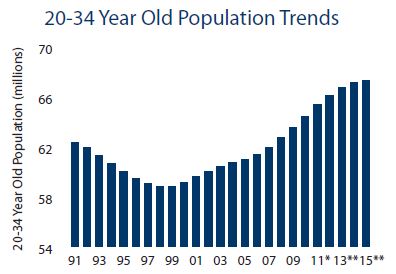
courtesy Marcus & Millichap
The apartment sector is rebounding nicely, but because of the intersection of favorable demographics and unfavorable economics. It’s driven by pent-up demand among “prime renters” (young adults who want to “unbundle” from parents and roommates) who would potentially have become homeowners a few years ago. Development had been stagnant for a few years, leaving the market with a potential shortage in supply. Developers, lenders, and investors had a brief pause late last year, but M&M expects to see steady additions to supply over the next three years.

courtesy Marcus & Millichap
As a result of all of this, vacancy rates are trending downward, and are expected to hit 5% this year (down from a peak of about 8% in 2009). This has the effect of driving up rents to historically high levels, even after a net decline from 2008 to 2009. With all this, apartment transactions are back up to pre-2009 levels, while the average price per unit is now topping $90,000 (up nearly to the peak of 2006) and cap rates are down in the 6.5% range (still off the trough of about 5.5% seen in the 2006-2006 period).

- courtesy Marcus & Millichap

The surprising upshot of all of this is that apartment cap rates are still at record high spreads over the 10-year Treasury long-term average. Market participants got nervous back in the 2006 period, when the spread had shrunk to 90 basis points (from a more “normal” rage of 380 to 430 basis points experienced since the S&L crisis 15 years earlier). Today, the spread is at 460 basis points, reflecting a bit of continued risk-aversion on the part of market participants, along with historic low rates on treasuries.
Share this:

Yet another comment about today’s economic news
It’s hard NOT to be pleased at today’s economic news. The unemployment rate is down, total employment is up (the two numbers don’t ALWAYS move in sync, due to the growth in the potential workforce), the stock market is up, the dollar is up versus the Euro, Yen, and Pound (not always a good thing), and bond yields are up (reflecting a potential demand for borrowing — a very “old school” view of stocks versus bonds). Intriguingly, oil is up but only by $0.59 a barrel as of this writing (12:35am EST on Friday the 3rd) — one would normally expect that great economic news would spur a run on oil.
Which may, in fact, reflect the continued anxiety in the marketplace. Recessions rarely happen in a straight line (see my post a few weeks ago on the relationship between the yield curve and the onset of a recession — click here for a shortcut). Real estate continues to be in disarray, and the banking sector is still in rehab, with the continued concern of a relapse if the Euro crisis doesn’t solve itself.
Ben Bernake’s testimony before the House Budget Committee this week was painful to watch — members of Congress would prefer to listen to themselves rather than the Chair of the Fed, and it was clear that members of that august committee had only a cursory understanding of what the FED actually DOES. Nonetheless, a piece of Bernake’s testimony had the tone of Armageddon. He noted that we’re on our way to addressing the CURRENT problems — the huge deficit overhang, the Euro crisis, etc. Congress still has ample work to do in those areas, but we are at least confronting the issues. The larger problem, in his mind, is what start happening in about 10 years or so when the demographic overhang starts hitting. The rapid shrinkage in the number of people PAYING into social security and medicare versus the number of people COLLECTING these transfer payments will be substantial, and this doesn’t even begin to address the productivity problems associated with a society in which a substantial number of people are retired and not contributing to the nation’s output.
Sigh…. at least it looks great today, right?
Share this:
Economy set to improve?
Neat article in CNN Money this morning titled “Economists a Bit More Optimistic”. To read in its entirety, click here.
In short, economists are a bit surprised — pleasantly so, I might add — at economic results thus-far in the 4th quarter. CNN’s survey of 20 economic forecasters finds a consensus sentiment of GDP growth at 3.3% this quarter, substantially higher than where it’s been thus-far in the past several quarters, and with perhaps some momentum to carry forward into 2012.
Now, 3.3% isn’t quite as good as we’d like to see — 4% would be even better. However, as I’ve been noting for some months, GDP growth in the 2% – 3% range would barely be enough to keep us at status-quo, much less get job growth to the levels needed to cure unemployment problems. Hence, if this survey and forecast are correct, it is indeed very good news for the holidays.
Share this:
FDIC — Supervisory Insights
The latest issue of the FDIC’s Supervisory Insights (Winter, 2011) just hit my desk. (If you really have plenty of time to kill, you’re welcomed to download your own copy, for free, from here.)
The focus of this issue is on appraisal problems, particularly re-inventing the review appraisal supervision role. This issue — which is ongoing — is a matter of considerable discussion and debate within the appraisal community. I’ll leave that matter to other pundits, but with the caveat no solution on the drawing board today will make everyone happy.
It may be a bit more interesting to examine the underlying arguments within the FDIC, to gain some insight in to where that agency is “coming from”. First, Table Four from the publication really sets the stage with the overarching problems facing the FDIC.
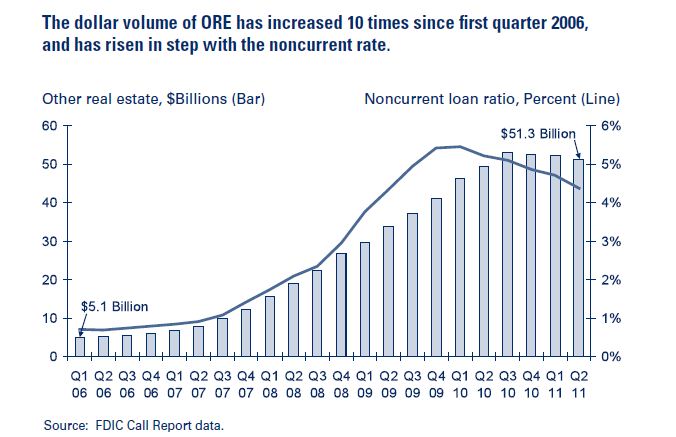
graphic courtesy FDIC
Notably, while the non-current loan ratio is slightly down from two years ago (although, terrifically higher than before the current crisis began), the dollar figure of “other real estate” (FDIC code for “real estate owned” or REO) hovers about 10 times as high as in 2006, with no end in sight.
So, the FDIC is challenged not only with fixing the CURRENT problem, but laying blame — so as to presumably prevent the NEXT crisis. Peeling back the layers of the onion, Table Three from that same report give significant insight into their perspective on the problem.
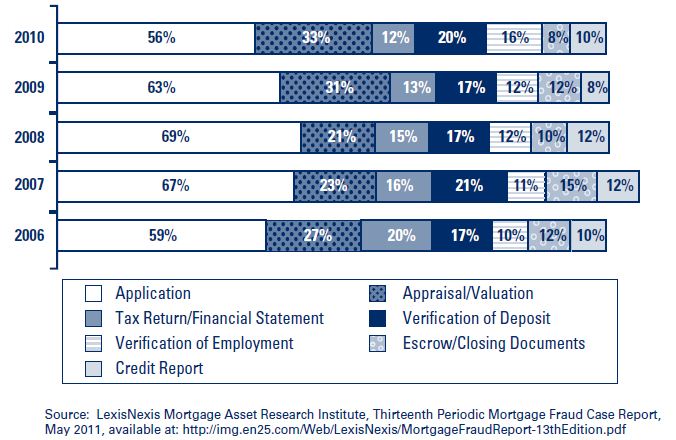
Courtesy FDIC
This data comes from LexisNexis, and the percentages do not total to 100% because many cases have multiple sources of problems. Nonetheless, since 2006, the trends for all categories have been flat or trending positively except for appraisal problems, which are now significantly higher than at the beginning of the crisis. One might argue that the increasing percentage of cases with appraisal problems is a manifestation of increased investigation in that realm, but that would be damning with faint praise, since it implies that oversight was lacking in the past.
Share this:

Now for a little good news….
Globe Street has a great piece about the self storage market, which is doing very nicely lately. Top firms in the fiele had revenue growth of 4% to 5.8% in the 3rd quarter, with net operating income growing 7.3% to 8.6%. ranged as high as 91.7% at Public Storage. The article properly notes that this sector is now joining apartments in strong, positive territory. Overall REIT share performance, as noted in the chart below, certainly underscores this (YTD as of October 2011, data courtesy NAREIT).
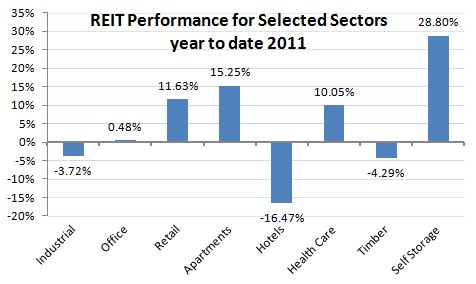
While the article correctly notes the strength in this market segment, it doesn’t connect the dots vis-a-vis why. Some of this is obvious, but it bears noting due to the very signficant long-range implications. The more-or-less simultaneous strength of the apartment sector and the self storage sector isn’t coincidental — the popularity of apartments for households which WOULD HAVE been in the owner-occupied housing market is driving the need for self storage. Anecdotal evidence of late suggests that the trend is toward smaller apartments — studios, efficiencies, and one-bedrooms seem to be in higher demand lately, although I haven’t seen this formally quantified as of yet. Given that, not only is there a need for self-storage, there will also be an increased need for SMALLER self-storage units as opposed to larger ones, urban infill units (or at least units near apartment communities) and even self-storage as an adjunct to apartment communities themselves.
Long term? This market risks getting over-build whenever the housing market stabilizes. However, that seems to be several years out. In the intermediate term, one would suspect a strong demand for more units paralleling the demand for apartments.
Share this:

CNBC reports on housing doldrums
Diana Olick is the real estate blogger/reporter for CNBC, and has a great column this week commenting on the recent “semi-good-news” from CoreLogic. For her full column, and links to the CoreLogic report, click here.
The synopsis — CoreLogic reports that foreclosure sales as a percentage of total sales are down. Great news, if it wasn’t for the sad fact that distress sales in May were still at 31% of the total market, albeit down from 37% in April.
Ms. Olick correctly notes that the “shadow” market hanging out there is huge. A few snippits:
Loans in the foreclosure process (either REOs or in-process) total 1.7 million homes, down from 1.9 million a year ago. Given that total home sales in America seem to be hovering around 5 million per year, this is a huge portion of the inventory.
Share this:
Mueller’s Market Cycle Monitor
Sorry it’s been so long — I’ve been traveling a good bit lately, and it’s hard to keep up!
One of my favorite real estate pieces hit my desk while I was gone — Dr. Glenn Mueller’ Market Cycle Monitor, published by Dividend Capital. He developed this model about 15 years ago, and it tracks occupancy and absorption of major commercial property types in about 50 geographic markets. As a property type (in a given market) sees increasing occupancy, market participants bring new property on-line. This creates an expansion. At the peak of the expansion curve, “hypersupply” begins, following which the new supply exceeds the market ability to absorb property. Vacancy rates increase, even as new property is still coming on line. This stimulates a recession. During the recession, no new property comes on-line, and occupancies hit a nadir. At that point, natural expansion of the economy stimulates a recovery, during which excess properties are absorbed and the cycle continues. The following, taken from Dr. Mueller’s excellent 1995 paper, captures the entire idea:

Currently, the market can be best described as “flat-lined”. Office occupancies were flat during the first quarter, and rents were actually down slightly (0.3%, on an annual basis). Industrial occupancies improved slightly, but rents actually fell signficantly (3.1% annualized). APartment occupancies improved slightly, and rental growth improved significantly (2.8% annually). Retail occupancy actually improved significantly, but rental growth trended downward (3.1% annually). Finally, hotel occupancies improved a bit (0.8%), and hotel income (measured as RevPAR, or Revenue per available room) increased 8.9% on an annualized basis.
For a complete copy of Dr. Mueller’s report, click here or write us at info@greenfieldadvisors.com.


 From a small northwestern observatory...