Archive for the ‘Valuation’ Category
FDIC — Supervisory Insights
The latest issue of the FDIC’s Supervisory Insights (Winter, 2011) just hit my desk. (If you really have plenty of time to kill, you’re welcomed to download your own copy, for free, from here.)
The focus of this issue is on appraisal problems, particularly re-inventing the review appraisal supervision role. This issue — which is ongoing — is a matter of considerable discussion and debate within the appraisal community. I’ll leave that matter to other pundits, but with the caveat no solution on the drawing board today will make everyone happy.
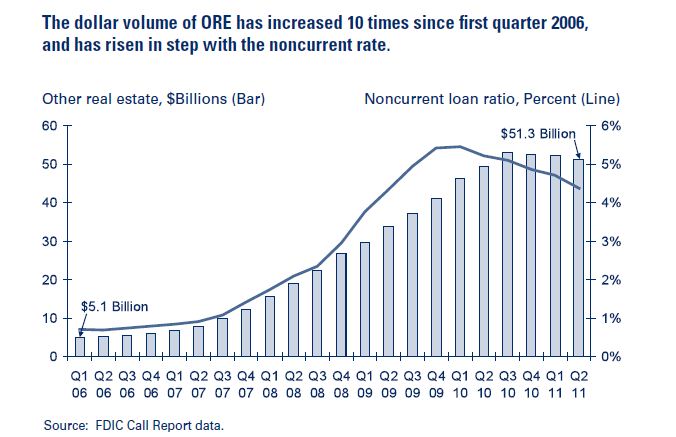
It may be a bit more interesting to examine the underlying arguments within the FDIC, to gain some insight in to where that agency is “coming from”. First, Table Four from the publication really sets the stage with the overarching problems facing the FDIC.
graphic courtesy FDIC
Notably, while the non-current loan ratio is slightly down from two years ago (although, terrifically higher than before the current crisis began), the dollar figure of “other real estate” (FDIC code for “real estate owned” or REO) hovers about 10 times as high as in 2006, with no end in sight.
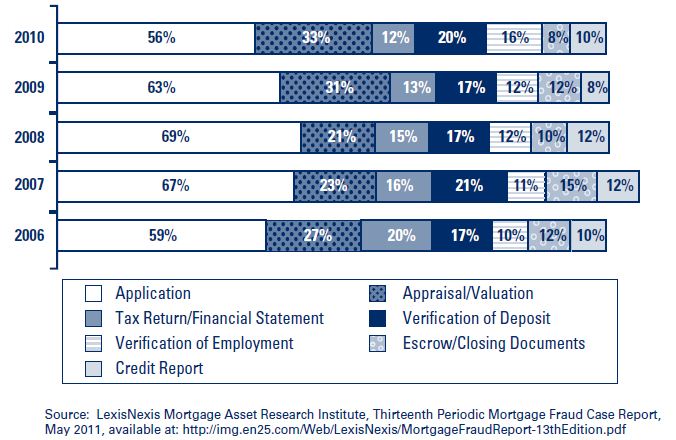
So, the FDIC is challenged not only with fixing the CURRENT problem, but laying blame — so as to presumably prevent the NEXT crisis. Peeling back the layers of the onion, Table Three from that same report give significant insight into their perspective on the problem.
Courtesy FDIC
This data comes from LexisNexis, and the percentages do not total to 100% because many cases have multiple sources of problems. Nonetheless, since 2006, the trends for all categories have been flat or trending positively except for appraisal problems, which are now significantly higher than at the beginning of the crisis. One might argue that the increasing percentage of cases with appraisal problems is a manifestation of increased investigation in that realm, but that would be damning with faint praise, since it implies that oversight was lacking in the past.
Share this:

Musings about the real estate market — part 1
When we say the “real estate market” we’re really talking about four distinct but somewhat inter-related components: housing sales (and values), housing finance, commercial real estate (starts, occupancy, etc.), and commercial finance. Each of these components has plenty of sub-groupings. For example, commercial apartment development is going well, although commercial apartment finance still has some problems. Housing development finance is on life support. Many aspects of commercial development (e.g. – hotels) are moribund.
I’ll start today with the most significant problem in the housing sector — the one which may take the longest to fix — and that’s housing starts. The market is worse than it’s been since we’ve been tracking data (40+ years) and certainly the worst in my experience. The attached graphic comes from the National Association of Homebuilders, and shows their tracking of both housing starts as well as the NAHB/Wells Fargo Housing Market Index (HMI).
 The HMI is based on a survey of current new home sales, prospective sales in the next six months, and “traffic” of prospective buyers (seasonally adjusted). While the two graphs seem to track one another, as you can see, the HMI is a bit of a leading indicator of the direction of housing starts. On a historic basis, this makes sense, since homebuilders will “start” houses they think will be sold six months from now, and they will heuristically base that on traffic from prospective buyers. (Back when I was in the game, we talked about a “qualified buying unit” being a prospective buyer or housing unit — such as a family — who actually had the capacity to buy a home and were actively in the market for a new home.)
As you can see, back during a period of relative housing stability (1985 – 2005), housing starts generally cycled between 1 million and 1.4 millin per year. With the bubble in home ownership rates, starts got up to 1.8 million for a short period then collapsed. More interestingly is the period between 1989 and 1993, when home starts dipped to about 600,000 per year, then rapidly bounced back to a healthy level. That was a period marked by real problems with acquisition, development and construction (ADC) loans, but the underlying demand and value equations still held firm. Thus, when the market cleared (when demand sapped up any supply overhang), the homebuilding community was ready to go back to work.
Today, it’s VERY different. ADC lending is still nearly non-existent (compared to a half-decade ago). The decline in values means that in many markets, it’s difficult to build a home for less than the selling prices. Further, the permanent lending market is also problematic. A big chunk of homebuilding is the “move-up” market, with a secondary chunk in the vacation or second-home market. Down payments for “move-ups” and second-homes traditionally come from equity in existing homes. However, a substantial proportion of homes in America have no net-equity. Reports talk about the high percentage of homes which are “under water” (that is, the value is less than the mortgage. However, for a home to have positive “net equity”, the value needs to exceed both the mortgage as well as anticipated selling costs. A handy rule-of-thumb in many markets is that a home needs to be valued around 110% of the mortgage for a seller just to break even on a sale. Worse, for there to be sufficient equity to “move up”, the home needs to be valued more like 120% to 130% of the mortgage. That simply doesn’t exist in most of America right now — trillions of dollars in paper equity disappeared over the past few years.
Additionally, there is a huge overhang in shadow inventory. As I noted in a recent blog post, Americans are currently buying under 5 million homes per year (new plus re-sale) and in a healthy market, the inventory for sale is about a six-month supply. However, the shadow inventory alone is close to 6 million right now (and that doesn’t include “regular” homes on the market). Thus, we’re looking at a couple of years of absorption just to get the market back to some level of stability. Even THAT presumes that the home ownership rate will stabilize right where it is (it’s been falling precipitously for several years). Bottom line, I wouldn’t be betting on home construction any time in the near future.
This is important for several reasons. First, home construction is a very big chunk of the economy. When homes aren’t getting built, lots of carpenters, plumbers, electricians, materials suppliers, real estate agents, bulldozer operators, bricklayers, and such don’t have work. Second, these are skills which are being lost to the economy. Further, if America is going to get the employment picture fixed, these people have to get back to work.
Good news — such as it is — is that the HMI is trending upward, ever so slightly. It’s currently standing at 20, up from a bottom below 10 about 3 years ago (and a near-term bottom of about 15 earlier this year). It needs to bounce all the way back up in the 50 range if the leading-indicator relationship holds true for it to point toward a healthy housing market. It actually went that far in the 1991 – 1993, range, when it bounced from 20 to 70 in about 3 years. However, that was a market with pent-up demand, good values, and a healthier lending climate.
Share this:

S&P Case Shiller Report
The latest Case-Shiller analysis hit my desk today, looking at housing prices through the 3rd quarter of 2011. Their headline says it all: Home Prices Weaken as the Third Quarter 2011 Ends.

Chart Courtesy S&P - Case Shiller
Their overall national index was declining at a 3.9% annual rate as of the end of the 3rd quarter. Looking for faint hope in the data, this is actually an improvement over the 5.8% decline rate measured at the end of the 2nd quarter. Home prices continue to cycle around (and mainly slightly below) their 2003 levels, which they’ve been doing for quite some time. For more information, visit the Standard and Poors web site.
Share this:

GDP, Housing, and post-Thanksgiving musings
First, the good news. My good friend, Dr. Bill Conerly, in his Businomics blog of 11/17, brought to my attention Dr. Mark Perry’s Carpe Diem post of that same date. Dr. Perry brings up two great points, both good news for the U.S. First, the global GDP is poised to hit $50 Trillion for the first time this year, up 2.7% from last year. Second, and a bit unfortunately, this good news isn’t evenly distributed. Somewhat surprisingly, the U.S. share of Real GDP has held fairly constant for the past four decades, hovering between 25% and 30% of the world’s total. While the U.S. share is down slightly from its peak a decade ago, it’s actually higher today than it was in the early 1980’s.

Courtesy Dr. Mark Perry, Carpe Diem
The most interesting — and obvious — observation is that growth in the Asian share has come at the expense of the Europeans. For more, I’d refer you to Dr. Perry’s exellent commentary on this.
In addition, this week’s Economist magazine just hit my mailbox. I cannot speak to highly of this weekly — anyone who really wants to be informed on the complexity of the world needs to read it cover-to-cover the moment it’s printed. It comes with a decidedly British feel and a slightly right-of-center focus, but with those caveats aside, it’s simply the best news magazine in the world. And no, I have to pay for my subscription just like everyone else.
This week’s issue has an intriguing piece on the softness of global housing market. I’ve long held that corrections in the U.S. bubble were triggered by the inablity of the secondary financing market to accomodate slight changes in underlying default rates. In short, the secondary market is basically made up of derivatives of derivatives of derivatives. Each layer of “securities” (a more ironic name for these instruments could not be found) assumes away a certain level of risk, applying a totally falatious reading of Markowitz. However, the pain in the U.S. market may be close to ending, as the bubble in home ownership rates nears a nadir.
The more global problem, however, is that other markets have not fallen in the same way as the American market. In the U.S., house-price-to-income ratio now stands below 80 (1977 to 2011 average = 100). On the other hand, Britain and France — two economies with some pent-up troubles ahead of them — both stand at between 120 and 140, and indeed France is near its peak for the past three decades. (Britain is slightly down, but not by much). By their measure, most of Europe (except Germany and Switzerland) is in trouble, as well as Canada and Australia. Japan has now declined even more than the U.S., but Japan’s market was widely considered to be terrifically overvalued before (maybe even worse than America’s).
While this is new territory for most countries, Britain’s housing market got out-of-whack back in the late 1980s, and fell about as far, relatively, as the U.S. market has fallen in the past few years (and over about the same time frame). If Britain’s experience provides any indication for the U.S., it’s market stayed relatively low for several years before rebounding.
Not all economists agree with this perspective, and many feel that systemic low interest rates make this particular measure of housing prices invalid. The problem with this perspective is that European interest rates are rising, and may continue to do so in the wake of the various debt problems in the Eurozone.
Share this:

Mueller’s Market Cycle Monitor
Dr. Glenn Muller of Dividend Capital Research has one of the more intuitive “takes” on the commercial real estate market. His Market Cycle Monitor is based on a piece he wrote for the journal Real Estate Finance back in 1995. It notes that a given type of real estate (office, industrial, etc.) in a particular geographic market (New York, Seattle, etc.) moves through a cycle which can be broken down into four phases: expansion, hypersupply, recession, and recovery. The driving force through these cycles is property occupancy — when occupancy levels rise, developers are encouraged to build new product, which leads into a hypersupply situation where occupancies fall and properties go into recession. For a more detailed look at his model, click on the link above, which will take you to the Dividend Capital website where you can view the 3rd Quarter report.
In short, he finds that as of the 3rd quarter, 2011, most property types in most markets are in the early stages of recovery. The office market nationally, as well as in about a third of the cities he follows, is still in the late stages of recession (except Sacramento, which is in the early recession stage). Austin and Salt Lake seem poised to break out into expansion.
In the industrial market, every region is in recovery, with Pittsburgh, Riverside, and San Jose the furthest along. However, none of these markets evidence being close to expansion at this time. As for apartments, every market is in some stage of recovery, with Austin close to breaking out into expansion. Lagging the recovery are New Orleans, Norfolk, and Richmond. Nationally, the apartment market is right in the middle of recovery, with expansion still a few steps in the future. The retail market is in about the same position as apartments, but with Long Island, San Diego, and San Francisco furthest along. Nationally, we’re still close to the beginning of a retail recovery and not very far along. Hotels seem to be slightly further along than regail, with Honolulu, New York, and San Francisco leading the pack (and poised to break out into expansion).
Share this:

Bottom, bottom, who can find the bottom?
In the owner-occupied housing sector, a “bottom” seems to be like the weather — everyone talks about it, but no one seems to be able to do anything. I’ve been positing that a “bottom” (or at least “stabilization”) won’t be a reality until we get some sort of stability in the home ownershps rate, which has been creeping downward for about 5 years. If that stabilizes (and my own projection is somewhere between where it is — about 66% — and 64%), then prices will have the necessary demand stabilization to perk up.
Money Magazine, on the other hand, says “lo, the bottom is nigh”. Specifically, they say that in the coming year, 95% of home-ownership markets that they track will begin to rise. Caveats about, of course — “The median expectation among more than 100 economists and real estate pros surveyed by MacroMarkets is that home values will inch ahead by a mere 0.25%, compared to their 2011 median forecast decline of 2.8%. They also foresee annualized gains through 2015 of just 1.1%, as the real estate market slowly works its way through a mountain of foreclosures.”
Why the continued sluggishness? The folks at CoreLogic tell us that the “shadow market” is 5.4 million homes, including bank-owned properties, homes in the foreclosure pipeline that haven’t hit the market yet, or properties where owners are seriously behind on payments. Now, compare that forecasts from FreddieMac that the entire market for homes in this coming year will be 4.8 million, and that a 6-month inventory of available properties is generally thought to be healthy, and you can see the supply-demand imbalance.
Mark Fleming, chief economist over at CoreLogic, uses the analogy of a flood. “The water is very deep in the living room, but it’s no longer getting deeper and is starting to recede.”
Share this:
Hard to feel sorry for Bank of America…
….but let’s try, just this once. As pretty much everyone knows, over the past few years, they’ve repeatedly shot themselves in the foot, then reloaded, then opened fire again. Public displays of embarassment like the $5 debit card fee are just the tip of the iceberg (and, indeed, helped them shed a lot of low-return or even negative-return depositors who could and should be better handled by credit unions).
More interesting has been their acquisition of Countrywide a few years ago, which everyone agrees was a debacle, and their subsequent messy handling of CW’s meltdown. However, now that they’re in such a fiscal and regulatory mess, BofA is having to shed itself of assets — at firesale prices — that in good years they’d want to keep. The latest example is BofA’s interest in Archstone Residential, one of the biggest apartment owners in the U.S. with 78,000 units. Recall that apartments are doing VERY well today, and are the one sector of the real estate industry which weathered the recession storm nicely. Indeed, given the trend in apartment valuation, BofA would be well advised to hang onto this asset for dear life.
BofA and Barclays acquired a 53% interest in Archstone Residential via a Lehman Brothers-led acquisition. The original purchase price in 2007 was $22 Billion. That works out to about $282,000 per apartment, which is pretty darned high, admittedly. Let’s suggest that a reasonable value would be in the range of $200,000 per apartment, or about $15 Billion. Of course, REITs often sell for a premium over net asset value, so the $22 Billion acquisition price probably wasn’t terribly off the mark at the time. Thus, the total net asset value $15 to $16 Billion, which indeed is close to Dow Jones’ current estimate of $18 Billion.
However, who has $15 to $16 Billion laying around? (Or, to be specific, 53% of $15 to $16 Billion, or about $8 Billion?) Up to the plate steps Sam Zell — yes the same guy who gave us Equity Office Properties. He now owns Equity Residential, which is making a bid for the 53% at….. (drum roll, please)….. $2.5 Billion in cash and stock. In general, this works out to about $64,000 per apartment, which is painfully low. Note also, that Zell is the winning bidder, having out-bid AvalonBay, Blackstone, and Brookfield.
Why is BofA letting this go so cheap? For one thing, they don’t have much choice. The regulators are making them dump whatver they can at Craigslist prices to generate cash and cash-equivilents. For another, the nasty market we’re in makes cash king — no one is financing this sort of deal, not even at these firesale prices.
In some ways, Sam Zell is a lot like Warren Buffett. Often it’s said — mistakenly — that you could do worse than simply buying stock in whatever Buffett buys. That’s true, but only if you pay the prices (usually deeply discounted) that Buffett pays. Now, the same appears to be true with Zell.
Share this:
Allison versus Exxon
If you follow the litigation news, you’re probably aware that this past week, a state-court jury in Towson, MD, awarded a group of plaintiffs $495 million in actual damages plus about $1 Billion in punitives in the mass-tort matter of Allison v. Exxon. The facts of the case are pretty straight-forward: Exxon leaked a significant amount of MTBE-laden gasoline into the drinking water aquifer of an unincorporated suburban Baltimore community known as Jacksonville.
I was the sole damages expert testifying for the plaintiffs, and methodologically, this was one of the more intriguing cases in my career. We utilized a mass-appraisal hedonic model for my determination of the unimpaired value of the properties as of February, 2006 (the date of the spill) and then amended this model to add factors for the impact of the contamination on these property values (using contingent valuation, meta-analysis, and case studies in the absense of a well-functioning transactional market). We also developed business loss determinations, loss of use-and-enjoyment measures, and present value calculations for medical monitoring costs.
Exxon literally threw everything they had into the damages aspect of the case — they knew this case had the potential to be both big as well as precedent-setting. They hired a veritable battalion of big-named appraisers, professors, modeling experts, and consultants, and one of their two damages testifying experts was a hold-over from the Exxon Valdez case. The multiple days of deposition, motions-in-limine hearings, and trial testimomy (and cross examination) were among the toughest I’ve ever seen.
Naturally, I’m always pleased when my clients win, but not for the reasons people tend to think. I’m not in this for the “win or lose” part of it, but it is intellectually challenging to climb these sorts of mountains, and when a court agrees with me, I’d be disingenuous to say it’s not intellectually affirming.
I’ll be developing a white-paper on this case very soon, and by some coincidence, I’m slated to speak in Manhattan at the semi-annual meeting of the American Academy of Justice next Monday on the topic of “Use and Enjoyment Damages”. As you might guess, this case will be featured in that talk — and probably plenty of subsequent ones.
Share this:
CNBC reports on housing doldrums
Diana Olick is the real estate blogger/reporter for CNBC, and has a great column this week commenting on the recent “semi-good-news” from CoreLogic. For her full column, and links to the CoreLogic report, click here.
The synopsis — CoreLogic reports that foreclosure sales as a percentage of total sales are down. Great news, if it wasn’t for the sad fact that distress sales in May were still at 31% of the total market, albeit down from 37% in April.
Ms. Olick correctly notes that the “shadow” market hanging out there is huge. A few snippits:
Loans in the foreclosure process (either REOs or in-process) total 1.7 million homes, down from 1.9 million a year ago. Given that total home sales in America seem to be hovering around 5 million per year, this is a huge portion of the inventory.
Share this:
Housing Finance — Take 2
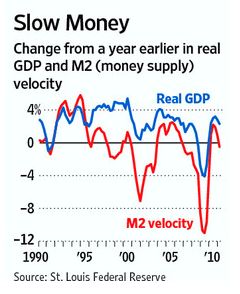
Again, from the Wall Street Journal, we find reasons for concern. The “Ahead of the Tape” column in today’s Journal, we find an excellent — but troubling — article by Kelly Evans titled “Economy Needs a Borrower of Last Resort.” It really follows my theme from yesterday, and I couldn’t agree more.
Graph courtesy The Wall Street Journal
Imagine a dollar (or a hundred thousand dollars) injected into the system which is loaned to a family buying a new home. They pay the builder, who deposits the money in the bank (actually, paying off the construction loan) and then that money can be loaned back into the system. Some of it bleeds off into taxes, exports, and such, with each iteration of the deposit-and-loan cycle, but still, the money cycles thru the system. Since each subsequent deposit and loan doesn’t happen instantly, there is a little bit of a lag. Nonetheless, over a short period of time, the system should work. The math behind this is called the “Cambridge Velocity Equation” and it’s been known to economists for hundreds of years.
So, since November, the FED has purchased $684 Billion in bonds, which SHOULD have resulted in trillions of dollars in new money creation. Instead, M2 (the abbreviation for the money supply, defined as all of the cash, bank deposits, and money market funds in the system) has only increased by $326 Billion, suggesting that the velocity of money is about 0.5. Note that it SHOULD be 2 or 3 or more in a vibrant economy. This means that for every dollar injected into the system by the FED, half of it has dissipated.
As the article points out, this is why the recovery has remained so anemic. I would posit that a big problem is in the home loan business, which is far weaker than merely “anemic” — it’s on life support with the undertaker waiting in the lobby.
Kelly Evans posits that the market needs a lender of last resort, which is exactly what I was saying yesterday. Unless and until the system starts turning into the skid, by fixing the totally busted mortgage market, a double-dip recession seems inevitable.



 From a small northwestern observatory...