Archive for the ‘Valuation’ Category
21st Century Valuation Problems
Did everyone have a great holiday? It’s been nearly 3 months since I’ve darkened the door of this blog. Between the holiday season, a couple of very interesting conferences (more on those later) and heading for warmer climates for the winter (MUCH more on that later!), I’ve been terrifically distracted since November.
The trigger to get me off my duff and writing again was a complex Federal Court trial in Missouri last week. Yes, I was the testifying expert, and yes, my clients prevailed, but that’s not exactly the point. The point is WHY I was testifying and WHY my clients ultimately prevailed, at least in my humble observation. The case was a class action concerning the value of a fiber optic telecommunications transmission easement. For a variety of reasons, this case only concerned 789 miles of the easement crossing about 3,250 properties, but the very important lessons learned from this case apply broadly to a variety of modern-day corridor easements.
Earlier in the litigation, the class action had been certified and the Court had held that the responsible party did not have the right to enjoy the easement without compensating the property owners. The court had held that the defendants had unjustly enriched themselves, and so this trial was narrowly focused on compensation. That compensation, it was held, would be the fair market value of the easement, and that’s where Greenfield came in.
The defendants proffered a valuation theory called “across the fence”, or “ATF” for short. ATF models were developed many years ago for easements like railroads and power lines when data on such easements were difficult to come by, and when the change in highest-and-best-use of the property resulting from the easement was minimal, at best. The ATF theory basically says that the value of the easement is equal to the value of the land taken (usually farmland or forests) plus an “enhancement factor” to equate the more valuable use of the railroad or power line easement. This enhancement factor would range from 1X for an easement which was no more valuable than the surrounding land to 10X or more for a very valuable easement. Note that the enhancement factor can be a matter of judgment on the part of the appraiser. It is supposed to be determined by looking at sales or leases similar easements and similar surrounding properties, but with a dearth of data, the enhancement factor was often just a matter of conjecture.
In addition, ATF valuation required individualized “before-and-after” appraisals of every affected property. In testimony in Missouri last week, the defendants’ appraiser acknowledged that each “before-and-after” appraisal would cost about $10,000, more or less. Given that there are 3,250 properties affected by this one easement, that translates into $32.5 million in appraisal fees. Ahem…..
In addition, the defendants’ appraiser applied a fractional enhancement factor, which he basically simply made up with no data or analysis to support it. He said that the land devoted to a fiber optic cable telecommunications easement was worth 25% of the value of surrounding pasture and grazing land. Again, ahem….
Greenfield was called in because modern valuation problems call for modern solutions. In 2002, the U.S. Fish and Wildlife Service (“FWS”) was faced with the challenge of determining the fair market value of fiber optic cable easements in National Marine Sanctuaries. Specifically, there were two such easements in the Olympic Marine Sanctuary in Washington State (one each headed to Japan and Alaska) and one in New England. Faced with the likelihood that Federal land would be used for such easements in the future, and the mandate that private users of public property pay fair market value for such uses, the U.S. Government undertook an extensive review of payments for similar easements, and found that prices ranged from $40,000 per mile to $100,000 per mile. (In the Missouri case, the defendants’ appraiser, applying pastureland values, a fractional enhancement factor, and a number of other adjustments, arrived at a value of $3.44 per mile. Ahem, yet again…..)
Shortly after the FWS report, Greenfield undertook our own analysis of telecommunications corridor easement transactions across the U.S. We gathered over 1,000 transactions dating back to the early 1970’s, with a particular focus on easements where both the grantor and grantee were operating on a level playing field (i.e. — telecom companies versus railroads). Our findings were solidly supported. Telecommunications easements are typically valued in America using corridor theory models. The values of the easements are unrelated to the values of the surrounding land (thus relegating ATF models to the history books). Corridor easements should (and indeed must) be valued with simple per-foot or per-mile data in a straightforward, easily understood, 21st century model.
The jury in Missouri deliberated about as long as it took to pick a fore-person to affirm the efficacy of corridor valuation models. The evidence and testimony could not have been more starkly different from the two sides.
The downside? I would love to have had a piece of that $32.5 million project they proposed.
Tea Leaves and Such
Flying back from Milwaukee to Seattle last night, I sat next to a fellow who owns several big truck dealerships in the mid-west. (Seattle, famed for Boeing and Microsoft, is the lesser-recognized headquarters of Paccar, the world’s third largest maker of heavy trucks, after Daimler and Volvo. Last year, they made and sold over $16 Billion worth of Kenworths and Peterbilts.)
ANYWAY, after the usual “how’s business?” question, I got an earful. Turns out no one’s buying heavy trucks right now, even though financing is historically affordable, and customers have cash. Why? Simply put, his customers are scared of the fiscal cliff. (We also talked about customers deferring potential acquisitions until after/if tax rates go up, but he said that this wasn’t a big issue in his surveys of customer sentiments.) He noted that demand for long-haul trucking was down, and noted that his trucking-company customers were reporting a lower volume of hauling for consumer retailers.
Now, if this was an isolated incident, we could write it off. However, the danger of the fiscal cliff isn’t just what will happen after January 1. Much like an impending hurricane, people are already packing their bags and getting out of the way or hunkering down and bolting the doors.
What is the impact on real estate? While it’s too early to completely quantify, clearly there is reluctance right now to make new investments in office, industrial, and retail. Add to this the realization that the apartment boom may have leveled off, and we have a fairly flat new development market on the horizon. This doesn’t bode well for real estate private equity firms that are focused on development profits or capital gains, but it does mean that income-oriented real estate (publicly traded REITs for example) may exhibit some buying opportunities due to both their tax advantaged nature. The most recent Current Market Commentary from NAREIT shows slight downward trends in apartment, office, and retail vacancy, with all three sectors showing positive rental rate growth (albeit at lower levels than earlier this year). The three-year moving average for renter household formation continues to trend upward, while the owner-occupied household formation is in negative territory (despite recent gains in home sales and housing starts).
Notwithstanding the dangers of the fiscal cliff, changes in non-farm payrolls have been strong and positive every month since mid-2010, and even though unemployment is higher than anyone wants to see it, the trend has been solidly downward since the peak of late 2009. As such, the fiscal cliff is the most significant economic problem on the horizon today. Fix it, and we continue on the track to full recovery. Let us drive off the cliff, and…. well, that’s a pretty good mental picture, eh?
Share this:

REITs — good news trumps “iffy” news
The “headline” in Erika Morphy’s piece in GlobeSt.Com this morning was that was that REITs underperformed the S&P 500 for August and September. Specifically, REITs were up 1.85% in the 3rd quarter this year, compared to 6.35% for the S&P 500. You have to dig a little deeper to get to the heart of the matter, though.
First, let’s remember that investors by-and-large buy REITs as an income vehicle with equity up-side. The current average REIT yield is 3.88% — not bad, compared to corporate bonds or preferred stocks, and more targeted income seekers can go after single tenant retail with a yield of 5.9%. (For a great review of this, see a piece by Brad Thomas in Forbes.com from September 10). Couple those sorts of dividend yields with any upside equity potential, and you have a real investment powerhouse in today’s market. For comparison, the current yield on the S&P 500 is 1.97%.
But, the news gets better. For the 12-months ending September 30, the NAREIT index was up 33.81%, compared to 30.2% for the S&P. Do the math — the total return for a portfolio of REIT shares for the past year would have been (33.81% + 3.88% = ) 37.69%. The total yield for the S&P 500 would have been (30.2% + 1.97% = ) 32.17%. Thus, slightly more than a 500 basis point return advantage to REITs.
Of course, (and this goes without saying), past performance doesn’t translate into future returns…..
Share this:
Comments to the Appraisal Foundation Strategic Plan
Appraisal standards and licensure qualification in the U.S. are promulgated by the Appraisal Foundation in Washington, D.C., a private organization which receives oversight from the Congressionally-established, inter-agency Appraisal Subcommittee.
This summer the Foundation issued a request for comments on a sweeping update to their strategic plan. I, along with many others, have submitted comments to the proposed updates, and my comments will soon be published on the Foundation’s website. I’m also presenting my comments here, verbatim, for discussion and input from colleagues and friends (see below).
Enjoy!
Comments to Appraisal Foundation Strategic Plan
Share this:
REIT Research — Real Estate in Volatile Times
The National Association of Real Estate Investment Trusts (NAREIT) recently commissioned Morningstar to study the role of securitized real estate in the well-balanced portfolio, with a particular eye to the investor attitudes regarding risk, as well as the actual performance of markets. Both of these two concepts — risk and investor attitudes — are less well understood than researchers seem to think. In the first, market models assume a degree of normalcy in the distribution of market returns. However, empirical evidence seems to contradict this, and in fact market volatility is significantly greater (and of greater magnitude) than models would predict.
In the second case — investor attitudes — traditional models suggest that rational investors react to “up” markets in the same way as “down” markets. More recent behavioral models recognize the fallacy in this — rational investors relish “up” volatility, but loathe down markets.
The results of the research were published in an excellent new research piece from NAREIT titled “The Role of Real Estate in Weathering the Storm” (click on the title for a copy of the paper). Some high-points from the study:
- Since 1929, the S&P 500 has had 10 months with declines of 15.74% or more — which is eight more than would be predicted by a normal distribution.
- Recent studies by James Xiong of Ibbotson Research show that the log-normal distribution fails to account for this down-side volatility.
- From 2000 – 2009 (often called the “lost decade”), the cumulative return on large-cap stocks was negative 0.95%.
Morningstar then crafted portfolios under the “theoretical” model (normal distribution) versus a more realistic model of volatility, with alternative structures for risk-averse investors and more risk-tolerant investors. Investment returns were measured over the period 1990 – 2009, which notably included the recent market melt-down.
Under normal distribution assumptions, an optimum risk-averse portfolio would allocate about 6% to securitized real estate and theoretically enjoy a return of 7.6%. Under more realistic volatility assumptions, the risk-averse portfolio would allocate 14% to securitized real estate and would have returned 8.2%.
A more risk-tolerant investor would have allocated 18% to 20% in securitized real estate, and would have enjoyed a return of 9.7%, with volatility (standard deviation of portfolio returns) of 10%.
The most striking finding of the study was the consistent role played by securitized real estate in all four of the models (normal versus non-normal, risk-averse versus risk-tolerant) and particularly thru the market melt-down. While this may seem counter-intuitive, given the roller-coaster ride of REIT prices, investors need to realize that REIT shares paid relatively high dividends through this period, thus ameliorating the downward price movements. In short, the gains from real estate holdings pre-meltdown, coupled with the dividends, more than made up for the price bounce over the past few years. Further, REIT prices have rebounded better post-recession than have other S&P shares.
Share this:
The right number of new homes?
Much has been said in recent days about the Census Bureau’s August 23rd announcement about new residential home sales in July. To summarize, 372,000 new homes were sold last month, which is 25.3% above the July, 2011. This is good news for a lot of reasons — construction workers get jobs, banks get new loans, etc., etc.
Naturally, it begs the question, “what’s the right number of homes?”. Here at Greenfield, we’ve posited that the U.S. housing price “bubble” was really a demand bubble, fueled by easy money, which led to an artificial inflation of the nation’s home ownership rate. (Housing bubbles in other countries were fueled by similar problems.) We’ve also suggested that the market won’t get healthy again until several things happen, including a stabilization of the homeownership rate at long-term equilibrium levels, a restoration of “normal” conventional lending (both for home mortgages as well as for development financing) and a restoration of the housing infrastructure (development lots in the pipeline, local regulatory department staffing, hiring & training skilled construction workers, etc.) . It is highly doubtful that we’ll see housing starts and new home sales “bounce back” to normal levels anytime soon, and our own projections suggest several years before we get back to “normal”.
But this begs the question: What’s normal? (A great t-shirt from the Broadway play, “Adams Family” simply said, “Define Normal”.) Anyway, as new home sales go, it’s helpful to glance at the experience over time. It may surprise you.

One might actually expect the graph to be less erratic, but there are good explanations for the “bobbing and weaving” you see from year to year. During recessions, new home sales decline, and then bounce-back afterwards. During periods of economic overheating, the FED tightens the money supply, thus causing home starts/sales to decline. (In practice, this is a major tool in the FED’s toolkit, simply because it has a great multiplier effect on the economy.) Of course, the bubble is quite apparent, and following it the inevitable decline.
With all that in mind, though, we can see that there is a decided upward trend in the chart — that makes sense, since a growing population, coupled with a fairly consistent homeownership rate, will generally demand more new homes each year than it did the year before.
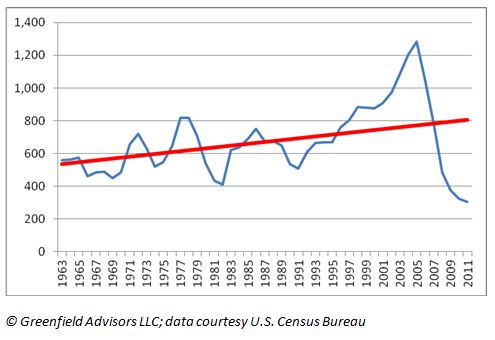
The second graphic adds a simple linear trend line for simplicity sake, which is not far removed from the actual household formation trend line during that same period. Note that from the beginning of the chart until about 2001, we had a nice cycle going, and in fact around 2001, the blue line should have turned negative to account for the recessionary impacts. However, money got very loose during the early part of the last decade, and rather than housing starts serving its normal “pressure relief” role, it was driven into a counter-cyclical path. This created the oversupply we are now trying to work through (often referred to as the “shadow inventory”) and we won’t see a healthy market until this inventory is mopped up.
Good news, though — if you glance quickly at the second chart, it becomes clear — albeit from a very simple visual perspective — that we must be close to a spot where an up-turn in the chart would give us as much negative area red line as we had during the previous cycle above the red line. In short, we’re not at the end of the tunnel yet, but this simple way of looking at things suggests we may be able to SEE the end of the tunnel in the not-too-distant future.
Share this:

Tightened appraisal standards?
Federal regulators have proposed new rules for “risky” mortgages, including tightened appraisal standards. The proposed new rules are open for comment until October 15.
The Federal Reserve, the Consumer Financial Protection Bureau and other Federal regulators have proposed that all risky mortgages have appraisals performed by licensed or certified real estate appraisers. Intriguingly, similar regulations were put in place two decades ago for all Federally insured mortgages by the Financial Institutions Reform, Recovery, and Enforcement Act (“FIRREA”). This act essentially created the appraisal license laws that exist in the 50-states today, but over the years, the appraisal requirements have been diluted to the point where many loans are made without an appraisal. These proposed regulations recognize the problems caused in the banking system by un-supported mortgage loans.
In an effort to prevent the use of fraudulent appraisals in illegal “flipping”, the regulations would also require a second appraisal if the seller had purchased the home at a lower price during the prior six months.
A mortgage would be deemed “higher risk” if the interest rate was significantly above the Average Prime Offer Rate, survey weekly survey from the Federal Financial Institutions Examination Council. As of last week, the AOPA stood at 3.64%for 30-year “conforming” loans, and under the proposed rules, a higher-risk loan would be one carrying a rate of 5.14% or higher. For “jumbo loans” (generally those exceeding $417,000), the threshold would be 6.14%.
Share this:
Appraisal Institute meeting in San Diego
I had the pleasure of being invited to speak at the Appraisal Institute’s annual meeting in San Diego last week, which brought together many of the top minds in the valuation field for three days of seminars and business meetings. While AI is fairly small (only about 23,000 members globally), its influence in the real estate field cannot be understated. In the U.S., appraisal license law and standards (the Uniform Standards of Professional Appraisal Practice, commonly known as USPAP) owe their genesis to work done by AI back in the 1980’s during the Savings and Loan Crisis, and possession of an AI designation (either MAI or SRA) is frequently cited in real estate contracts as required for establishing lease renewal rates or other contractual matters. Courts throughout the land routinely accept testimony from AI members without question. Real estate regulatory bodies throughout the U.S. are populated by AI members, and rare is the state legislature that will make changes to real estate law without the consultation of AI members. The AI’s government affairs team in D.C. has influence throughout the real estate arena, which of course today transcends traditional boundaries and includes regulatory efforts of the GAO and SEC, among others.
I was asked asked to deliver an address on advanced statistical methods. I’ll leave that discussion for another day, and focus on what I learned there — which was significant — rather than what I said. Other sessions dealt with meaty topics like the attorney/appraiser interface and the complexity of real estate valuation in the financial reporting arena. Not unexpectedly, there was a tremendous amount of attention paid to technology, which is really leading to an interface between “automated valuation model”-type tools and the individual appraiser. In short, we may be very close to a day, thanks to technology, when the individual home appraiser is tapping into a more robust set of analytical tools in order to produce collateral valuations with strong statistical support. Anyone who has been following the mortgage meltdown news for the past few years will understand the significance.
The keynote speaker was Dylan Taylor, CEO/USA of Colliers International. He riffed off of the title of the book “The Earth is Flat”, and talked about barriers to globalization in the real estate biz which he called “rounders”. The two principle ones for our field are regulatory barriers (licensure problems, even across 50 states, much less across countries) and capital needed to grow businesses (technology, etc.) He notes that in most professions, there is a tipping point to consolidation, and uses CPA firms as examples. The total billings of U.S. CPA firms last year was about $120 Billion, and the big 4 accounted for $80 Billion of that. The need for technology, increased specialization, etc., will probably stimulate that in appraisal firms (which currently have world-wide billings on the order of $3 Billion, but the top few only account for a small fraction of that). He says that in the future, there will be a handful of very large appraisal firms plus “boutiques”. In his view, the boutiques will do quite nicely, but the middle-market appraisal firms will die on the vine.
Taylor notes that USPAP will be generally moving toward International Valuation Standards (“IVS”) in the same way Generally Accepted Accounting Practice (“GAAP”) is moving toward International Financial Reporting Standards (“IFRS”). The latter sets of standards provide much more “client defined” reporting standards. He notes, for example, that several aspects of IFRS will cause “disruptive change” in American real estate, such as the way the two different paradigms treat carried interest.
As noted, a separate session dealt with the interface between appraisal and financial reporting. Earlier this year, the SEC “kicked the can” toward 2013 for U.S. adoption of IFRS. It was noted that while 90% of GAAP and IFRS are functionally identical, the changes needed to adopt the remaining standards could be so costly and disruptive as to dwarf the problems following adoption of Sarbanes-Oxley. Nonetheless, some movement in that direction is inevitable. From a real estate perspective, this may include the elimination of depreciation for financial reporting, substituting annual “mark-to-market” valuations instead. That is a very different paradigm for property valuation in the U.S.
Other sessions included a presentation from the FDIC’s General Counsel’s office, a presentation on standards and practices for Federal land acquisition, and a VERY informative presentation on “getting published”.
Share this:
REIS reports on the office market
Got an early peek this morning at the forthcoming office market report from ReisReports. Like everything else in the economy today (except apartments), the operative word is “sluggish”. Indeed, even in the bullish apartment market, the core driver is the sluggish economy turning “owners” into “renters”.
On the surface, the facts aren’t all that bad. Office vacancy rates topped out above 17.5% in mid-2010, and have been on a slow trend downward. However, for the last two quarters, the rate has stalled at 17.2%. Quarterly absorptions have been in positive territory since early 2011, totalling about 4 millions square feet nationally in the 2nd quarter 2012, even in the face of the lowest office completions level since REIS began tracking data in 1999. Rents remain at 2007 levels, with 0.3% gains in both asking and effective averages.
The reasons are obvious — continued fears from Europe (which may be abating, given very recent pronouncements from European central bankers), the close presidential election, and the very real fear of of the “fiscal cliff” in early 2013 contribute to an anemic jobs recovery. Without new jobs, there is no demand for office space. You do the math.
In most American cities, the stark reality on the skyline is the absence of high-rise cranes. Given the very long pipeline for office construction, coupled with the difficulty financing in this sector, and it may be many years before we see this market turn fully around.
Share this:
Apartments, economic uncertainty, and demographic shifts
The latest issue of Marcus & Millichap’s apartment research just hit my desk, and while they may some important observations, I think they may miss the bigger picture about why the apartment market is so hot today.
First, the good news — apartments are the brightest star in a recovering commercial real estate market. As M&M note, leading economic indicators are trending up — not nearly as high as the pre-crash peak, but higher than we saw at any time between 1990 and 2005 or so. Job growth is rugged, but at least it’s in positive territory, albeit not at levels we need to get America’s fiscal house in order. Apartment absorption is in strong, positive territory, with some of the best, sustained numbers we’ve seen in over a decade. These are all positive trends for the apartment investment market.
Despite the well-wishing about owner occupied housing, that market continues to be sour — home sales are moribund, with a report out today that new home sales have trended back down to 350,000/year. While some statistics show prices beginning to stabilize or rise, others continue to show cycling around 2003 levels. Our own models here at Greenfield suggest that home prices and new home sales volumes will not return to healthy levels until the home ownership rates stabilize. In addition, a recent report out of the homebuilding community points to lack of buildable lots as a very real impediment to growth in this area. We would add that structural issues in the lending arena will keep lot development at all-time lows for several years to come.
In short, many investment funds have viewed apartments as the next instant money machine, and indeed occupancy rates are frequently well above optimum levels. There is plenty of research to suggest that a “healthy”, profit-maximizing apartment market has an occupancy rate around 93%. A 100% occupancy rate suggests that rents are too low, and indeed this has happened in many markets as developers have chased occupancy rather than profitability. As stabilized apartments raise rents, NOI increases, and with them cap rates. As a result, cap rates are actually on the rise again, up from 2006 levels, and with the decline in 10-year Treasury rates, the cap-to-T spread has expanded to the widest level we’ve seen (490 basis points).
One would think that investment funds would chase this NOI, forcing cap rates down. Indeed, just the opposite is true. Funds are looking for income, not future growth, and unlike the private equity and hedge funds of the past, aren’t trying to buy low and sell high. They’re perfectly contented to buy a cash flow and hold forever, thus allowing cap rates to float upward.
Add to this the demographic part of the equation — America forms about a million new households per year, but we’re only building owner-occupied homes for about a third of them. M&M notes that we’re currently only building about half of the units needed to meet demand. They project occupancy rates by year end at about 95.6%, far above optimum levels. As such, they expect rent growth of about 5% by year end. This will flow straight to the bottom line, pushing up both transaction prices AND cap rates simultaneously.
Apartments were grossly underbuilt during the last decade, so what we have is a pure supply-and-demand play. With constrained supply, and demand pushed both by population growth (particularly in the key 20-t0-34 age bracket) and shortage of new owner-occupied housing, this trend appears to have legs.


 From a small northwestern observatory...