Archive for the ‘Economy’ Category
New Home Sales — “Much Ado About Not Enough”
Big news today — new home sales hit an annualized rate of 369,000 in May, compared to 343,000 in April. That’s 20% higher than a year ago. It also beat economists collective prognostications of 350,000.
Wow…. and only about 63% less than the 1,000,000 per year we would consider health.
And about 74% below the peak of 1.4 million during the boom years.
Obviously, there’s a problem here, and unless and until we get back to “normal”, the portion of the economy which is driven by home development, construction, financing, and sales will continue to suffer. Three things are currently terribly broken, and fixing them is no easy task.
1. The lending market is utterly disfunctional. There was a great headline in one of the papers the other day — if you don’t NEED money, there’s plenty of it. Unquestionably, one of the contributing factors (not a major one — but one, none the less) to the market meltdown was the sale and financing of homes to folks who had utterly no idea how they were going to meet their mortgage payments. However, even in good times, we know that a certain percentage of loans will go sour — call it about 2%. The straw that broke the camel’s back was when the recession hit, that “sour loan” percentage went up to about 4% – 6%. Unfortunately, the secondary market had “priced” these loan pools with the notion that only 2% or so would go bad. The loan pools themselves were so badly over-leveraged (at Lehman, apparently, the pools were leveraged something like 35-to-1 or more) that an increase into the 4% range completely destroyed the secondary mortgage market. Today, the pendulum has swung too-far in the other direction, and first-time homebuyers, who often have good jobs but little in the way of demonstrable credit, are completely shut out. If they can’t buy “starter” homes, then the “move-up” market suffers, and the retirees (who want to buy in places like Reno and Ft. Lauderdale) can’t sell their homes to “move down”. Fixing this lending crisis is the first order of business.
2. The land development business is broken. Even if we magically “fixed” the lending problem tomorrow, there is a real shortage of land in the development pipeline. It takes years to turn a vacant field into a subdivision full of lots (or a condo site), with extensive engineering, planning, financing, and entrepreneurship efforts. Even in good years, there is a fair amount of risk-taking and capital expenditure. We can’t just pick up where we left off a few years ago, because many (most? nearly all?) of these development projects burst like soap bubbles during the recession. Thus, we have to completely hit the “re-start” button on subdivision development in America. Unfortunately, there is absolutely no appetite for financing these projects, and many of the players have gone out of business. After World War II, the country was able to kick-start the housing market with extraordinarly favorable financing (remember VA and FHA loans?). None of that exists today, and the secondary market to sustain all of that has gone away. In the absense of a Federal mandate to kick-start housing, comparable to the GI Bill of 1944, this aspect of the market will continue to be flat-lined.
3. Local community infrastructure development is broken. Housing development requires a substantial public-private partnership. In many communities, much of this is paid for as a “public good”, while in others there is the expectation of significant developer contribution. Nevertheless, local planning agencies, transportation and utility departments, and even school districts and fire departments have to stand ready to provide infrastructure for housing. Local government fiscal crises have frequently broken the back of these agencies. Nationally, we’ve laid off something like 50,000 teachers in the past few years, yet new housing development and household formation will require increasing numbers of schools. The same is true for fire fighters, EMTs, police, road maintenance, and utilities. Until our cities, counties, and states are back on their financial feet, this segment of the equation will continue broken
Sadly, these are interactive parts of the same equation. For example, local governments fund planning departments with fees paid by developers. Hence, the city or county reviews tomorrow’s building permits with fees paid by yesterday’s developers. Restarting the system will take talent, money, and some significant leadership, none of which is currently apparent.
Share this:

North, to Alaska
Now, you’re dating yourself if you recognize the name of this song/movie from 1960 (Johnny Horton sang the theme song to the John Wayne movie. The song, which topped Billboard‘s Country chart and reached #4 on the “Top 100” chart, was significantly more popular than the film.)
Ms. K and I took a lovely cruise to Juneau, Ketchikan, and Skagway last week, on board Norwegian’s Jewel — kudos’ to them, by the way, for a great job on the cruise. More intriguing, though, was my observations of the Alaskan economy and real estate. I’ve been to the 49th state several times on business, and still have some back-burner projects up there. Ms. K had never visited (ironic, given her Scandinavian background). We did the normal tourist-y stuff, including riding the Juneau tram to the top of the mountain and riding the Skagway Railroad along the Yukon Trail gold-rush route into British Columbia. Of course, throughout the trip, I had a careful eye on tell-tail signs of the health of the state, or at least that small part I was able to see.
Ketchikan — This is the southeast-most “sizable” city in the state, and is often referred to as the gateway to Alaska. The economy is heavily driven by tourism and fishing, and it serves as a marine and air hub for this part of the state. I had more “on the ground” time in Ketchikan than in other cities, and also was accompanied by a local real estate investor. I had the chance to meet with two bankers (one of whom is also a state official) and tour a mechanical contracting facility. In general, the economy seemed to be booming. There was significant construction ongoing, and I also saw significant interior shopping mall which has been successfully “turned around” by an investor. The local bankers I met with were “conservatively positive” about the economy, and indicated that lending was ongoing.
Ketchikan has benefitted in no small part from major governmental changes in 2010. Previously, in 2006, the Alaska state government enacted certain taxes and regulations on the cruise industry which were difficult, if not impossible, for the industry to meet. As a result, there was a significant decline in cruise passengers into Ketchikan from 2006 – 2010. However, the state rolled-back the taxes, and now Ketchikan is expected to receive about 470 port-calls from cruise ships this year and over 900,000 passenger visitors. The economic impact of this cannot be under-stated.
Thus, as long as the state government continues on a business-friendly pattern, the economy of Ketchikan should continue on solid footing.
Juneau — This is the state capital (no, it’s not Anchorage!) and about half of the employment is government related. Juneau also receives about the same level of tourism as Ketchikan, plus it’s a significant center for commercial fishing and mining. As such, the economy is less vibrant than Ketchikan but more solid. (Juneau’s unemployment rate is 4.8% — the lowest in the state.) Since my last visit to Juneau, there has been significant construction and upgrades in the “tourist” part of town, and occupancy looked strong.
Skagway — This was the launch-point for the Yukon Trail gold rush, and later a rail road was built (about 120 miles or so to the Yukon) to haul gold down to the Skagway docks. Today, the entire town is a national park, and the population is entirely dependent on tourism. Nonetheless, there are efforts afoot to expand Skagway’s economy, leveraging off of the fact that it’s one of the only cities in that part of the state to have road access to Canada and the lower 48 states. New construction is almost non-existent, since nearly the entire town is historically preserved. However, the preservation efforts seem to be paying off, and the town appears to be flush with tourism money.
I’m not trying to write a promotional piece on Alaska, nor would I suggest that the benefits in these three cities are in any way transferable to other parts of the world (how many cities could handle a daily tourism influx equal to their entire population?). However, the efforts of locals to integrate tourism with other strengths, and to focus on being “business-friendly” so as not to kill the goose laying the golden eggs, is an admirable set of traits for other cities to study.
Share this:
Wither goeth the Euro?
Observations on Greece, the Euro, and the implications for real estate finance —
First, there is extraordinary confusion over the causes of the Euro crisis, and thus confusion over the effects, particularly here in the U.S. A few observations, to set the stage:
1. Europe is in a massive demographic decline. “Native” Europeans have a birth rate which does not support the population, and as such their “native populations are getting older and smaller. Up to a point, this has positive effects on the economy, because small children cost money and a population actually gets more productive as the “bubble” in its age demographic approaches middle age (middle-agers are more productive than young folks or old folks). The REAL problem begins when that bubble starts approaching retirement, and there aren’t any younger cohorts to replace them. This is part and parcel of what happened in Japan not to long ago, and the reason why the Japanese economy seems to be in permanent doldrums.
2. As an aside, I focus entirely on Europe’s “native” population. Unlike the U.S., Europe has a terrible problem integrating immigrants into its productive society. That’s a topic for others to expound on.
3. The Euro was formed in a very different way from the dollar. When the U.S. dollar was adopted as a currency, the Federal government took on all of the state’s “operational” debts (the “Alexander Hamilton Solution”) which resulted from the American Revolution, and the states were prohibited from running operational deficits going forward. States can issue debt to pay for capital items (highways, schools) but not for operational items. Hence, a state can’t borrow money to pay interest on money it already borrowed. The Hamilton Solution means that the U.S. has a highly integrated economy, unlike Europe’s, which is more artificially integrated. (One might argue that the U.S. also benefits from a common language. Anyone who has ever traveled from Seattle to New Orleans may debate this issue.)
4. Soooo…… if the U.S. borrows money to cover its operational deficit, it can “print” money to cover those debts. (OK — a bit of advanced Econ for ya’ll — “print” is an analogy. Technically, the Fed expands or contracts bank credit to increase or decrease the money supply. “Print” is just a handy shorthand for the more complex methods.) On the other hand, Greece can’t “print” Euros — they all come from European central banks.
One might notice that the debt/GDP ratios in Greece and the other troubled countries are no where NEAR where we’d historically see countries in dire straights (Given the dampening influence of the World Bank, IMF, the G-20, and such, we really don’t see hyper-inflation any more in emerging markets like we did a generation ago.) The big problem is that Greece can’t “inflate” itself out of debt by printing Euros. If they could, the banks would gladly loan them money so as to “kick the can” down the road a bit. If Greece had a growing, productive economy, then they could grow their way out of debt, but no-one buys into THAT fairy tale, either.
If, on the other hand, they withdraw from the Euro zone, they’ll be able to print all the Drachmas they want, albeit at terrible inflation rates. If the Greek citizenry thinks that current austerity plans are potentially painful, they should re-read some history of the German Weimar Republic (you know — that period in history when the Germans were so distraught, they elected Adolf Hitler because he promised to “fix things”.)
What does this have to do with real estate? At the core, the Greek problem (and by extension, the entire Euro problem) is a BANKING issue, not a debt/GDP problem. Admittedly, some countries within the Euro zone borrowed money that they had not idea how they would pay back. That’s a structural failure dating from the creation of the Euro, and it’s highly doubtful, particularly at this stage in Europe’s economy, that the Eurozone nations would be willing to accept such a level of fiscal unity and central governance. (Not to mention the European Union countries which are NOT members of the Eurozone — such as the UK).
Currently, in the U.S., we just came out of a banking-induced housing bubble. We’re currently IN a banking-induced housing depression. In the worst-hit states (for example, Florida and Nevada), the lending market, particularly for retirement or second homes, has nearly stopped. The Greek problem is, at its heart, a banking problem, since European sovereign debt relies much more heavily on commercial banks than in the US. Relatedly, banking is global today (Note how many HSBC Bank offices are scattered through the US?) At the back-office level, banking is almost completely global, with liquidity flowing across oceans as rapidly as phone calls and e-mails. (Recall: central bankers don’t “print” money anymore, they just fine-tune liquidity.)
With that in mind, an already damaged US banking system, with credit severely curtailed to one of the most important sectors of the economy, will be increasingly damaged if and as the Greek/Euro crisis continues to escalate. On the other hand, if the Greek citizenry recognizes that austerity under the Euro is preferable to ultra-austerity under the Drachma, then a huge sigh of relief will permeate the world’s banking customers.
Share this:
American Real Estate Society annual meetings
ARES is one of the two primary real estate academic organizations in the U.S. (The other is the American Real Estate and Urban Economics Association, “AREUEA”). While most real estate academics are members of both, ARES also attracts a significant number of practitioners (typically ex-professors who are now in the consulting or investments business) plus has a great relationship with such practitioner organizations as the Appraisal Institute and the Royal institution of Chartered Surveyors. ARES publishes several of the top real estate academic journals, including the Journal of Real Estate Research (for which I’m a reviewer), the Journal of Real Estate Literature, the Journal of Real Estate Practice and Education, the Journal of Real Estate Portfolio Management, the Journal of Housing Research, and the Journal of Sustainable Real Estate (for which I’m on the editorial board).
ARES holds its annual meeting in April, usually in a coastal city on alternating sides of the US. This year’s meeting was last week at St. Pete Beach, Florida (an island just off the St. Petersburg coast), and we believe we set a record for attendance at a real estate academic conference. Several hundred working papers and panel presentations dominated the program, along with sessions featuring research from doctoral students, and a well-attended, day-long “Critical Issues Seminar” on Wednesday co-sponsored by the Appraisal Institute and the CCIM Institute.
I presented papers in sessions, including one I chaired (“Real Estate Cycles”) and participated in an excellent panel discussion on Friday on “Real Estate Failure”, chaired by my good friend Dr. Gordon Brown of Space Analytics (and featuring Dr. Larry Wofford of U. Tulsa, Dr. Richard Peiser of Harvard, and myself).
I’m still digesting the huge volume of intellectual content that came out of ARES, and I’ll probably discuss some of these papers in future blog posts. More later!
Share this:
Welcome to April
…and welcome to Florida. I’ve been in the southeast corner of the U.S. for the past two weeks in a hearing. I happen to love Florida, and if I ever get around to retiring, I’ll probably end up here. Thanks to personal choice, some business, and just a little bit of kismet, I get to travel here at least 3 or 4 times a year. Indeed, by the end of April, I will have made 3 trips here in 2012, with at LEAST two more planned.
In many ways, Florida is the poster child for the current economic problems plaguing the U.S. It has all of the hotbutton issues in one place — overbuilt housing, lending practices to match, and huge demographic shifts. The latter is almost humorous — Florida is jokingly referred to as “God’s waiting room”, not withstanding the fact that suburban Las Vegas, Orange County, California, and Scottsdale, Arizona, are all fighting for that moniker. Indeed, about 15 years ago, I was relegated to represent my university at the annual meeting of the American Association of Retirement Communities. I learned (among other things) that the two Carolinas, when taken together, actually get as many retirees every year as does Florida. However — and here’s the funny part — the “source” of Florida’s retirees is primarily the New England and Mid-Atlantic region. The “source” of the Carolinas’ retirees is Florida — they’re called “half-backs” because they move to Florida, find the weather to be abysmal, and move half-way-back home.
Being that as it may, Florida is still the destination for seemingly millions of retirees, a large proportion of whom seem to be “snow-birds”. They live in Florida 6.01 months of the year (just enough to qualify for Florida citizenship, and thus preferential Florida taxes) and then head back up north on March 31 every year. (I was in Florida on March 31, and the out-migration seemed to clog the interstates).
Before the melt-down, the whole housing industry in Florida existed to provide half-year housing for these snow-birds. Pick what you want — condos, townhouses, detached homes, we’ve got it at every price-point, size, color, and configuration. It would be hard to imagine a housing solution that wasn’t available in Florida. Financing? No money down? No problem. Move right in. While a surprisingly large number of homes were paid for with cash, there was certainly lots of available financing for the retiree who didn’t want to tap his funds for a down payment. And why tap your funds? When the stock market is growing at 10% per year, and real estate is going up by 15% per year, who would avoid a 4% mortgage? And what bank wouldn’t make that mortgage? After all, Grandpa and Grandma are great credit risks, and if they die before the loan is paid off, certainly the property can be re-sold for a profit. It’s a win-win, right?
Yeah, we don’t need to re-visit the meltdown, but the aftermath is a fascinating war zone. First, a lot of cond0-dwellers simply walked away. A lot of single-family dwellers tried to hang on, but often to no avail. Nothing would re-sell, so the market just froze. But, remember that a LOT of the buyers paid cash or had very low LTV loans. Those folks are particularly harmed — they are sitting on nearly unsellable property, with no end of the pain in sight.
If you visit Sarasota or Naples or any of the dozens of “retirement” communities on the Florida coast, you’ll get two distinct pictures. The beaches are filled, the hotels are filling back up, and the neighborhoods look healthy. Visit the county government complex, though, and you get a distinctly different picture. Floridians are a distinctly tax-averse lot, and so many county and city governments thrived on fees paid by developers. With that market frozen, the local government finances are a mess. Couple with it an actual and meaningful decline in property tax collections, and you get a local finance problem that won’t get fixed anytime soon.
With that in mind, millions of Americans (and an increasing number of South Americans and Europeans) see Florida as the best of all retirement solutions. The weather is great most of the year, there is excellent infrastructure and health care, and plenty of recreational opportunities. The cost of living is among the lowest in the U.S., providing ample opportunity for “worker bees” who move here to care for the retirement cadre. However, the housing market continues in the doldrums. A good friend of mine, with excellent credit and not unsubstantial resources, recently bought a Florida condo. The BEST loan he could get was 40% LTV, and even that was a paperwork nightmare. There is plenty of demand for Florida housing, but the financing side of the equation continues to be an issue. Unless and until the financing problem gets fixed, the housing problem will still be with us.
Share this:
Gulf Coast Oil Spill Update
Separating fact from rumor can be challenging, particularly when there are complex competing issues that cloud the media. Even the Court’s own website disclaims any final details, and notes that further information will be available as the settlement progresses.
First, a few confirmed “facts” as we know them. On March 8, the Federal Court in New Orleans overseeing the mass tort issued an Order affirming that the Plaintiffs’ counsel and BP had reached a broad agreement on the terms of a proposed class settlement for remaining claimants. Notably, this does not affect all claimants against BP, but apparently creates a mechanism to settle the remaining private claims.
For those who haven’t been following the saga, about four months after the Gulf Coast Oil Spill, BP set up a fund (the “Gulf Coast Claims Facility”, or GCCF for short) to be administered by Washington, DC, attorney Ken Feinberg. BP agreed to provide up to $20 Billion, although only about $6.1 Billion has been distributed to date. Many claimants applied to the fund, were turned down, and pursued legal action. Other claimants elected to pursue legal action without applying to the fund at all.
Under the terms of the new settlement, the Court has appointed a new claims administrator, Patrick Juneau, an attorney from Lafayette, LA. A new claims center will soon replace the Gulf Coast Claims Facility. During the transition period, the GCCF will continue to pay out claims, and in fact has paid out about $26 million so far in March.
The new facility will settle with about 100,000 lawsuits which have been filed. The rough estimate is that a total of about $7.8 Billion will be paid on all of these claims. Two separate settlement processes will be followed — an economic damages fund and a medical fund. Currently pending claimants can get a “quick payment” of 60% of their claim without signing a release (less legal fees of about 6%). They may then wait for final adjucation to receive either the remaining 40% or, potentially, a higher figure in a later “settlement class”.
If that sounds complicated, note that the final terms of the settlement are still up in the air, but essentially, it’s recognized that there may be further appeals or claims to be adjudicated. This settlement covers property damages, economic losses, and medical claims, and also provides for BP funding $100 million in enhanced health care throughout the region. Included within the estimated $7.8 Billion is a $2.3 Billion “seafood fund”. Other than the seafood fund, the actual maximum settlement isn’t capped, so $7.8 Billion is simply a best-estimate going forward.
Of course, BP still has various state and Federal claims to face. The U.S. Government has yet to start proceedings under the Clean Water Act or the Migratory Bird Act, and some estimates put BP’s exposure under that alone at potentially $20 Billion. BP also faces exposure on state and local government claims, which could prove significant.
Attorneys for both sides are expected to propose final terms to the Court on April 16. One interesting squabble which has emerged is over fees. As noted, many claimants filed suit while others filed with the GCCF. Of the latter group, many were represented by counsel and many others weren’t. The current settlement plan calls for a 6% set-aside to reimburse plaintiff attorneys who have funded and managed the litigation. Since 6% of $7.8 Billion is nearly a half billion dollars in legal fees, there is naturally some push-back from attorneys who were not part of the litigation group but have been representing claimants through the fund. This promises to be an interesting fireworks show as Spring turns into Summer in New Orleans.
Share this:
Real Estate Marketing Focus
I’ve observed over the years that real estate investors, developers, and such try to aim for the “middle”. It’s a defensive strategy. Lots of community shopping centers got built before the recession hit, not because they were hot or trendy or even hugely profitable, but because they were generally considered to be “safe”. The same was true with single family subdivisions, all of which looked pretty much alike by 2006. Lots of “average” apartments were built, Class B to B+ office buildings (some of which marketed themselves at Class A, but could get away with that only because of demand), and plain, vanilla warehouses were added to the real estate stock.
Now that we’re (hopefully!) coming out of a recession, it may be a good time to dust off some basic truths about business in general as it applies to real estate. Sure, there’s a very strong temptation to rush to the middle again, and in the case of apartments (for which there is a demonstrably strong demand right now), that may not be a bad idea. Nonetheless, I recall one of the great pieces of advice from Peters and Waterman’s In Search of Excellence: “average” firms achieve mediocre results. The same is frequently true in real estate.
Case in point — there was a great article on page B1 of the Wall Street Journal yesterday titled “The Malaise Afflicting America’s Malls”. by WSJ’s Kris Hudson. (There’s a link to the on-line version of the article on the WSJ Blog.) Using Denver, Colorado, as an example, they note how the “high end” mall (Cherry Creek Shopping Center), with such tenants as Tiffany and Neiman Marcus is enjoying sales of $760/SF. At the other end of the spectrum, Belmar and the Town Center at Aurora are suffering with $300/SF sales from lower-end tenants. Other malls in Denver are shut-down or being demolished and redeveloped. For SOME consumers and SOME kinds of products, in-person shopping is still the normal. It’s hard to imagine buying a truck load of lumber from Home Depot on-line (and Home Depot has done very well the past few years), although even they have a well-functioning web presence for a variety of non-urgent, easily shipped items.
I noted recently that some private book sellers are actually doing well in this market, and have partnered with Amazon to have a global presence. (We buy a LOT of books at Casa d’Kilpatrick, and nearly all of them come from private booksellers VIA Amazon’s web site.) On the other hand, it’s hard to imagine buying couture fashion over the web. Intriguingly, Blue Nile, the internet-based jeweler, notes that their web-sales sales last year (leading up to Christmas) were great at the both ends of the spectrum, but lousy in the middle. Stores like Dollar General, who aim for a segment of the market below Wal Mart, have done quite well in this recession (the stock has nearly doubled in price in the past two years). Ironically, Wal Mart, which is increasingly being viewed as a middle-market generalist retailer, hasn’t fared as well. Target, which seems to aim for the middle of the middle of the middle, has seen it’s stock price flat as a pancake for the past two years, and Sears, the butt of so many Tim Allen jokes, is trading at about half of where it was two years ago. These lessons are being lost on some retail developers, but being heeded by others. Guess who will come out on top?
So, who needs offices, warehouses, and other commercial real estate? Businesses at the top, middle, or bottom? If we follow the adages of Peters and Waterman, we’ll expect the best growth — and hence the most sustained rents — at the top and bottom of the spectrum. (Indeed, even in apartments, one might build a great case that the best demand today is at the low end and high end). However, we’re willing to bet that developers will aim for the middle, as always.
Share this:
Latest from S&P Case Shiller
The always excellent S&P Case Shiller report came out this morning, followed by a teleconference with Professors Carl Case and Bob Shiller. First, some highlights from the report, then some blurbs from the teleconference.
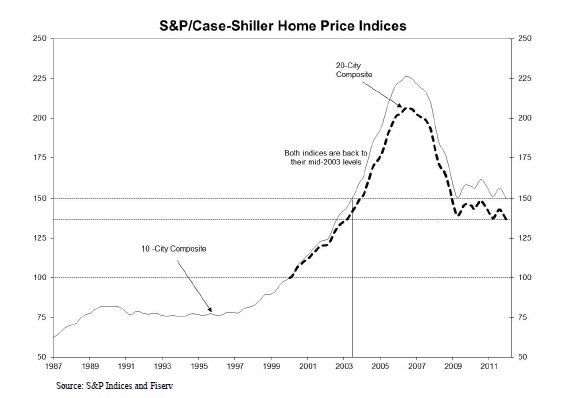 The average home prices in the U.S. are hovering around record lows as measured from their peaks in December, 2006, and have been bounding around 2003 prices for about 3 years. Overall in 2011, prices were down about 4% nationwide, and in the 20 leading cities in the U.S., the yearly price trends ranged from a low of -12.8% in Atlanta to a high (if you can call it that) of 0.5% in (amazingly enough) Detroit, which was the only major city to record positive numbers last year. In December, only Phoenix and Miami were on up-tics.
 One thing struck me as a bit foreboding in the report. While housing doesn’t behave like securitized assets, housing markets are, in fact, influenced by many of the same forces. Historically, one of the big differences was that house prices were always believed to trend positively in the long run, so “bear” markets didn’t really exist in housing. (More on that in a minute). With that in mind, though, w-a-a-y back in my Wall Street days (a LONG time ago!), technical traders — as they were known back then — would have recognized the pricing behavior over the past few quarters as a “head-and-shoulders” pattern. It was the mark of a stock price that kept trying to burst through a resistance level, but couldn’t sustain the momentum. After three such tries, it would collapse due to lack of buyers. I look at the house price performance, and… well… one has to wonder…
As for the teleconference, the catch-phrase was “nervous but hopeful”. There was much ado about recent positive news from the NAHB/Wells Fargo Housing Market Index (refer to my comments about this on February 15 by clicking here.) The HMI tracks buyer interest, among other things, but the folks at S&P C-S were a bit cautious, noting that sales data doesn’t seem to be responding yet.
There are important macro-economic implications for all of this. The housing market is the primary tool for the FED to exert economic pressure via interest rates. Historically (and C-S goes back 60 or so years for this), housing starts in America hover around 1 million to 1.5 million per year. If the economy gets overheated, then interest rates can be allowed to rise, and this number would drop BRIEFLY to around 800,000, then bounce back up. However, housing starts have now hovered below 700,000/year every month for the past 40 months, with little let-up in sight.
Existing home sales are, in fact, trending up a bit, but part of this comes from the fact that in California and Florida, two of the hardest-hit states, we find fully 1/3 of the entire nation’s aggregate home values. The demographics in these two states are very different from the rest of the nation — mainly older homeowners who can afford now to trade up.
An additional concern comes from the Census Bureau. Note that for most of recent history, household formation in the U.S. rose from 1 million to 1.5 million per year (note the parallel to housing starts?). However, from March, 2010, to March, 2011, households actually SHRANK. Fortunately, this number seems to be correcting itself, and about 2 million new households were formed between March, 2011, and the end of the year. C-S note that this is a VERY “noisy” number and subject to correction. However, the arrows may be pointed in the right direction again.
Pricing still reflects the huge shadow inventory, but NAR reports that the actual “For Sale” inventory is around normal levels again (about a 6-month supply). So, what’s holding the housing market back? Getting a mortgage is very difficult today without perfect credit — the private mortgage insurance market has completely disappeared. Unemployment is still a problem, and particularly the contagious fear that permeates the populus. Finally, some economists fear that there may actually be a permanent shift in the U.S. market attitude toward housing. Historically, Americans thought that home prices would continuously rise, and hence a home investment was a secure store of value. That attitude may have permanently been damaged.
“Nervous, but hopeful”
Share this:

Retail and the Internet
First, if you can only read ONE magazine every week, it must be The Economist. If I were to go into hibernation for a year (or 20, for that matter), a cover-to-cover read of the current issue would bring me up-to-date on pretty much every topic of major importance, both in the U.S. and globally. And no, I don’t get a kick-back from them on subscriptions.
The current issue has not one but TWO thoughtful pieces on the impact of the internet on retailing. From a real estate perspective, this is of vital importance for three reasons. First, internet retailers actually DO occupy space, but it’s a very different kind of space than most-bricks-and-mortar retailers occupy. (For more on my perspective on this, read my interview about Amazon in Seattle’s Daily Journal of Commerce this past week.) Second (as the Economist articles point out), many retailers “get it” but many don’t (more on this in a minute). As a result, some retailers thrive (Apple and Disney are two cited examples, but I’d also note Seattle’s Nordstrom as a firm that grasps how to thrive in both markets).
The third reason is a bit more subtle. The Economist quotes Roy Amara, the American futurologist, who says, “We tend to overestimate the effect of technology in the short run, and underestimate the effect in the long run.” As a small-e economist, I would note that in the long run, internet retailing has the very real impact of making American business more productive, in terms of “unit of output” per “unit of cost” (or “unit of labor”), which is a very good thing indeed. Why? Simply put, the developed economies (U.S., Europe, and Japan, for starters) are fighting a demographic battle. Japan and Europe are more-or-less losing. Their populations are becoming increasingly older, and their population growth is basically flat. The U.S. is barely winning the demographic battle, ironically thanks in no small part to immigration (both legal and otherwise). Why is this important? Simply put, increases in GDP are necessary in order to create jobs and to support the increasing costs of an increasingly aging population. There are only two real ways to accomplish this (note the word “real”, as in without inflation): either grow the working-age segment of the population (we’ve already thrown in the towel on that one) or make equal strides in productivity. Hence, the information age allows fewer workers to generate greater productivity in order to support a population in which increasingly large segments are not part of the productive landscape.
As noted, some bricks-and-mortar retailers “get it”. For many segments of the shopping landscape, an on-line substitute just won’t do. Apple figured this out with the Apple Stores, which are slick looking, very efficient, and a far better solution when need instant answers or want to buy something “Apple”. By the way, I have an Iphone which I acquired from an ATT store. I have to go back into that store occasionally for upgrades or accessories — it’s near my house and thus very convenient. I can’t help but notice that they’ve re-done the store in much more of an Apple-esque image. Accident? I don’t think so, plus the shopping experience is much more efficient and enjoyable now.
Borders didn’t make it, but Barnes and Noble seems to be hanging on, in no small part because of the adaptation to the internet. Interestingly enough, many “mom-and-pop” booksellers were predicted to go out of business due to Amazon, yet many of them have thrived by partnering with Amazon and doing what entrepreneurs do best (catering to “niche” needs). Last time I bought a “new” book it was a Christmas present, and I got it at a deep discount at Costco. The last 10 books to come into the Kilpatrick house, though, came from small-town retailers who had partnered with Amazon, and to whom we paid full-retail.
Interesting side note — ONE of these retailers was Seattle’s Goodwill store, who have cataloged their bookshelves and partnered with Amazon to sell used books. (My congratulations to my good friend, Ken Colling, the CEO of Seattle Goodwill, and no, I didn’t get a penny’s worth of discount.) Also, by the way, it was cheaper for me to go on-line to Seattle Goodwill, buy the book, and have them mail it to us, than for us to drive to downtown Seattle and buy the book the old fashion way. Is Goodwill going out of business because of Amazon? Far from it — this is a windfall for them.
As The Economist notes, and I concur, retailers are struggling to figure out this new paradigm. They are also coping with an explosive growth in shopping space — between 1999 and 2009, shopping space in the U.S. ballooned from 18 square feet per person to 23 square feet.
A final note: The Economist deals primarily with the experience in the U.S.. Clearly in Europe and Japan, this is also a struggle and perhaps an even worse one. However, this information-age paradigm shift is occurring right as many developing nations (China in particular) are seeing an emerging middle class, and the retail-therapy that permeates middle-classes everywhere. Retail real estate developers who look at the Chinese economic trends and think that China may need as many square feet of shopping experience as Americans have come to enjoy over our cultural history may need to think again. The simultaneity of the emergence of the information age with the emergence of a Chinese middle class (not to mention the cultural history, which in China may favor small, entrepreneur-driven businesses) may portend a very different retail future.
Share this:
U.S. housing market — good news and bad
The good news, such that it is — home sales are inching up — a 0.7% rise in January from the previous January.
Now, for the bad news — the median home price in America, measured on a January-to-January basis, just hit its lowest point in 10 years, according to a recent announcement from the National Association of Realtors. Indeed, 35% of home sales were “distress sales”, driving the median home price down to $154,000.

- graphic courtesy CNN-Money

This represents a 6.9% price decline from 2011, and a drop of 29.4% since the peak in 2007.



 From a small northwestern observatory...