Archive for February 2012
Marcus & Millichap’s Apartment Report
Of the major commercial real estate brokerage firms, Marcus and Millichap seem to consistently do the best job of thoughtful and insightful research. We track their work regularly here at Greenfield. Their 2012 Apartment Report just hit our desks, and it follows our expectations of excellent work on their part.
courtesy Marcus & Millichap
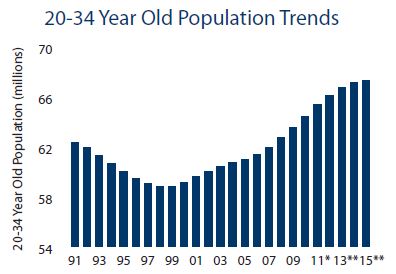
The apartment sector is rebounding nicely, but because of the intersection of favorable demographics and unfavorable economics. It’s driven by pent-up demand among “prime renters” (young adults who want to “unbundle” from parents and roommates) who would potentially have become homeowners a few years ago. Development had been stagnant for a few years, leaving the market with a potential shortage in supply. Developers, lenders, and investors had a brief pause late last year, but M&M expects to see steady additions to supply over the next three years.

courtesy Marcus & Millichap
As a result of all of this, vacancy rates are trending downward, and are expected to hit 5% this year (down from a peak of about 8% in 2009). This has the effect of driving up rents to historically high levels, even after a net decline from 2008 to 2009. With all this, apartment transactions are back up to pre-2009 levels, while the average price per unit is now topping $90,000 (up nearly to the peak of 2006) and cap rates are down in the 6.5% range (still off the trough of about 5.5% seen in the 2006-2006 period).

- courtesy Marcus & Millichap

The surprising upshot of all of this is that apartment cap rates are still at record high spreads over the 10-year Treasury long-term average. Market participants got nervous back in the 2006 period, when the spread had shrunk to 90 basis points (from a more “normal” rage of 380 to 430 basis points experienced since the S&L crisis 15 years earlier). Today, the spread is at 460 basis points, reflecting a bit of continued risk-aversion on the part of market participants, along with historic low rates on treasuries.
Share this:

Yet another comment about today’s economic news
It’s hard NOT to be pleased at today’s economic news. The unemployment rate is down, total employment is up (the two numbers don’t ALWAYS move in sync, due to the growth in the potential workforce), the stock market is up, the dollar is up versus the Euro, Yen, and Pound (not always a good thing), and bond yields are up (reflecting a potential demand for borrowing — a very “old school” view of stocks versus bonds). Intriguingly, oil is up but only by $0.59 a barrel as of this writing (12:35am EST on Friday the 3rd) — one would normally expect that great economic news would spur a run on oil.
Which may, in fact, reflect the continued anxiety in the marketplace. Recessions rarely happen in a straight line (see my post a few weeks ago on the relationship between the yield curve and the onset of a recession — click here for a shortcut). Real estate continues to be in disarray, and the banking sector is still in rehab, with the continued concern of a relapse if the Euro crisis doesn’t solve itself.
Ben Bernake’s testimony before the House Budget Committee this week was painful to watch — members of Congress would prefer to listen to themselves rather than the Chair of the Fed, and it was clear that members of that august committee had only a cursory understanding of what the FED actually DOES. Nonetheless, a piece of Bernake’s testimony had the tone of Armageddon. He noted that we’re on our way to addressing the CURRENT problems — the huge deficit overhang, the Euro crisis, etc. Congress still has ample work to do in those areas, but we are at least confronting the issues. The larger problem, in his mind, is what start happening in about 10 years or so when the demographic overhang starts hitting. The rapid shrinkage in the number of people PAYING into social security and medicare versus the number of people COLLECTING these transfer payments will be substantial, and this doesn’t even begin to address the productivity problems associated with a society in which a substantial number of people are retired and not contributing to the nation’s output.
Sigh…. at least it looks great today, right?
Share this:

Proposals for fixing housing
John K. McIlwain is the Senior Resident Fellow/J. Ronald Terwilliger Chair for Housing at the Urban Land Institute (ULI) in Washington, D.C. I don’t necessarily agree with everything he says, but he stimulates some interesting thinking in a piece this week titled “Fixing the Housing Markets: Three Proposals“. (click on the title to link to the article itself.)
In summary, he proposes:
1. Renting federally held REO
2. Creating a mortgage interest credit
3. Divide mortgages for underwater homeowners into a “paying” first and a “delayed” second.
He admits that in the current political climate, none of the above stands a ghost of a chance (nor would any other solution, good or bad), but even though I might disagree with some of what he says, I’m a firm believer in the old In Search of Excellence adage: ready, shoot, aim. Really excellent organizations (and government entities — which are rarely even CLOSE to achieving excellence) have a proclivity for doing SOMETHING. The Marine Corps calls it the “70% solution”, which dictates that you attack as soon as you think you have 70% of the information needed for success. Why not 100%? Because fate favors the side with the initiative and momentum, that’s why.
So, please indulge me for a moment to comment on McIlwain’s proposals, but DON’T take my criticism as an indication that I wouldn’t vote in favor of doing exactly what he proposes, because in the current climate, a half-good idea is probably better than no idea at all.
1. Rent federally held REO — Well, even McIlwain admits (or at least implies) that the government is a terrible landlord, so he would propose turning this over to the private sector via pools of “privatized” REOs. What he’s essentially saying is to sell these REO’s (currently about 250,000, and expected to grow to a million) to investors with the caveats that they be held off the market as rentals for a period of time, AND that there be adequate maintenance to keep them from turning into slums.
My ONE disagreement with this is that less government involvement is usually better than MORE. Plenty of investors stand ready to buy REOs right now, and the resale market is sufficiently poor that these investors recognize they have to be in it for the long haul. Local planning ordinances are usually adequate vis-a-vis slum prevention IF they are enforced properly (as is not always the case). There is no reason to believe that additional Federal caveats would improve the situation. In short, this is actually being accomplished already, and deserves facilitation by the government, not regulation.
2. Mortgage interest credit — McIlwain notes, and we concur, that the current mortgage interest deduction benefits taxpayers earning over $100,000, but hardly those earning less. He suggests replacing this with a flat 15% tax credit, which would have the double-barrelled effect of raising the effective tax rate on those earning over the 15% marginal break-point, but directly benefitting dollar-for-dollar those below that break point. It’s an intriguing idea, but would require the Realtors’ and Mortgage Bankers’ buy-in. In today’s troubled market, it’s difficult to see how they would agree to anything that tinkers with the status quo.
3. Divide mortgages for underwater homeowners into a “paying” first and a “delayed” second. As much as I like this one on the surface, it ONLY works for homeowners who plan to stay in their houses until prices rise (on average) about 20%. We don’t see that happening for quite a few years, so this essentially just kicks the can down the road a bit. Even that, though, is an improvement over the status quo, and keeps homeowners in their homes for the time being. The real problem, of course, is how to deal with the “delayed” paper on banks books.
In short, McIlwain’s proposals at least stimulate some conversation about solutions for the terrific vacant REO problem. One big issue is lack of credit for suitable property managers — banks are loathe to loan on “second” homes today, and investment property (REOs turned into rental homes) is a troublesome loan to get. I would propose that the agencies/banks holding paper on vacant homes simply privatize it immediately — if a bank holds a $100,000 loan on a vacant house, then a reasonably creditworthy investor who is willing to start amortizing that loan should be able to walk in, pick up the keys, and walk out the door. Sure, this would violate all sorts of down-payment caveats in place right now, but it would get interest payments moving again, provide much-needed rental housing, and get some local entrepreneurs busy managing otherwise dead assets.


 From a small northwestern observatory...