Posts Tagged ‘history’
The ROAD to Housing Act
This week, the U.S. Senate passed a sweeping bi-partisan package of bills aimed at lowering housing costs. The measure faces some opposition in the House due to some political pressures, but it’s likely this will eventually land in the White House for a signature. Given the widespread concern in the electorate about housing affordability, these politicos can hardly be seen as going home doing nothing. However, will this package do what it intends?
One section of the bill aims to ‘cut red tape around environmental reviews, empowering state, local, and tribal governments to streamline reviews and increase housing development.” (A summary of the bill from the Senate Committee on Banking, Housing, and Urban Affairs.) This has long been a sore spot for housing developers, but these sorts of review usually happen well before the first shovel of dirt is turned in a new subdivision. Further, this will require local, state, and tribal rule making, and I think you can already see the long knives being sharpened by attorneys representing environmental interests. This part of the bill will be tied up in 10,000 court cases for quite a few years, and even if it is ultimately successful, it may reduce new housing costs by one or two percentage points ten or so years from now. None the less, it’s something.
There is a related provision to offer grants or loans to state, local, and tribal governments to assist in updating local rules and regulations. Local urban planning departments are strained already, and the notion of trying to re-write local environmental and housing rules on the fly without some assistance is unimaginable. That said, what we’re talking about is money to hire new staff and consultants, and so again this is something that will only kick in down the road.
The bill encourages increased production of manufactured housing. Currently, a manufactured home is required to have a steel chassis so that it can be moved from one place to another, like a trailer. However, these homes are almost never moved. The new rules would update the definitions to include modules manufactured without a permanent steel chassis. Of course, this means a manufacturing infrastructure will have to be spun up, and local rules and regulations re-written to accommodate the new housing product. However, of the various provisions in the bill, this one perhaps holds the most utility for near-term help in the market.
Another section creates a program to offer grants and forgivable loans to homeowners and landlords seeking to repair homes. This provision also has some potential, although it probably aids small landlords much better than fixer-upper homeowners. I don’t see it doing anything for housing affordability, though, but I am open to argument. Nonetheless, anytime the Federal Government ‘creates a program’ without funding it, we can only wait and see. More benefit might come from a requirement that the Federal Housing Administration (FHA) increase the limits on loans for multifamily mortgages. This can have some substantial benefits for investors, increasing the availability of rental housing, but not necessarily for home ownership affordability.
Finally — and this is the provision that is giving the bill some headaches in the House — the bill would ban large institutional investors from directly or indirectly owning 350 or more single family units (with the exception of government entities). This is less of a deal than it’s made out to be. I’ll write a separate blog post sometime soon about this, but for the record, Blackstone owns 63,000 single family dwellings, which is roughly six-one-hundredths of one percent of the U.S. housing stock. My argument is that these large investors tend to overpay but this doesn’t crowd out actual home owners, it crowds out traditional mom-and-pop landlords. Again, that’s a matter for another discussion.
Since the House of Representatives doesn’t have a filibuster, and this has wide bi-partisan support (this being an election year), there’s a strong likelihood this will become law before summer. However, any actual impact of this is quite a few years down the road.
As always, if you have any questions or comments, please e-mail me!
John A. Kilpatrick, Ph.D., MAI
Share this:

The K-Shaped Economy
“I’m mad as hell, and I’m not going to take it anymore!” (Howard Beale, played by the actor Peter Finch, in the movie “Network”, 1976)
In the coming days you’re going to hear the phrase ‘K-Shaped Recovery’ bantered about by economists. It’s a little misleading, because it suggests we’re in the midst of some kind of economic recovery. In fact, we’re not, but it harkens back to basically everything that’s happened since the Pandemic, and it also explains the National and World politics, the state of the nation, and the state of everyone’s pocketbooks.
In a ‘K-Shaped’ economy, there are winners and losers. Now, you might say, “Hey, John, haven’t there always been winners and losers in the economy?” and I would say, “Yeah, but generally not so predictably systematic.
If you went into the pandemic with money/assets, or a job in high-demand sectors, or both, then you’ve done quite well over the past five years. If you didn’t have money/assets, and had a job in low-demand sectors, then you’ve done quite poorly.
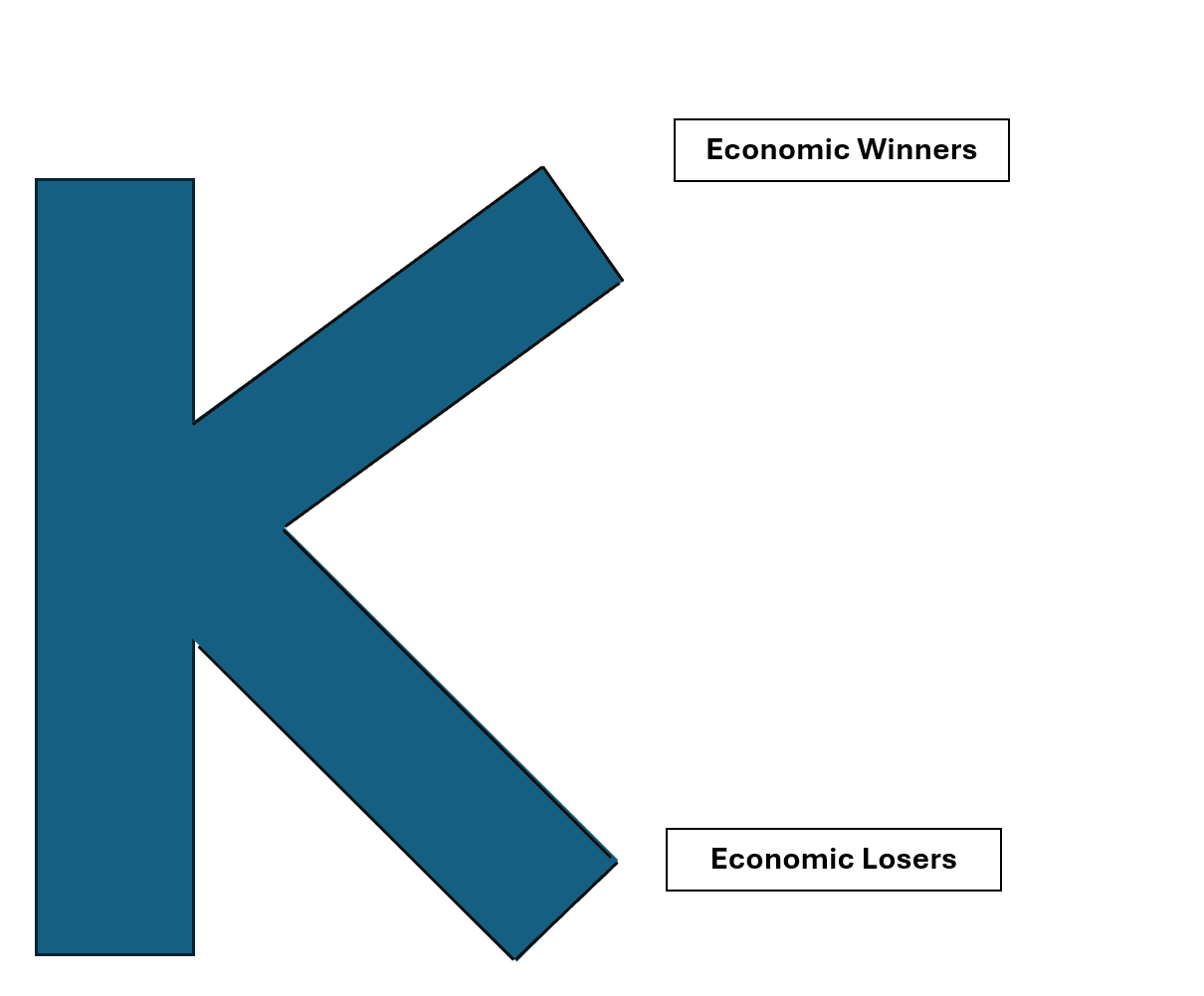
The 2024 election turned on this issue. Most (but not all) economic winners were likely to vote to stay the course. Economic losers were likely to vote to change. Change won. Today, though, the economic losers are getting worse off, and the economic winners (amazingly enough) are getting better off.
So, what can be done to fix this? Pretty much the opposite of what’s being done right now. First, America benefits from wide-open free trade. We send dollars (which we can print by the bucketload) in return for cheap goods. We also sell lots and lots of stuff that provides lots and lots of employment, like soybeans and airplanes and Hollywood movies and the upper echelons of technology.
Second, the social safety net is crumbling. It’s crumbling because very short sighted billionaires wanted tax cuts, which in the long-run are counterproductive to their best interests. These billionaires generally sell stuff to consumers. If consumers at the bottom half of the economic ladder cannot afford to buy their stuff, then in the long run, Amazon and Walmart and Apple have unsustainable business plans. For example, people make bad economic decisions in the absence of a good health care system, a healthy housing market, or stable food prices.
Third, controlled and regulated immigration is and always has been extraordinarily healthy for the economy. It brings in hard workers who are anxious to take the lowest jobs on the ladder, and pushes higher-paying jobs up the economic ladder.
Fourth, education is key. Instead of eviscerating our schools, we should double-down on public education and add to that skilled trade education. Teachers should be among the best paid professionals in our society. (Right now, nursing schools cannot find professors because the private sector pays so much better than the nursing schools can manage.)
Fifth, we should develop trade alliances with the other democracies in the world, rather than force them into the arms of our economic enemies. China’s belt-and-road strategy was brilliant. We can duplicate that with agencies like USAID. The free nations of the world would much rather ally with us, but we’ve shut the door on them.
Sixth, our infrastructure – and particularly our energy grid – is in serious need of attention. This is a powerful investment, and would have the same multiplier effect as the development of the interstate highways in the 1950’s and 60’s.
Are you mad as hell? Yes, you ought to be. Particularly if you’re a soybean farmer, or a recent graduate looking for a job, or a contractor who can’t afford to buy lumber, an immigrant who just wants to put in an honest day’s labor, or a young person who wants to buy a house but can’t make the down payment.


 From a small northwestern observatory...